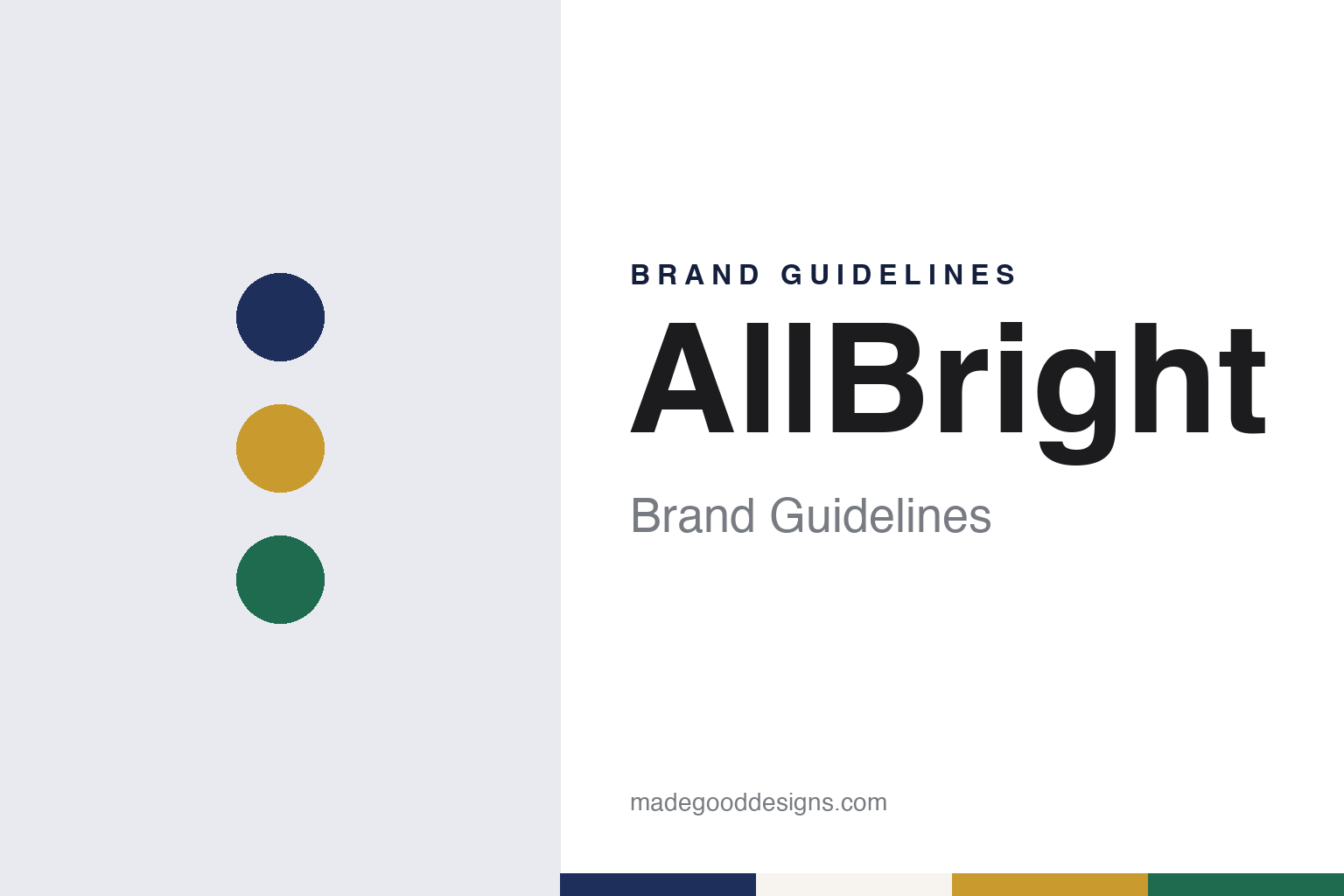
AllBright Brand Guidelines
A women’s club that gave each townhouse its own designer.
Aa
Two constants: a deep blue, mustard and emerald palette and a townhouse serif register. Abstract homage — not an AllBright asset or mark; no sign, logo or interior is reproduced.
A women’s club
A business network that opened townhouses.
AllBright began in London as a business network and members’ club for women. Hospitality Interiors reported in June 2018 that AllBright, which it described as an educational, networking and funding organisation for working women, had been set up in 2016 by the entrepreneur Debbie Wosskow and Anna Jones, a former chief executive of Hearst in the UK. The Caterer gives 2018 as the year the two co-founded the business, and Wosskow, in a 2025 post quoted by BusinessCloud, recalled 2017 as the time it began. The club said its name was a tribute to the former US Secretary of State Madeleine Albright, according to Seth Thévoz’s Clubland newsletter. Membership was for women, while men could visit as guests, Dezeen reported in 2019.
The first clubhouse opened on 8 March 2018, International Women’s Day, Clubland says. Hospitality Interiors described it as spanning five floors of a Georgian townhouse on Rathbone Place, just north of Oxford Street; the magazine placed it in Bloomsbury and Clubland in Fitzrovia. The founders tied the site to the Bloomsbury Set, the magazine said, and took as a framing idea Virginia Woolf’s line, from lectures she gave to Cambridge’s women’s colleges in 1928, that a woman needs money and a room of her own if she is to write fiction.
A second London club followed on Maddox Street in Mayfair, which Dezeen reported in May 2019 had opened in a five-floor townhouse, and a third in West Hollywood. UncoverLA reported in February 2020 that the Melrose Place club had been open since September 2019 and described it as a 12,000-square-foot space and AllBright’s third outpost. Clubland put the club’s membership at about 1,000 in January 2025.
Colour
Three clubhouses, three interior designers.
Each clubhouse had its own designer, and the design press covered all three. At Rathbone Place the interiors were by the London practice No.12, co-founded by Emma Rayner, Hospitality Interiors reported. Each of the five floors was named after a member or associate of the Bloomsbury Set, among them Lopokova, Bell and Woolf, and the designers graded the palette from light on the lower floors to dark on the upper. The magazine said they deliberately avoided pink, choosing mustard yellows, deep blues and bright reds with bold geometric prints and a range of marble surfaces. The top-floor bar had deep blue walls with gold and brass accents, marble-topped tables, grey tinted mirror, flecked terrazzo and deep-pile velvets, and a lower floor used wallpaper by Kelly Wearstler. The art throughout was by women, chosen with the curator Beth Greenacre.
For Maddox Street the founders hired the interior designer Suzy Hoodless, Dezeen reported in May 2019, asking for an interior that was “feminine but not girly”. The building had been the headquarters of an auction house, and Jones told the magazine that Hoodless restored it as an elegant London townhouse with timber floors and panelled walls. The nearness of Savile Row led to traditional suit fabrics such as fine wools and houndstooth checks. The first-floor brasserie had blue leather banquettes and green Thonet chairs; a floor above used a Christopher Farr Cloth reissue of Raoul Dufy’s Mille Feuille wallpaper; and the fifth floor was styled as a glasshouse, with rattan furniture and beams picked out in green. Greenacre chose more than 120 works by more than 80 women artists, spanning 60 years.
In West Hollywood the three-storey club was designed by Brigette Romanek, UncoverLA reported, in blush and emerald tones with brass fixtures and houndstooth bar chairs. Its rooms included co-working spaces, a restaurant, a screening room, a podcast studio and a rooftop terrace, with more than 150 works by women artists selected by Greenacre.
Typography
Clubs and their buildings.
Private members’ clubs present themselves through a small set of signals. The name often carries the story: The Groucho Club borrows a line attributed to Groucho Marx, ARTnews explained in 2022, while Annabel’s takes its name from Lady Annabel Vane-Tempest-Stewart, The Guardian reported in 2018. Wordmarks, crests and monograms tend to appear quietly, on a website header, an application page or, as Vogue noted at Annabel’s, on china stamped with the club’s crest.
Buildings and interiors do much of the work that advertising does elsewhere. Many London clubs occupy period townhouses, and their refits are credited to named architects and designers in the design press: Wallpaper* has credited Michaelis Boyd and Transit Studio with successive changes at the Groucho Club, and Martin Brudnizki with the rooms Annabel’s moved into at 46 Berkeley Square in 2018. Art collections, murals and wallpaper are often described as part of a club’s character, and this guide names them only where a dated source does.
Printed and practical matter carries the rest of the voice: menus, event brochures, dress codes, signage, membership cards and keys, and the pages that explain how to apply, how to book a tour or how to hire a room. The tone ranges from the dry wit of a Soho club to the formal language of a Mayfair house, and this guide quotes it only from the clubs’ own published pages or from dated reporting.
Owners and groups matter to the identity as well. Clubs are bought, sold and grouped, and they move, close or rename; the Groucho Club passed from private-equity owners to Artfarm in 2022, and Annabel’s is one of The Birley Clubs. The guides in this category state ownership, sites and closures plainly with dates, leave out fees and prices, and never name members or guests.
Aa
A townhouse serif for a club that lived in Georgian buildings. (Specimen set in Cormorant Garamond, a serif STAND-IN; NOT the AllBright logo.)
AllBright
Administrations and a closed townhouse.
The clubhouses closed one by one. Clubland reports that the original Fitzrovia branch never reopened after March 2020, and that the business consolidated around the Mayfair clubhouse. In West Hollywood, WhatNow Los Angeles reported in March 2022, citing Eater LA, that a restaurant called Melrose Place was replacing the former AllBright club in the same building in phases.
Ownership changed through administration. The Caterer reported that AllBright appointed the administrators Begbies Traynor, who in July 2023 oversaw a pre-pack sale to AllBright Collective Limited, and that The Times reported at the time that the club had been bought out of administration by Cain International, the investment firm run by Jonathan Goldstein and Todd Boehly. Clubland dates the original management company’s entry into administration to 17 July 2023 and says that company was dissolved on 19 October 2024. Wosskow left the business in 2022, BusinessCloud reported.
The second administration came in January 2025. The Caterer reported on 29 January 2025 that AllBright had closed its five-storey Mayfair townhouse, home to the restaurants Madeline and Claudette, a bar and a roof terrace, after entering administration for a second time, while its online events platform continued. BusinessCloud reported on 3 February 2025 that an investee company of Cain International had acquired AllBright’s assets, that Viviane Paxinos was its chief executive, and that members had been given access to a shared space at Old Sessions House, a Grade II-listed building in Farringdon. None of the three original clubhouses is run by AllBright today.
For a design guide, AllBright shows how one club name could carry three distinct interiors by three designers, each tied to its neighbourhood: the Bloomsbury Set at Rathbone Place, Savile Row tailoring in Mayfair and blush and emerald in West Hollywood. Compare The Wing, another women-focused members’ club, and Soho House. For this guide we use deep blue, mustard, emerald and blush with a serif, an unofficial interpretation; no product or logo is reproduced.
Explore & save
Keep AllBright’s identity on hand — save it to a board in the Made Good inspiration library.
AllBright identity set
Pin the AllBright deep blue, mustard and emerald palette and the townhouse serif register to your own board.
Source & notes
Frequently Asked Questions
What font can I use to match the AllBright look?
This guide describes AllBright’s type as “A townhouse serif for a club that lived in Georgian buildings”. Its type specimen is set in Cormorant Garamond from Google Fonts as a stand-in; Cormorant Garamond is not AllBright’s own lettering.
What colours are in the AllBright palette?
This guide’s AllBright palette is Deep blue #1E2F5C, Mustard #C99A2E, Emerald #1F6B4F, Blush #E9C9C1 and Paper #F7F3EE. The tones are the guide’s own unofficial interpretation, not official AllBright hex codes.
Who founded AllBright?
AllBright was founded by Debbie Wosskow and Anna Jones.


