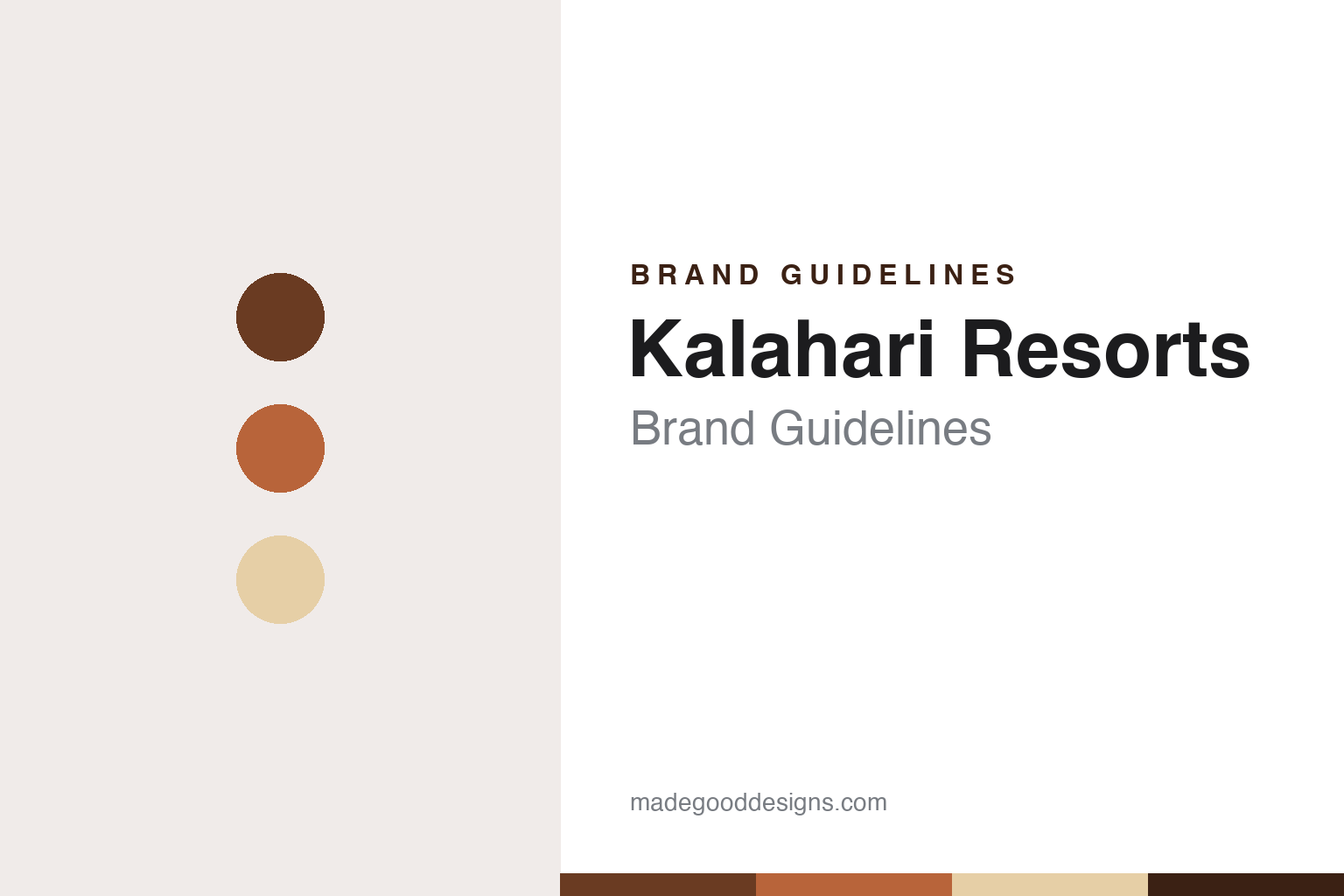
Kalahari Resorts Brand Guidelines
The Wisconsin Dells family firm that named its resorts after a desert.
Aa
Two constants: a baobab brown, clay and dune sand palette and a warm serif register. Abstract homage — not a Kalahari Resorts mark; no logo, mascot, artwork or resort interior is reproduced.
A desert name in the Dells
A pizza pub, a trip south and a resort in 2000.
Kalahari Resorts, which trades as Kalahari Resorts and Conventions, is a group of indoor waterpark resorts with hotels and convention centres in the United States. It began in Wisconsin Dells, Wisconsin, a town that styles itself the Waterpark Capital of the World. CNN Business, profiling the founder Todd Nelson in October 2018, reported that Nelson and his family had been running a pizza restaurant and a bar in his home town of Wisconsin Dells when he came up with the idea of opening his own water park.
Most water parks in the Dells at the time had a wilderness or rainforest theme, CNN Business wrote, and Nelson wanted his to stand apart. The idea came during a trip to South Africa in 1999. He named the park after the Kalahari, the desert in southern Africa, and imported artwork, furniture and decor from Africa, among them stone figures, paintings, carved doors and chairs decorated with beadwork and shells. English Wikipedia says the resorts are decorated throughout with African animals, plants and other African motifs.
The first resort opened in 2000; English Wikipedia gives the date as 4 May 2000. According to CNN Business, it opened with 272 rooms and suites with themed names such as Hut, Desert and Nomad, five restaurants and a 74,000-square-foot indoor water park, and a 25,000-square-foot convention centre was added later the same year. Nelson funded the first park with loans from local community banks, the profile said.
The Dells resort has grown in several stages since. English Wikipedia gives it 756 guest rooms and an indoor water park of 125,000 square feet, and says its convention centre was expanded in 2011 from 100,000 to 230,000 square feet. The same article records a 77,000-square-foot outdoor water park with slides, a lazy river and a three-storey play structure, and, from December 2008, Tom Foolery’s Adventure Park, a 110,000-square-foot indoor theme park. Amusement Today, reporting in December 2023, named Todd and Shari Nelson as the owners of Kalahari Resorts & Conventions and said the couple had led the development of the brand since its start in 2000.
Colour
Ohio, the Poconos and Texas.
The second resort opened in Sandusky, Ohio, on the shore of Lake Erie. English Wikipedia dates its opening to 20 May 2005, and CNN Business wrote that Nelson cut the ribbon there five years after the first opening. Its water park opened at 80,000 square feet and was extended by 93,000 square feet in 2008, bringing it to 173,000 square feet, English Wikipedia says, citing the Orange County Register of May 2008. A convention centre followed in August 2006 and was later enlarged, and the hotel has 884 guest rooms. Outside, according to English Wikipedia, an outdoor water park and adventure park cover about 300,000 square feet, with a lazy river and zip lines.
A Virginia project near Fredericksburg did not go ahead. In March 2012 the local news site Patch reported that the Kalahari project there was no longer expected; English Wikipedia says it was dropped after problems with financing.
The third resort, in the Pocono Mountains of Pennsylvania, opened on 1 July 2015 and completed an expansion in March 2017, according to English Wikipedia, which cites USA Today. It lists a 220,000-square-foot indoor water park, an outdoor water park, a 230,000-square-foot convention centre, 977 guest rooms and a 40,000-square-foot arcade and entertainment centre.
The fourth moved away from resort towns. The Round Rock resort, north of Austin, Texas, opened on 12 November 2020, English Wikipedia says, citing the Austin American-Statesman. It has a 223,000-square-foot indoor water park, an outdoor water park and about three acres of outdoor pools, a 975-room hotel, five restaurants and a 200,000-square-foot convention centre. English Wikipedia notes that it was the first Kalahari site in a metropolitan area rather than a resort town, and quotes a manager who pointed to Round Rock’s fast growth as the reason for heading south.
Across all four, the format is the same: a hotel wrapped around a heated indoor water park, with an outdoor park for the summer, restaurants, an indoor adventure park and a large convention centre. English Wikipedia says the conventions held there are mostly by state and regional organisations.
Typography
Design and documentation.
Water parks and indoor waterpark resorts sell a day out, a short break or a family holiday, and their identities are built for that job. A park name, a logo and often a mascot or a theme carry across tickets, wristbands, park maps, signage, towels and shop merchandise, and the same marks appear on the operator’s website, booking pages and advertising. On Tenerife, Blooloop reported in 2022, advertising for one family’s parks runs from bus stops and billboards to taxis and litter bins.
Much of the look comes from architecture. Some parks borrow a whole setting, such as a historic kingdom or a myth tied to a host hotel, and build their entrances, shops and restaurants to match. Others are organised around slide towers, whose shapes, names and colour schemes act as landmarks visible from across the site. Indoor resorts put the water park, hotel rooms and restaurants under one roof and one name, so the identity has to work in corridors and rooms as well as at the poolside.
Ownership varies widely. Some parks belong to family companies that also run zoos, aquariums or hotels; others belong to hotel and resort groups, to listed leisure companies or to investment owners that have bought and sold parks over time. Ride makers such as ProSlide and WhiteWater are often credited for the slides, and industry reports such as the Themed Entertainment Association’s annual index publish attendance figures that the trade and national press repeat.
The guides in this group set out what dated sources say about each brand: when and where it opened, who owns and operates it, how it has changed its name or its sites, and how its theme, naming and visual material are presented to visitors. Where a fact rests only on the operator’s own word, the guide says so.
Aa
A warm serif for resort signage and room keys. (Specimen set in Fraunces, a serif STAND-IN; NOT the Kalahari Resorts logo.)
Spotsylvania
A fifth resort, off Interstate 95, in November 2026.
Kalahari returned to Virginia more than a decade after the Fredericksburg plan ended. Amusement Today reported that the company broke ground on its fifth resort on 20 October 2023 in Thornburg, an unincorporated community in Spotsylvania County, beside Interstate 95. The magazine described a resort of about 1.38 million square feet and said that, as at the earlier sites, it would carry an African theme with custom art and textiles made by African craftspeople.
The resort opened on Thursday 12 November 2026, the Richmond television station WWBT reported that day, calling it the company’s fifth resort and its first in Virginia. WWBT described a 175,000-square-foot indoor water park with more than 50 water attractions, among them slides, a lazy river, wave pools and splash areas; 907 hotel rooms; a 150,000-square-foot convention centre; and a 90,000-square-foot indoor adventure park with arcade games, go-karts and bowling, under the Tom Foolerys name used at other Kalahari sites. Day passes for the water park are sold to visitors who are not staying overnight, the station said.
Five resorts now share one name and one theme. The name is the clearest constant: a single word taken from a place, used for the resorts, their convention centres and the company itself. The interiors, as CNN Business and English Wikipedia describe them, lean on carved wood, beadwork, African art and animal motifs rather than on the wilderness or rainforest themes that CNN Business said were common in the Dells, and the outdoor pools, adventure parks and convention halls are presented as parts of the same resort rather than as separate attractions. That makes the earth tones of sand, clay and dark wood an obvious starting point for any study of the brand.
For a design guide, Kalahari Resorts shows how a family-owned resort group can build its identity on a single place name and a consistent decorative theme, repeated from one state to the next. Compare Great Wolf Lodge, the other indoor waterpark resort chain that began in the Wisconsin Dells area, and Tropical Islands, an indoor resort in Germany. For this guide we use baobab brown, clay and dune sand with an acacia green and a serif, an unofficial interpretation; no product or logo is reproduced.
Explore & save
Keep Kalahari Resorts’s identity on hand — save it to a board in the Made Good inspiration library.
Kalahari Resorts identity set
Pin the baobab brown, clay and dune sand palette and the warm serif register to your own board.
Source & notes
Frequently Asked Questions
What font can I use to match the Kalahari Resorts look?
This guide describes Kalahari Resorts’ type as “A warm serif for resort signage and room keys”. Its type specimen is set in Fraunces from Google Fonts as a stand-in; Fraunces is not Kalahari Resorts’ own lettering.
What colours are in the Kalahari Resorts palette?
This guide’s Kalahari Resorts palette is Baobab brown #6A3B22, Night earth #3B2114, Clay #B8643A, Dune sand #E6CFA6 and Acacia green #5E6B3A. The tones are the guide’s own unofficial interpretation, not official Kalahari Resorts hex codes.
Who owns Kalahari Resorts?
Kalahari Resorts is owned by Todd and Shari Nelson.