Thos. Moser Brand Guidelines
The signed chair.
Aa
Two constants: a cherry-and-walnut palette and a craftsman serif register. Abstract homage — not a Thos. Moser chair or wordmark.
The signed chair
Thos. Moser hand-builds solid American cherry furniture, signed by the maker, in Auburn, Maine.
Thos. Moser is a lesson in a material and a hand as the identity. An American maker in Auburn, Maine, it hand-builds furniture in solid North American hardwood — its signature American black cherry — in a Shaker-inspired, fine-woodworking tradition, with each piece signed and dated by its maker. A chair, made and signed by hand.
Its identity is the signed chair. Thos. Moser’s cherry furniture, and the maker’s signature on each piece, are the work it is known for. A material, made a signature — literally. A workshop that puts a name on its joinery.
(Honest notes, so the story stays precise. Thos. Moser was founded in 1972 by Thomas and Mary Moser — Thomas, a former college professor, died in March 2025, so we refer to him in the past tense. Two things changed in 2025: the company was acquired in January by Chenmark Holdings, a Maine-based, family-owned holding company, so it is no longer family-owned, though son Aaron Moser stayed on as an ambassador. Everything is still genuinely hand-made in the USA, in-house in Auburn, Maine, by staff cabinetmakers. Its signatures are solid American black cherry, Shaker-inspired joinery and the maker’s hand-signed mark, seen in icons like the Continuous Arm Chair. Its designs and name are its IP, described but never reproduced, and there is no official brand hex — these tones are an unofficial interpretation. This is design commentary and does not promote any product.)
Colour
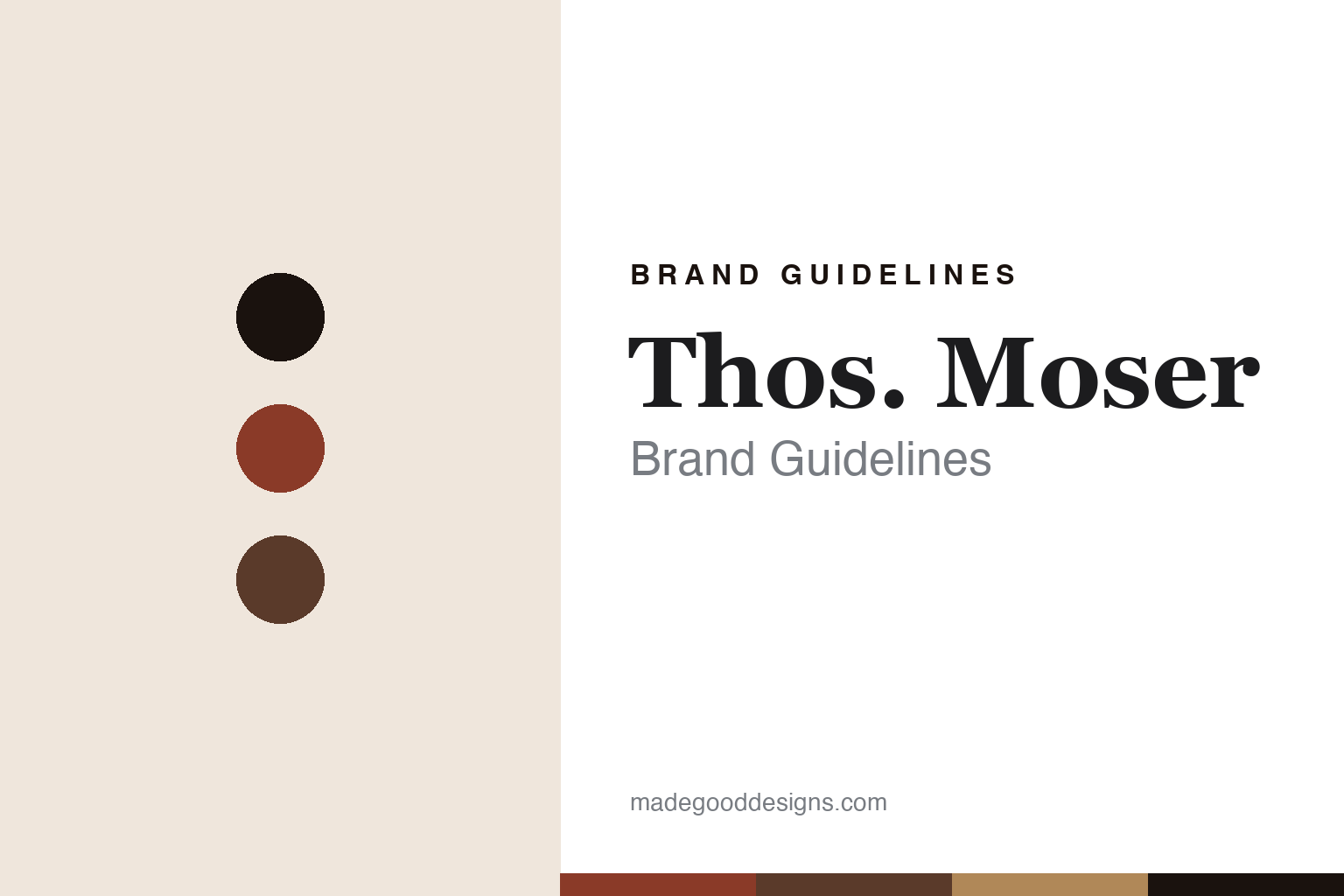
Thos. Moser lives in a cherry-and-walnut palette. Click a swatch to copy the hex.
Thos. Moser’s identity is warm, honest and made — a cherry, an ink, a walnut, a honey, and a cream. The palette leans cherry and walnut: the register of solid American hardwood, oiled and warm. It signals craft and material over flash. The honest caveat: with no published brand hex, these values are an original, unofficial interpretation, not first-party colours.
The lesson is a cherry-and-walnut palette signals a warm, hardwood identity. Thos. Moser’s world is a warm, hand-made, American-hardwood object. For designers, it is a reminder that rich hardwood tones can carry a brand built on craft — the red-brown of cherry and the deep brown of walnut. Because these tones can fail as small text, keep type dark and let the colour live in the accents, palette and band. The takeaways: own a wood; sign your work; make it at home; and treat any single hex as unofficial.
Typography
The register is a craftsman serif — warm, sturdy, honest.
Thos. Moser’s identity carries a warm, sturdy, honest spirit — a made object, not a mass one. A craftsman serif captures the mood: solid, grounded and a little traditional, the register of hand-made hardwood furniture. Set in a cherry-and-walnut palette, the craftsman serif feels warm and sturdy — exactly the personality Thos. Moser carries. It is honest rather than showy, mirroring a signed, solid-cherry chair. (Thos. Moser’s real chairs and wordmark are things we describe but do not reproduce, and the exact typeface is not ours to use.) Because it is not ours to use, the honest description is “a craftsman-serif spirit,” shown here in a stand-in. The type behaves like the maker: warm, sturdy and honest.
Aa
A craftsman-serif spirit — warm and sturdy. (Specimen set in Bitter, a craftsman-serif STAND-IN; NOT the Thos. Moser wordmark or any chair design.)
A hand as identity
Thos. Moser stands for the signed chair.
Thos. Moser is a lesson in making a hand the identity. A cherry-and-walnut palette, a craftsman serif and hand-signed hardwood make craft the whole maker — warm, sturdy and honest. The hand is the differentiator. The differentiator is a genuine, human standard — solid American cherry worked by a cabinetmaker who signs the piece — made in Maine, not a factory abroad.
Put to work, the identity is a signature as design. A maker building in this spirit would put a real name on its work, keep the making at home, and be candid about a change of ownership, so the customer buys into a made object rather than a brand. It would let one wood — American cherry — be the house material, so that a species becomes a signature. It would treat the maker’s mark as a promise rather than a flourish, so that the signature means accountability. The lesson Thos. Moser teaches is that a hand plus a material can build a brand — and outlive its founder: the cherry gives it warmth, and the Maine making gives it substance. The hand is the personality, and the making is the proof.
For designers and brand-builders, Thos. Moser offers a clear takeaway: sign your work and make it at home. The lessons: own a wood; sign the piece; keep it in Maine; and be honest about the story. It is also a reminder to stay accurate: Thos. Moser is an American maker founded in 1972 by Thomas Moser (who died in 2025) and Mary Moser, hand-building signed solid-cherry furniture in Auburn, Maine — acquired in 2025 by Chenmark and no longer family-owned — with the palette here an unofficial interpretation. Thos. Moser made the signed chair the maker — proof that a hand can be the difference.
Explore & save
Keep Thos. Moser’s identity on hand — save it to a board in the Made Good inspiration library.
Thos. Moser identity set
Pin the cherry-and-walnut palette and the craftsman-serif register to your own board.