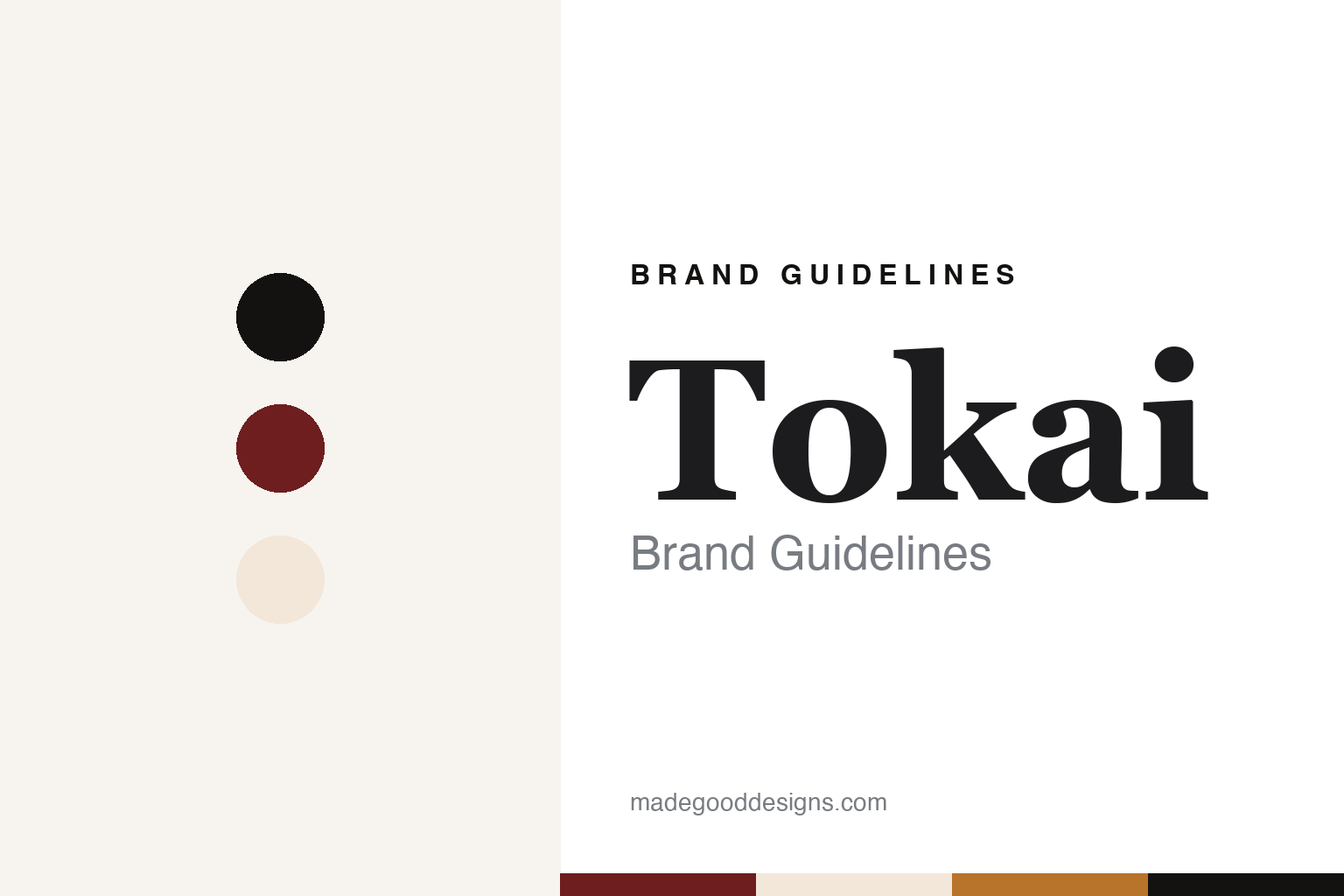
Tokai Brand Guidelines
The Hamamatsu maker of Love Rock, Springy Sound and the aluminium Talbo.
Aa
Two constants: a Tokai cherry, amber and aluminium palette and a Vintage serif register. Abstract homage — not a Tokai product or mark; no instrument, logo or headstock is reproduced.
A research institute
Pianos and harmonicas in Hamamatsu.
Tokai began in Hamamatsu, the Shizuoka city that is also home to Yamaha and Kawai, in 1947. Its own history says it was set up that year in Terajima-chō as the Tōkai Gakki Kenkyūsho — the Tokai Musical Instrument Research Institute — to research and develop pianos and harmonicas. English Wikipedia names the founder as Tadayouki Adachi, citing a retailer’s web page; the company’s own history does not name him, so we give that as Wikipedia’s account. The family link is documented later: when the company was sold in 2021, its president was Shohei Adachi, according to the buyer’s press release.
Its first hit was not a guitar. In 1961, the company says, it developed the Pianica, a keyboard harmonica. Japanese Wikipedia says that from 1967 Nippon Gakki, now Yamaha, sold Tokai-made Pianicas under its own name, which is why both companies have used the word; the buyer’s 2022 press release also says Tokai supplied the instruments Yamaha sold, though it dates the Pianica’s development to 1967, so the sources differ on the year.
Guitars followed. The company dates its classical guitars to 1965, its first electric guitars, sold under the Humming Bird name, to 1968, and Humming Bird acoustics to 1970. English Wikipedia, citing the book 2,000 Guitars, describes that first electric as loosely based on the Mosrite Mark I and II. Through the 1970s Tokai also made banjos and harpsichords, an electric piano it called the Light Piano and, from 1978, upright pianos, its history says.
Colour
Martin, copies and an aluminium body.
Tokai’s guitar reputation was built partly on other companies’ designs. In 1972, by its own account, it signed an agreement to act as Japan’s sole distributor for C.F. Martin, the American acoustic maker, and in 1973 began imports and a technical tie-up; English Wikipedia adds that it supplied parts and built Sigma-brand electric guitars for Martin. In 1975 it launched its own acoustic line, Cat’s Eyes, which English Wikipedia describes as Martin replicas.
Then came the electric copies. The company says it introduced its ST series in 1977 and its LS series the following year — the Stratocaster-style Springy Sound and a Les Paul-style guitar first sold as the Les Paul Reborn. English Wikipedia says the Les Paul copy was renamed “Reborn Old” by 1980 and later Love Rock, the name it still uses, and that the changes followed threats of court action from American makers; a Telecaster-style Breezy Sound and a Precision-style Hard Puncher bass were also sold. Collectors call Japanese copies of this era “lawsuit” guitars, a term English Wikipedia links to a 1977 suit by Norlin, then Gibson’s parent, against the American importer of Ibanez, which was settled in 1978.
Tokai also made original designs. In 1983, the company says, it introduced the Talbo — from “Tokai ALuminium BOdy” — which it calls the world’s first guitar with a metal body of its kind; English Wikipedia dates it to 1982, and Terry Burrows’s 1001 Guitars to Dream of Playing Before You Die notes that Devo played one. The MAT, in carbon fibre and fibreglass, followed in 1985. Tokai brought the Talbo back in 1996 after a pause, and in 2004 filed a patent for its Sound Effect Body, a three-layer body whose middle layer is cut across the grain, launching SEB guitars in 2005. Its model numbers often encoded the original price in yen: a TLS-100, English Wikipedia says, cost ¥100,000.
It has long built guitars for others, too. English and Japanese Wikipedia both describe Tokai as a contract maker. The enthusiast site Vintage Japan Guitars says it built for Fernandes and, from 1997 to 2006, for Fender Japan, with those guitars marked “Crafted in Japan”; English Wikipedia describes a much briefer Fender arrangement in the mid-1990s. The sources differ, and we note both.
Typography
Design and documentation.
The seven European and Japanese guitar brands in this guide have been owned and run in different ways: some are one-maker workshops, some sit inside larger music groups, and one has stopped trading.
In Germany, Framus was founded by Fred Wilfer in Erlangen in 1946 and went bankrupt in the later 1970s — sources differ on the year; his son Hans-Peter Wilfer revived the name in 1995 as part of Warwick, in Markneukirchen, English Wikipedia says. In Sweden, Hagstrom began in 1925 as Albin Hagström’s accordion business and made guitars at Älvdalen from 1958; the brand returned in the mid-2000s, and its website today is published by Musik Meyer of Marburg, Germany, its European distributor. In Finland, Ruokangas, founded by the luthier Juha Ruokangas in 1995, has worked from Harviala manor in Janakkala since 2011 and is solely owned by him, English Wikipedia says.
In France, LAG was founded in Toulouse in 1981 by Michel Chavarria and has belonged since 2002 to Algam of Thouaré-sur-Loire, near Nantes, French Wikipedia says.
In Japan, Tokai Gakki was founded in 1947 and is based in Hamamatsu, according to its website; English Wikipedia says the Grace Company bought it in 2021. Aria grew from Shiro Arai’s Nagoya trading company of 1956, Arai & Co. Fernandes, founded in 1969, stopped trading in July 2024, and a Tokyo court opened bankruptcy proceedings in July 2025, Tokyo Shoko Research reported.
Where the guitars are made varies too — French Wikipedia says LAG’s entry-level and mid-range guitars come from China and South Korea — and the makers do not always say.
This guide sets out what can be checked about each brand — who founded it, who owns it, and what it says about where its products are made — and marks clearly what rests only on the company’s own word.
Aa
A vintage serif — the Love Rock era. (Specimen set in Fraunces, a serif STAND-IN; NOT the Tokai logo.)
Tokai
From family firm to GRACE subsidiary.
Tokai stayed in family hands until 2021. On 12 November 2021 the Yokohama company GRACE bought all its shares and made it a wholly owned subsidiary, GRACE announced on the PR Times wire in January 2022. GRACE’s instrument business, UNISOUND, buys and sells used instruments, and the release said it wanted to use Tokai’s skills to add manufacturing. Tokai’s own history describes the step as a management integration with GRACE, a company “mainly engaged in instrument reuse.” Tokai’s company page now names GRACE’s chief executive, Yuta Sawamura, as its representative and gives its capital as ¥100 million; English Wikipedia puts its staff at 65.
Where are Tokai guitars made? The company presents itself as a domestic maker. It says it has made guitars in Japan since 1947, calls itself one of the few factories left with a craftsman’s spirit, and says veteran workers fit each neck to its body by hand with hide glue — a method it calls “inefficient manufacturing” — alongside computer-controlled routers. English Wikipedia, citing 2,000 Guitars, says Tokai guitars have also been made in Korea, from about the mid-1990s, and in China. The current product pages we read list woods and hardware but not a country of origin, so we give the Japanese claim as the company’s.
The brand is still active. In April 2026 Tokai warned that guitars sold online under a “Gession (Session)” name as Tokai-made were not its products, and in May 2026 it announced a new Tokai Grand bass series, to be shown at the Sound Messe trade fair in Osaka.
For a design guide, Tokai shows how a copyist can grow a name of its own: the Love Rock and Springy Sound names, an aluminium body, a patented wood laminate. Compare Gibson and Fender, the American makers whose shapes its best-known guitars follow. For this guide we use a cherry red, a sunburst amber and an aluminium grey with a serif, an unofficial interpretation; no product or logo is reproduced.
Explore & save
Keep Tokai’s identity on hand — save it to a board in the Made Good inspiration library.
Tokai identity set
Pin the Tokai cherry, amber and aluminium palette and the Vintage serif register to your own board.