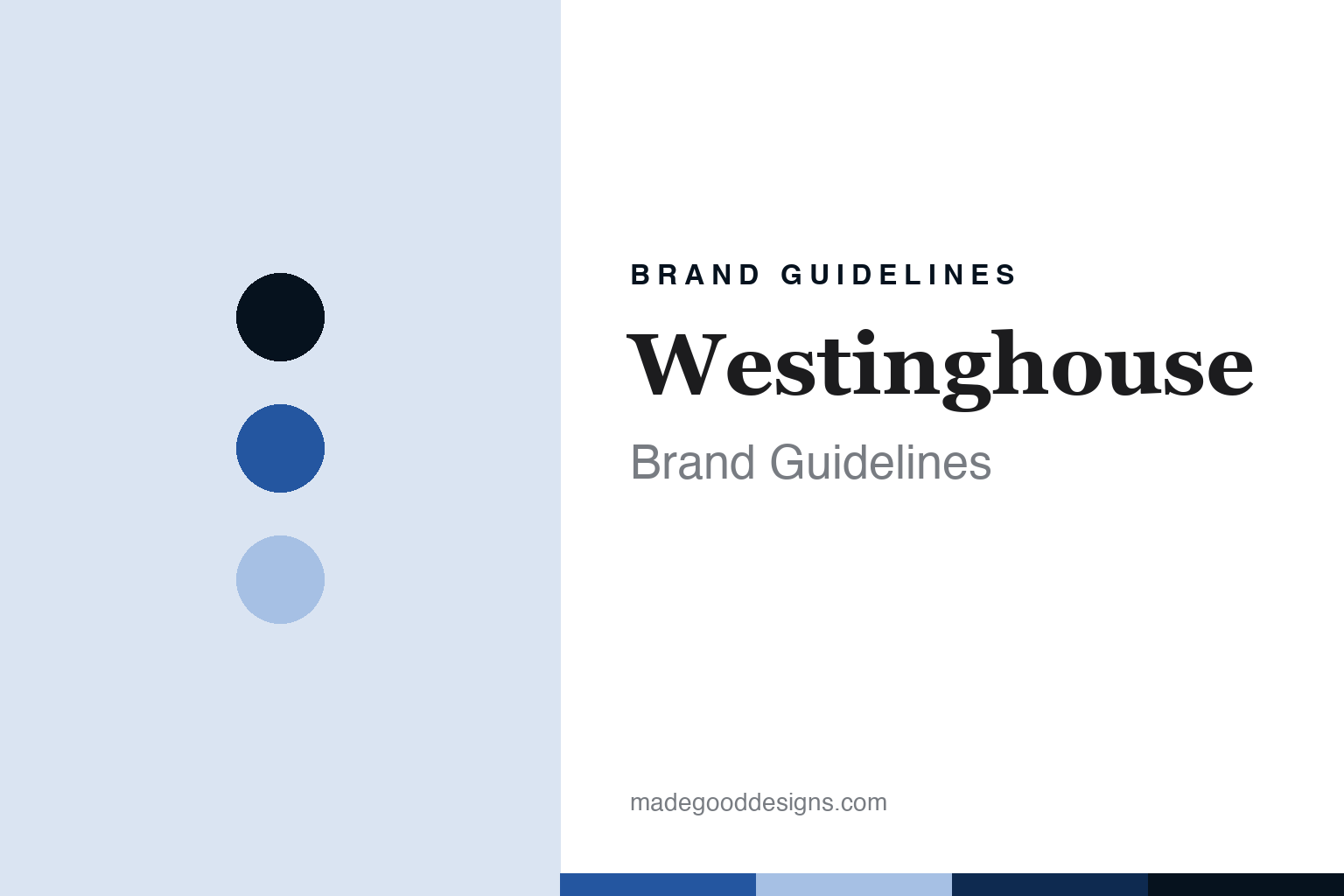
Westinghouse Brand Guidelines
The licensed heritage name.
Aa
Two constants: an electric-blue palette and a licensed-serif register. Abstract homage — not a Westinghouse product or mark; no generator, engine or logo is reproduced.
The licensed heritage name
Westinghouse is the 1886 Westinghouse trademark licensed for generators to a separate maker — and built in China and Vietnam, not the original electric company.
Westinghouse follows Champion as the round’s licensed-name node — a heritage American name from 1886 that appears on generators under a trademark licence, made by a separate company overseas rather than by the original electric firm. Its answer to a round about who owns the generators is the licensed one: a famous old name whose maker is someone else.
Its identity is the licensed heritage name. The 1886 name, the trademark licence and the overseas manufacturing are the story here. Old name, other maker. The licensed heritage name.
(Honest notes, so the heritage, the licensing structure and the making are framed accurately, with a clear separation. Westinghouse sells generators as its heroes — the iGen inverters, the WGen portables and dual-fuel models; we report its language as the brand’s own. On the heritage: George Westinghouse founded the original Westinghouse electric company in 1886 in Pittsburgh, but these generators are a licensed use of that name, not the original company. On the licensing structure, the key point: the consumer Westinghouse trademarks were bought from ViacomCBS in 2021 by a consumer-brand licensor, and the outdoor-power name has been operated by MWE Investments, an Ohio company that took the licence in 2016, so we make clear the maker is separate from the historic firm, and we note that in 2024 the Westinghouse brand company acquired MWE, bringing the distributor in-house. On the making: designed in the US and made in China and Vietnam, per the recall notice. On a documented recall: a 2020 CPSC recall of about 7,500 dual-fuel generators for a fuel-leak hazard, which we date and attribute. Its designs and the Westinghouse name are IP we describe but do not reproduce; there is no official brand hex; these tones are an unofficial interpretation.)
Colour
Westinghouse lives in an electric blue. Click a swatch to copy the hex.
Westinghouse’s identity is heritage-named, licensed and overseas-made — an electric blue, an ink, a pale blue, a deep navy, and a paper. The palette leans electric blue and deep navy: a classic, electrical register that nods to a heritage electric name rather than a loud logo colour. It signals the licensed heritage name — heritage-named, licensed and overseas-made. The honest caveat: with no official brand hex, these values are an electrical, unofficial interpretation, not first-party colours.
The lesson is an electric blue signals a heritage, electrical identity. Westinghouse’s world is the trusted old name. For designers, it is a reminder that a classic blue and a deep navy can carry a heritage, licensed brand — an electrical tone held as an accent, not a product shot. Because a mid hue can fail as small text, keep type dark and let the colour live in the accents, palette and band. The takeaways: credit the 1886 name but separate it from the maker; explain the trademark licence and MWE, brought in-house in 2024; say made in China and Vietnam; and date the 2020 recall.
Typography
The register is a licensed serif — heritage-named, licensed, overseas-made.
Westinghouse’s identity carries a heritage-named, licensed spirit — an old name on a new maker’s machine. A licensed serif captures the mood: classic, editorial and established, the register of a heritage name. Set in an electric-blue palette, the licensed serif feels trusted and formal — exactly the personality the Westinghouse name carries. It behaves like a borrowed, historic thing rather than a loud logo, mirroring a volt-line and a current-ring. (Westinghouse’s real products and the name are things we describe but do not reproduce, and the exact typeface is not ours to use.) Because it is not ours to use, the honest description is “a licensed-serif brand,” shown here in a stand-in. The type behaves like the brand: heritage-named, licensed and overseas-made.
Aa
A licensed-serif brand — trusted and formal. (Specimen set in Fraunces, a licensed-serif STAND-IN; NOT the Westinghouse logo or products.)
The generator node
Westinghouse stands for the licensed heritage name.
Westinghouse sits fourth in the round as its licensed-name node. An electric-blue palette, a licensed serif and an 1886 name make one thing — the licensed heritage name — the whole identity: heritage-named, licensed and overseas-made. The 1886 name is the pitch, the trademark licence is the frame, and the overseas manufacturing is the honest detail. The point is a famous old name whose maker is someone else, in a round about who owns the generators.
Put to work, the identity is the brand told straight, the name separated from the maker and the licence explained. A brand in this spirit would credit the 1886 name but separate it from the maker, explain the trademark licence and MWE brought in-house in 2024, say made in China and Vietnam, and date the 2020 recall. A reader in this spirit would keep the facts right: Westinghouse sells the iGen and WGen lines; the name comes from George Westinghouse’s 1886 company, but the generators are a licensed use; they were operated by MWE Investments, acquired by the Westinghouse brand company in 2024; and they are made in China and Vietnam. Westinghouse sits after Champion and before DuroMax. The honest editorial moves are to credit the name, to separate the maker, to explain the licence, and to date the recall.
For designers and brand-builders, Westinghouse carries the generator node: separate a licensed name from its original company. The lessons: a brand can be a heritage name applied under licence, here Westinghouse on generators; a heritage is credited but separated, George Westinghouse’s 1886 Pittsburgh electric company distinct from these licensed generators; a licensing structure is explained, the consumer trademarks bought from ViacomCBS in 2021 and the outdoor-power name operated by MWE Investments, which took the licence in 2016 and was brought in-house by the Westinghouse brand company in 2024; a making is stated as designed in the US and made in China and Vietnam; and a recall is dated, the 2020 CPSC recall of about 7,500 dual-fuel generators for a fuel-leak hazard. It is also a reminder to stay precise: Westinghouse is the licensed heritage name of the generator aisle, made overseas by a separate company — with the palette here an unofficial interpretation. The hook is that borrowing: Westinghouse is the licensed heritage name, the 1886 Westinghouse trademark licensed for generators to a separate maker and built in China and Vietnam, not the original electric company. Read that way, Westinghouse is less a single generator than the licensed heritage name: heritage-named, licensed, overseas-made. The lesson for a brand is that separating a licensed name from its original company reinforces the honesty, and crediting the heritage keeps it earned. Westinghouse made the-licensed-heritage-name the identity — proof that an honestly-separated licensed name can anchor a node.
Explore & save
Keep Westinghouse’s identity on hand — save it to a board in the Made Good inspiration library.
Westinghouse identity set
Pin the electric-blue palette and the licensed-serif register to your own board.