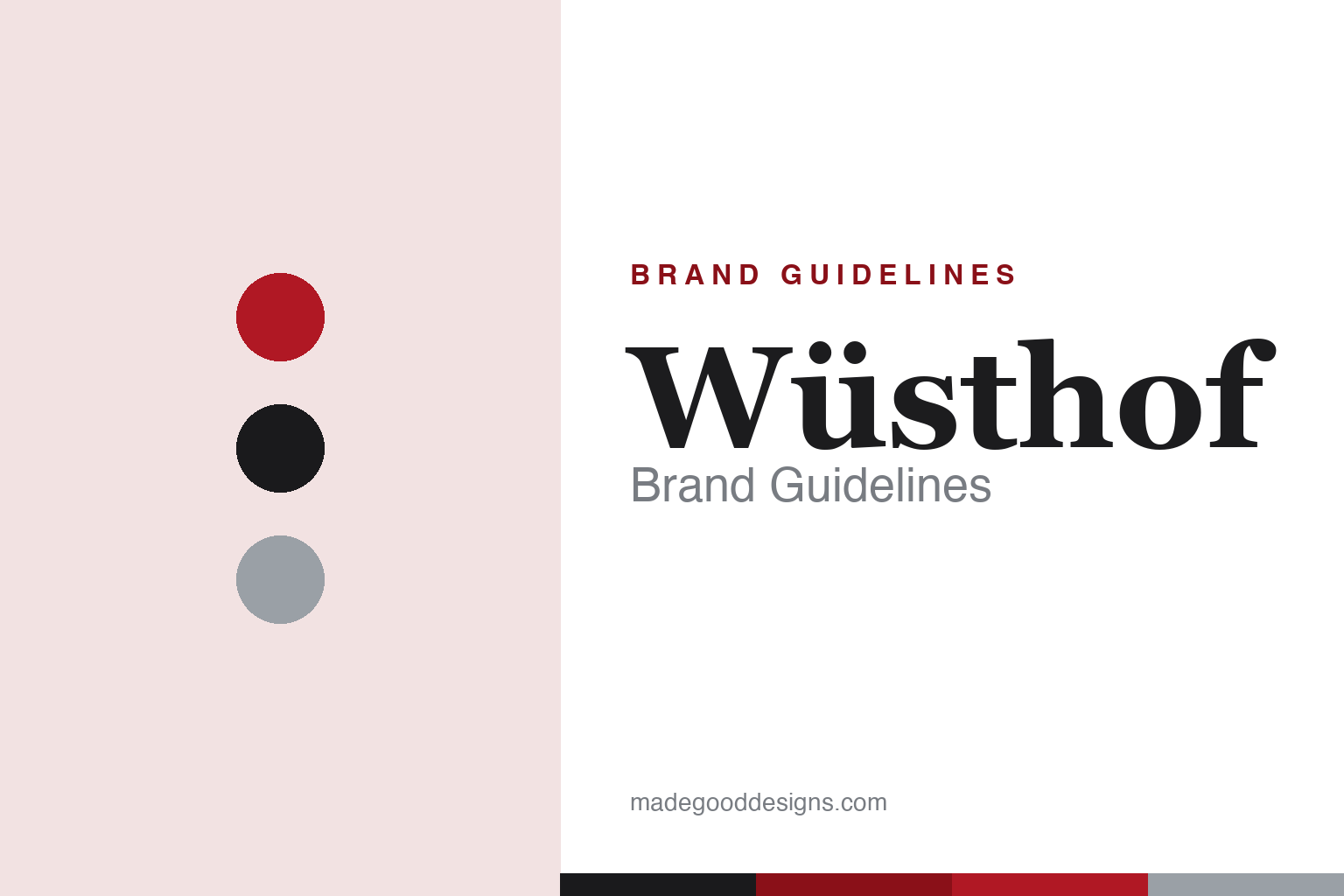
Wüsthof Brand Guidelines
The trident since 1814 — Solingen forging, a full-bolster blade, and seven generations of one family.
Aa
Two constants: a heritage red-and-black palette and an elegant heritage serif. Abstract homage — no trident, not the Wüsthof mark.
The trident of Solingen
Wüsthof has forged in Solingen since 1814.
Wüsthof is a lesson in heritage plus a single, enduring mark. It was founded in 1814 in Solingen, Germany — the “City of Blades” (Klingenstadt) — and it remains family-owned into its seventh generation (today led by cousins Harald and Viola Wüsthof). (Two honest notes: no official brand hex is published, and the wordmark typeface is undocumented.)
Its signature is the trident. The trident trademark — registered with the Imperial Patent Office in Berlin in 1895 — is why English speakers know the company as “Wüsthof-Trident,” and a red trident still anchors the brand. Wüsthof is famous for precision-forged German kitchen knives: each is forged from a single blank of high-carbon stainless steel (X50CrMoV15), with a full bolster and full tang. Its flagship is the Classic line (a synthetic, triple-riveted handle), alongside Classic Ikon, Grand Prix and Epicure.
The knives are still made in Solingen, and modern craft meets tradition: Wüsthof’s PEtec (Precision Edge Technology) individually laser-measures every blade to hit a precise ~14°-per-side edge, yet the final honing is still done by hand (even with 100+ robots in the factory). It’s privately held and family-owned. One important disambiguation: Wüsthof is not Zwilling J.A. Henckels — both are historic Solingen forged-knife houses, but they are separate, unrelated companies (Zwilling’s mark is twin figures, founded 1731; Wüsthof’s is the trident, 1814). The identity is heritage and precise — a red trident, a forged blade. The trident of Solingen.
Colour
Wüsthof lives in a heritage red on black. Click a swatch to copy the hex.
Wüsthof’s identity is anchored by its red (the trident and wordmark), usually set against black or near-black, with steel supporting tones. The red reads as heritage, confident and authoritative — a mark colour carried across two centuries of blade-making — while the black and steel reinforce the forged-steel craft. It’s a restrained, grown-up palette befitting a 200-year-old family cutlery house: it signals precision and tradition rather than fashion novelty. The honest caveat: Wüsthof publishes no official brand hex, so the red and black here are observed approximations, not first-party values — and no trident is reproduced.
The lesson is a single heritage mark-colour can carry two centuries of trust. Wüsthof’s red-on-black world reads as precise and enduring — matching forged German knives. For designers, it’s a reminder that a restrained, consistent heritage palette can signal reliability better than novelty. The takeaways: anchor on a confident heritage mark-colour (the red); support it with forged-steel neutrals (black, steel); and treat specific hexes as approximate when no official spec is published.
Typography
The wordmark is an elegant heritage serif spirit — precise and enduring.
Wüsthof’s identity carries a refined, heritage, precise spirit — a dignified feel befitting a cutlery house founded in 1814. An elegant serif captures it well: the classical letterforms read as crafted, authoritative and enduring, matching a brand built on forged steel and two centuries of family blade-making, and the restraint lets the mark and the steel speak. Set with a heritage red on black, the type feels trustworthy and timeless — exactly the precision-craft personality Wüsthof cultivates. It’s refined and heritage rather than loud, mirroring the forged blades. Because the exact wordmark face is undocumented, the honest description is “an elegant heritage serif spirit,” not a named font. The type behaves like the brand: precise, heritage and enduring.
Aa
An elegant heritage serif spirit — precise and enduring. (Specimen set in Lora, an elegant heritage serif in the spirit of the Wüsthof identity; the real wordmark is undocumented.)
Two centuries of the blade
Wüsthof sells heritage craft.
Wüsthof is a lesson in heritage craft as the brand. Its deepest asset is continuity: a single family, a single city (Solingen), a single mark (the trident) and a single craft (forging) sustained for more than 200 years. That continuity is nearly impossible to copy and it compounds into trust — a Wüsthof knife carries two centuries of blade-making reputation. The brand manages that heritage intelligently, pairing it with genuine modern engineering (PEtec laser-measuring every edge) rather than resting on history, so the story is “heritage and innovation,” not nostalgia alone. The lesson is that an authentic, single-place, single-family heritage — protected by a consistent mark and kept honest with real ongoing craft — can be one of the most durable premium brands of all, because it sells something competitors literally cannot manufacture: time. Guard the mark, keep forging, and heritage does the selling.
For designers and brand-builders, Wüsthof offers a clear takeaway: an authentic, continuous heritage, anchored by one mark, can be a deep and durable moat. The lessons: protect and centre a heritage mark (the trident since 1895); keep the craft genuinely alive and modern (forging plus PEtec); and let continuity — family, place, method — do the work. It’s also a reminder to keep the facts precise — Wüsthof was founded in 1814 in Solingen, is family-owned into its seventh generation, forges from high-carbon stainless steel, and is a separate company from Zwilling J.A. Henckels. Wüsthof sells heritage craft — proof that continuity can be the brand.
Explore & save
Keep Wüsthof’s identity on hand — save it to a board in the Made Good inspiration library.
Wüsthof identity set
Pin the heritage red-on-black palette and the heritage-serif spirit to your own board.