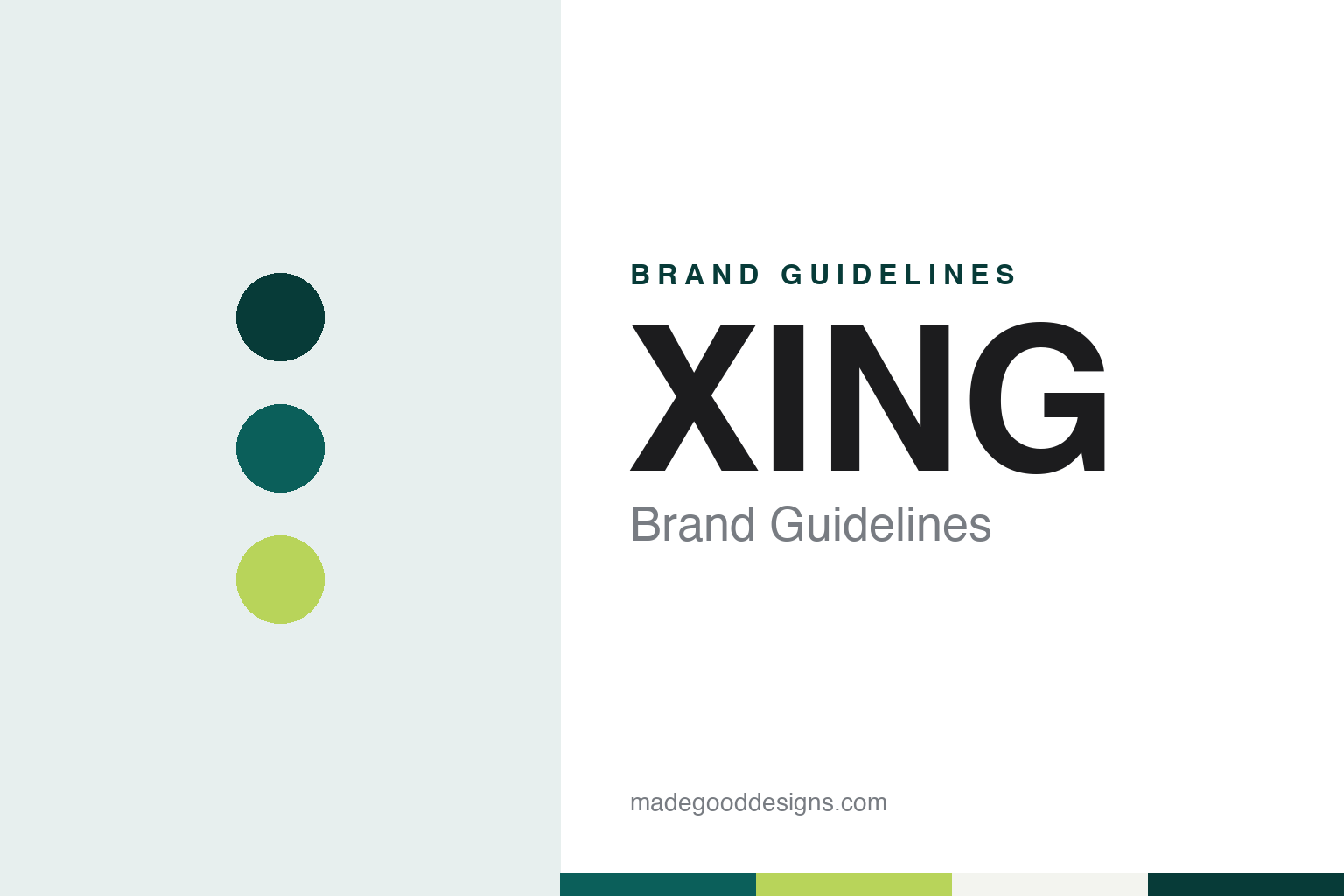
XING Brand Guidelines
A Hamburg business club that became a jobs network.
Aa
Two constants: a harbour teal and fresh lime palette and a rounded grotesque register. Abstract homage — not a XING product or mark; no logo, app screen or campaign image is reproduced.
OpenBC
A Hamburg business club, online from 2003.
XING began in Hamburg in August 2003, when Lars Hinrichs founded Open Business Club, a site for professional contacts that went by the short name OpenBC. English Wikipedia gives its official debut as 1 November 2003 and says the service was renamed XING in November 2006. German Wikipedia adds that the operating company kept the name Open Business Club AG until July 2007, then traded as XING, and in July 2019 took the name New Work SE; English Wikipedia says it had become a European company, a Societas Europaea, in September 2017.
The shares were listed in Frankfurt from 7 December 2006, and German Wikipedia says they sat in the TecDAX technology index between September 2011 and March 2021. In its early years the site pursued a global strategy, English Wikipedia says; from 2012 it concentrated on Germany, Austria and Switzerland, the region German Wikipedia puts at about nine in ten page views.
The publisher Hubert Burda Media arrived early. In November 2009 it bought 25.1 percent from the holding company of the founder and became the main shareholder, German Wikipedia says. A takeover offer in 2012 lifted Burda above half of the shares by December of that year, before it sold some again in February 2013, according to the same account; by March 2024, the company said, Burda Digital SE held about 74 percent.
Colour
From profiles and groups to a job market.
For most of its life XING was a networking site in the classic sense: members kept a CV-style profile, collected confirmed contacts, wrote in discussion groups and met at regional events. German Wikipedia says members ran more than 180,000 events in 2010. The company bought the Munich ticketing service Amiando with effect from January 2011 and ran it as XING Events, and in January 2013 it added kununu, the Austrian employer-review portal. English Wikipedia lists further purchases: the expat network InterNations and the Austrian recruiting firm Prescreen in 2017, and the Berlin tech-jobs platform Honeypot in 2019.
Jobs were part of the offer from October 2007, when XING opened a job market that German Wikipedia says was called Marketplace until March 2009. Over time that side took over. In late 2022 New Work SE gathered its recruiting tools under a new business-to-business brand, onlyfy, the company’s brand director told Personalmagazin in an interview published by Haufe in January 2023, describing XING as on its way “from business network to job network”; the events market was to close at the start of 2023. In October 2023 Horizont reported that XING was changing its business model to put job search ahead of networking, twenty years after its launch. German Wikipedia says the event and group functions ended in 2023 and that since July 2024 most of the job market has been open to visitors without an account.
The brand now speaks mainly about jobs. In January 2025 XING started a new 360-degree campaign built around a “hot seat” format carried over from 2024, created with the Berlin agency Antoni and running on television, social media, outdoor posters and podcasts, the company said. New Work SE calls XING “the leading jobs network in German-speaking countries” and says it has 21 million members and more than 20,000 companies and recruiters; those are the company’s own figures.
Typography
Job boards and recruitment platforms.
For a designer, a job board is mostly a search box and a list: a field for the job, a field for the place and a button, followed by a column of job cards giving the title, the employer, the location and the date. Where that pattern is shared, the brand has to work in the small places: the wordmark at the top of the page, the colour of the button, the app icon on a phone and the tone of the alerts that arrive by email.
The names do a lot of the work. Many are plain words or short compounds that say what the site is for, and some companies build their advertising directly on the name: SEEK, for example, has long used the line “SEEK and you shall find,” according to the trade title Campaign Brief. Others keep separate names market by market: SEEK’s group runs Jobstreet and Jobsdb sites in Asia alongside SEEK itself, according to its own website.
The second audience is the employer. Job sites sell advertising, résumé search and matching tools to hirers, and their corporate pages speak to recruiters as much as to candidates, with products for job posting, candidate search and employer branding presented next to the public job search.
Ownership is part of the story too. Many of these brands belong to larger groups, and their corporate pages list the countries and sites they run: SEEK’s about page names marketplaces in eight countries, and after the 2025 sale of CareerBuilder + Monster, the new owner BOLD listed CareerBuilder and Monster among its brands, HR Dive reported. This guide sets out who founded each brand, who owns it now and what has changed hands, and treats colours and type as an unofficial interpretation rather than an official specification.
Aa
A rounded grotesque — friendly, plain and screen-first. (Specimen set in Manrope, a sans STAND-IN; NOT the XING logo.)
New Work SE
A Burda subsidiary, off the exchange since 2024.
The listed years ended in 2024. That January job cuts were announced; German Wikipedia says 400 of about 2,000 posts were to go, as part of a restructuring the company reported on through the year. In June 2024 New Work SE signed a delisting agreement with Burda Digital SE, which made a public tender offer to the other shareholders; the Frankfurt Stock Exchange revoked the listing at the company’s request, and the shares stopped trading on the regulated market at the end of 26 August 2024, the company said.
At the annual meeting in June 2025 shareholders approved the transfer of the remaining minority shares to Burda, and Petra von Strombeck, chief executive since 2020, handed over to Henning Rönneberg, the company said; German Wikipedia says Hubert Burda Media has owned all the shares since June 2025. German Wikipedia also records a further round of job cuts in December 2025. On 13 July 2026 New Work SE sold InterNations to the investor FairCap and said the sale was completed that day, explaining that its focus is now recruitment and employer branding.
Today New Work SE is based in Hamburg, with offices in Vienna, Barcelona, Valencia and Porto among other places, and XING remains its main consumer brand, with onlyfy on the recruiter side, the company says. The name New Work has roots in the brand’s own publishing: for its tenth anniversary in 2013 XING launched a print magazine, Spielraum, about the changing world of work, followed by a New Work Award for companies with ideas for that new working world, German Wikipedia says. The corporate site still sets out the idea behind the name: a vision of “a better working life” and of matching people to companies on culture as well as on the CV.
For a design guide, XING shows how a brand can keep its name while its purpose narrows from networking to hiring. Compare StepStone, another German jobs platform, and LinkedIn, the network it competed with. For this guide we use a harbour teal, a deep teal and a fresh lime with a sans, an unofficial interpretation; no product or logo is reproduced.
Explore & save
Keep XING’s identity on hand — save it to a board in the Made Good inspiration library.
XING identity set
Pin the XING harbour teal and fresh lime palette and the rounded grotesque register to your own board.