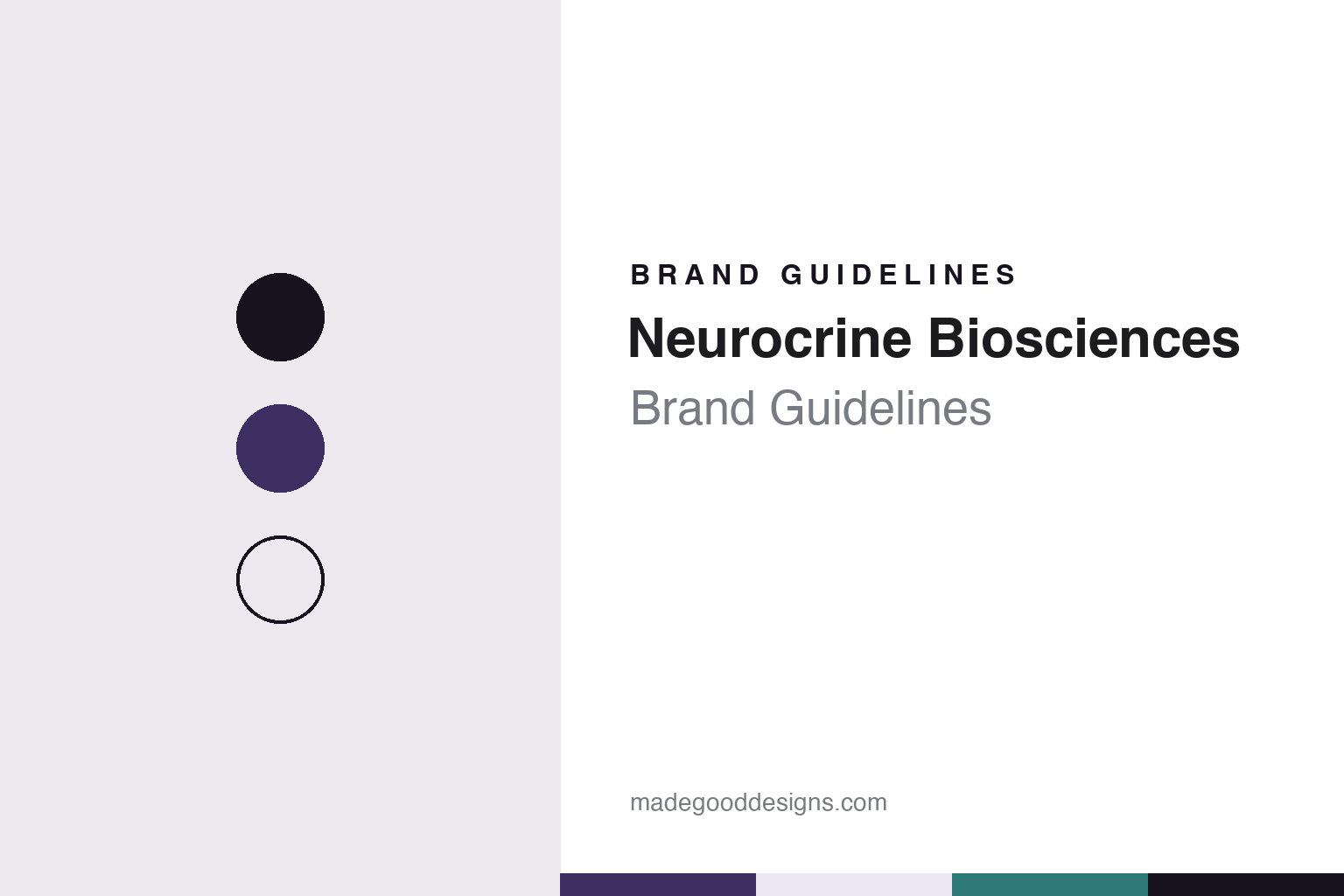
Neurocrine Biosciences Brand Guidelines
The San Diego neuroscience company built on a stress hormone.
Aa
Two constants: a Neurocrine violet and teal palette and a Clinical sans register. Abstract homage — not a Neurocrine Biosciences product or mark; no pack, logo or nameplate is reproduced.
A Salk Hormone
Two scientists and a stress hormone.
Neurocrine Biosciences was founded in San Diego in 1992. English Wikipedia names its academic founders as Wylie Vale of the Salk Institute for Biological Studies and Lawrence Steinman of Stanford University, and says the company was backed and organised by Larry Bock of Avalon Ventures, among others; its infobox also lists Kevin Gorman, who later ran the company, among the founders. The company’s own history names Vale and Steinman as its co-founders, and says Vale’s work at the Salk contributed to Nobel Prize–winning research in endocrinology.
The science behind the start was a hormone. Neurocrine says its foundational work began with Vale’s discovery and study of corticotropin-releasing factor, or CRF, a stress hormone that governs the release of another hormone, ACTH, from the pituitary gland. Early partnerships followed that thread. Wikipedia records a 1995 collaboration with Belgium’s Janssen Pharmaceutica on CRF antagonists for psychiatric disorders, an October 1996 agreement with Eli Lilly on obesity and Alzheimer’s research built on CRF-binding protein, and a July 2001 research agreement with GlaxoSmithKline on CRF-receptor compounds.
The company went public in May 1996, listing on Nasdaq under the symbol NBIX, Wikipedia says. Gary Lyons led it as chief executive from its founding until January 2008, when Kevin Gorman succeeded him; Kyle Gano has been chief executive since October 2024, and William Rastetter is named as chairman. The company describes its growth as “from two people to a company of more than 2,000,” and says its focus is on neurological, neuroendocrine and neuropsychiatric disorders that it calls rare or under-addressed.
Colour
From indiplon to Ingrezza.
Neurocrine’s road to market was not straight. In December 2002 it licensed its insomnia candidate indiplon to Pfizer. In May 2006, Wikipedia records, the FDA issued a non-approvable letter for one formulation and an approvable letter with conditions for two others, and Pfizer ended the agreement; after a resubmission in December 2007 the agency asked for further studies, and Neurocrine stopped developing the drug in the United States. A partnership with Dainippon Sumitomo Pharma for indiplon in Japan followed in 2007.
Licensing became a pattern. In June 2010 the company granted worldwide rights to elagolix, an oral GnRH antagonist for endometriosis and uterine fibroids, to Abbott, whose pharmaceutical business is now AbbVie, Wikipedia says. In February 2017 it took North American rights to opicapone, a Parkinson’s disease medicine, from the Portuguese drugmaker Bial.
The turning point was valbenazine, sold as Ingrezza. The company says its own scientists synthesised the molecule, a VMAT2 inhibitor, after research showed the role of that transporter in regulating movement. On 11 April 2017 the FDA approved Ingrezza capsules for adults with tardive dyskinesia, a disorder of repetitive involuntary movements, and the agency’s announcement called it the first drug it had approved for the condition. Neurocrine says a second indication followed in 2023, and its website lists chorea associated with Huntington’s disease among the uses of its approved medicines. Valbenazine has also been studied in Tourette syndrome: in October 2017 Neurocrine announced that the FDA had granted it orphan drug designation for treating children with the condition, Wikipedia records.
The CRF thread came back in December 2024. The FDA approved Crenessity (crinecerfont), a CRF1 receptor antagonist taken by mouth once a day, for patients aged four and over with classic congenital adrenal hyperplasia, pharmaphorum reported on 16 December 2024; Neurocrine called it the first new option for those patients in more than 70 years, the report said. The company traces the compound to its pharmacology group, first led by Dimitri Grigoriadis, whom Vale mentored.
Typography
Design and documentation.
Biotechnology companies sell things that are almost impossible to photograph. A medicine made from a strand of RNA or an engineered antibody has no shape a camera can see, so the sector leans on a small set of stand-in images: rendered molecules, ribbons and double helices, antibodies drawn as glowing Y-shapes, and close-ups of cells under a microscope. These macro images carry most of the visual weight on corporate websites, investor decks and annual reports.
The second familiar picture is the laboratory itself. Scientists at benches with pipettes, racks of sample tubes and gloved hands over a plate reader appear again and again, because they show work in progress rather than a finished product. Alongside them sit patient-advocacy portraits: people living with a rare disease, their families and the groups that represent them, photographed in everyday settings rather than in the clinic.
Architecture does the rest. Glass-fronted lab campuses in clusters such as Cambridge, Massachusetts, Copenhagen and South San Francisco stand in for scale and ambition, and company websites often show their buildings alongside their people. The calendar adds its own stage: the BIO International Convention and the J.P. Morgan Healthcare Conference, held each January in San Francisco, are where pipelines are presented to partners and investors.
Within that common language, names and colours do much of the work of telling companies apart. This guide sets out what can be checked about each brand — who founded it, where it is based, what it makes and what has happened to it — and marks clearly what rests only on the company’s own word. No product, logo or pack is reproduced, and the palettes are our own unofficial interpretation.
Aa
A clinical sans — NBIX on Nasdaq since 1996. (Specimen set in Inter Tight, a sans STAND-IN; NOT the Neurocrine Biosciences logo.)
Neurocrine
From two people to more than 2,000.
Not every programme went forward. In August 2024 Neurocrine reported Phase II results for NBI-1117568, a schizophrenia candidate it had licensed in 2021 from Japan’s Nxera Pharma, and its share price fell 19% the following day, Wikipedia records.
The company has also grown by acquisition. On 18 May 2026 it completed its purchase of Soleno Therapeutics, adding VYKAT XR (diazoxide choline) tablets, a medicine for hyperphagia in Prader-Willi syndrome, according to the announcement of that date; Soleno became a wholly owned subsidiary. Neurocrine’s website now lists treatments for tardive dyskinesia, Huntington’s chorea, classic congenital adrenal hyperplasia, hyperphagia in Prader-Willi syndrome, endometriosis and uterine fibroids, and a pipeline of compounds in mid- to late-stage development. Its stated values are five single words: Passion, Integrity, Collaboration, Innovation and Tenacity, the last glossed as “We do not quit.”
The company remains independent and headquartered in San Diego, and its full name, Neurocrine Biosciences, appears across its website, with the shorter Neurocrine used throughout its own history page. Its identity rests less on a symbol than on two molecules with long back-stories: a hormone first studied at the Salk Institute and a transporter that the company’s chemists targeted with valbenazine.
For a design guide, Neurocrine Biosciences shows how a company can carry one line of science, from a stress hormone to an approved medicine, through more than three decades of its story. Compare Biogen, another neuroscience-focused biotechnology company, and Ionis Pharmaceuticals, another independent biotechnology company. For this guide we use a deep violet and a teal with a sans, an unofficial interpretation; no product or logo is reproduced.
Explore & save
Keep Neurocrine Biosciences’s identity on hand — save it to a board in the Made Good inspiration library.
Neurocrine Biosciences identity set
Pin the Neurocrine violet and teal palette and the Clinical sans register to your own board.