Bank Islam Brand Guidelines
Malaysia’s first Islamic bank, founded under a 1983 law.
Aa
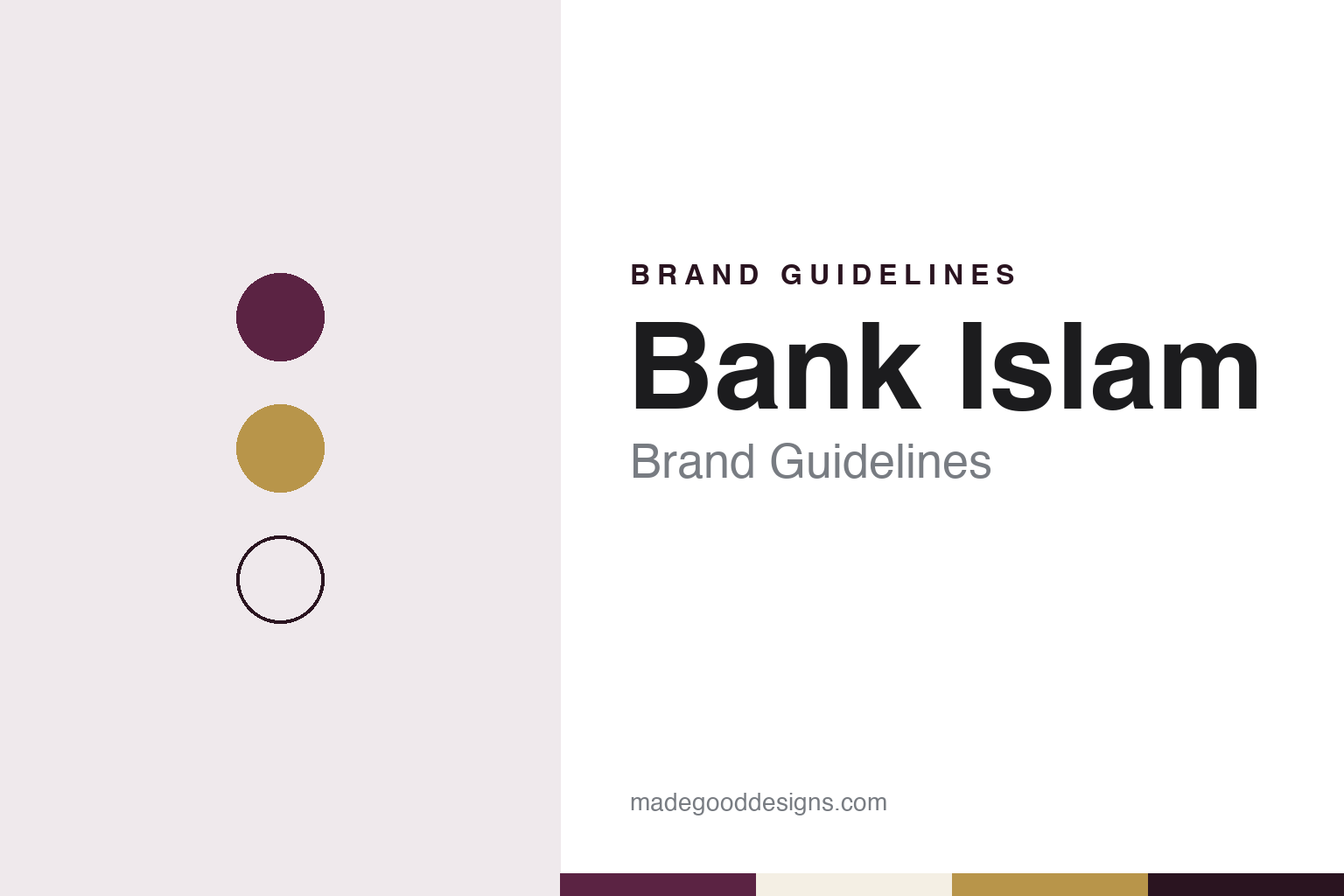
Two constants: a plum, gold and ivory palette and a rounded geometric sans register. Abstract homage — not a Bank Islam asset; no logo, card or app screen is reproduced.
July 1983
Malaysia’s first Islamic bank, under a new law.
Bank Islam Malaysia Berhad, which trades as Bank Islam, began operating on 1 July 1983 as Malaysia’s first Islamic bank, according to Malay Wikipedia. International Banker, in a profile published in June 2017, ties the bank’s start to the Islamic Banking Act of the same year and says it was first set up to serve the financial needs of the country’s Muslim population, before its services were opened to the whole country. English Wikipedia describes the bank in the same terms and places it in Kuala Lumpur, where it is still based.
Other lenders followed a decade later. English Wikipedia’s article on Islamic banking in Malaysia notes that the country’s first Islamic bank was set up in 1983 and that from 1993 commercial banks, merchant banks and finance companies were allowed to offer Islamic products under the Islamic Banking Scheme, provided they kept those funds and activities apart from their conventional business. In July 2022 Fintech News Malaysia described Bank Islam as Malaysia’s oldest Islamic bank.
The name itself is plain Malay for an Islamic bank, and Wikipedia gives the full company name in Jawi script as well as in Latin letters. For most of its life the bank sat inside a listed group, BIMB Holdings, whose owner English Wikipedia gives as Lembaga Tabung Haji, the Malaysian pilgrims’ savings board. Malay Wikipedia says Bank Islam once moved its financial year to match Tabung Haji’s, describing the board as its main holding shareholder.
Colour
Al-Awfar, BIMB Mobile and an app called Be U.
Bank Islam sells Shariah-compliant savings, financing and investment products. Malay Wikipedia singles out Al-Awfar, a combined savings and investment account that offers cash prizes, which it calls the first of its kind, along with corporate products such as Waheed-i, a fixed-term ringgit deposit built on a wakalah, or agency, contract. The bank’s main app is BIMB Mobile.
Its most visible digital experiment was Be U. Fintech News Malaysia reported in July 2022 that the bank had set up a Centre of Digital Experience in 2021 to lay the ground for a fully digital bank, that Be U appeared in the app stores in June 2022 with a full launch planned for mid-July, and that it was aimed at gig workers, independent contractors and solopreneurs. The chief executive told the site that work on Be U had begun about two years earlier.
The experiment ended in 2026. Bank Islam stopped taking new Be U registrations in April 2026, and the app closed on 31 July 2026, with customers moved to BIMB Mobile from 1 August, Fintech News Malaysia reported in May 2026. The group chief executive described Be U as a digital incubator that had completed its role, with its cloud-native features being folded into BIMB Mobile.
The bank has also worked on its internal culture. The same 2022 report describes a programme called CODE21, begun in 2019; core values summed up as TAAT — Think Customer, Act with Integrity, Advance Beyond and Take Charge; a Digital Academy for staff; and a house nickname for employees, “BITIZENs,” short for BIMB’s citizens.
On identity, Malay Wikipedia lists a corporate rebranding — a new identity, core values and brand essence — among the results of the recovery plan the bank began in 2006, together with refurbished branches given a fresh look. It also records a Reader’s Digest Trusted Brand Platinum award for Islamic financial services in May 2009.
Typography
Malaysian and Vietnamese banks.
Banks in Malaysia and Vietnam tend to present themselves through a bold wordmark or a short set of initials, often set in a single strong colour. Red, green, blue and orange recur across the sector, and many names work in two languages at once: a Malay or Vietnamese name for home customers and an English form or abbreviation for markets, filings and overseas branches. Several of the banks in this guide are known chiefly by initials that began as the names of older holding companies or merged institutions.
In Malaysia, Islamic banking usually sits beside the conventional bank as a range of its own, often run through a separate subsidiary with Shariah-compliant deposits, financing and cards. Public Bank, for example, says it began Islamic banking in 1993 and moved that business into Public Islamic Bank in 2008, while RHB offers its Islamic products through RHB Islamic Bank. RHB’s Sinar Credit Card-i, launched in November 2026, shows the “-i” suffix some Malaysian banks use for Islamic products.
Bank websites in both countries are organised around everyday tasks: deposits and savings accounts, home and vehicle loans, cards, QR payments and mobile apps. In Malaysia the national QR standard, DuitNow QR, was launched by PayNet in July 2019, according to Public Bank, whose own site lists DuitNow QR and its MyPB app under mobile banking. Photography tends to show branches, city skylines, head-office towers and customers at counters or on phones rather than abstract imagery.
Much of how these banks describe themselves appears in formal documents. Listed banks publish annual reports and, increasingly, sustainability reports, and their corporate websites group these with investor pages, milestone timelines and anniversary campaigns. This guide draws on those pages, on encyclopedia entries and on dated press reports, and marks where a fact rests on a bank’s own word.
Aa
A rounded geometric sans for a name that is plain Malay. (Specimen set in Plus Jakarta Sans, a sans STAND-IN; NOT the Bank Islam logo.)
Bank Islam
Losses, new capital and a listing of its own.
The bank’s path was not smooth. International Banker reported in 2017 that 2005 brought Bank Islam’s first loss in its 22 years of operation, followed by a larger loss in 2006, driven chiefly by provisions for non-performing financing; a significant share came from its Labuan subsidiary’s foreign-currency financing for clients abroad. In October 2006 two new shareholders put in fresh capital: a subsidiary of Dubai Investment Group took a 40 per cent stake and Lembaga Tabung Haji 9 per cent, and more capital followed in 2009. A three-year turnaround plan rebuilt credit and risk management and replaced the bank’s IT systems, the magazine said. By 2016, it reported, the bank had 145 branches, more than 4,500 employees and about 5 million customers.
The group was reorganised in 2021. On 8 October 2021 Bank Islam listed on the main market of Bursa Malaysia, taking over the listing status of BIMB Holdings, which became a wholly owned subsidiary of the bank; Fintech News Malaysia described it as the first full-fledged Islamic financial institution listed on the main market. The same exercise left Takaful Malaysia as a standalone operator, while the new Bank Islam group kept BIMB Investment Management and BIMB Securities. At the time the bank said it aimed to offer what it called Shariah-ESG total financial solutions, through digital banking and social finance, by 2025.
For a design guide, Bank Islam shows how a descriptive name, plain Malay for an Islamic bank, can carry an identity through a rescue, a rebrand and a new listed group. Compare Maybank and CIMB, two other Malaysian banking names. For this guide we use a deep plum, a muted gold and a warm ivory with a sans, an unofficial interpretation; no product or logo is reproduced.
Explore & save
Keep Bank Islam’s identity on hand — save it to a board in the Made Good inspiration library.
Bank Islam identity set
Pin the Bank Islam plum, gold and ivory palette and the rounded geometric sans register to your own board.