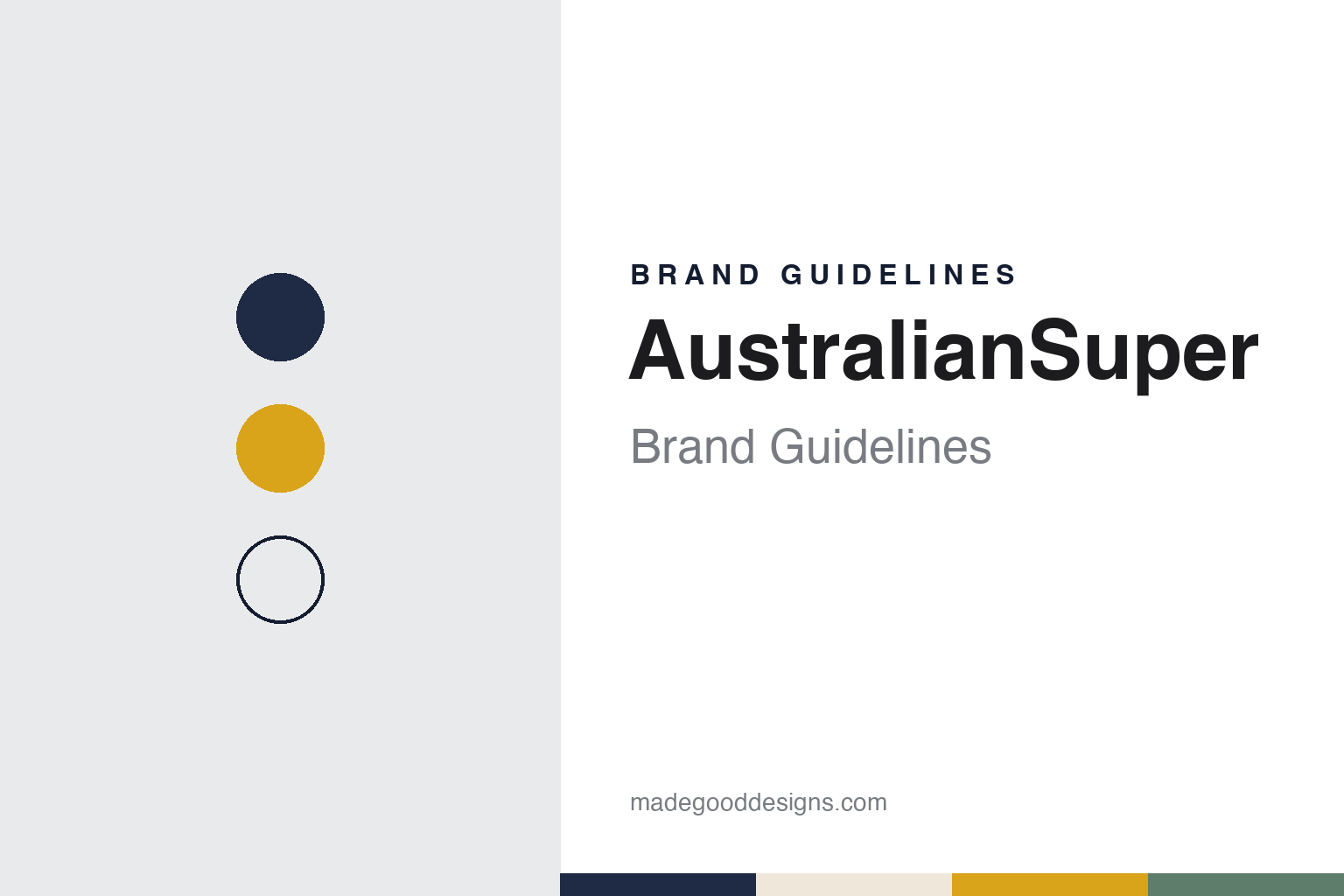
AustralianSuper Brand Guidelines
A Melbourne industry fund built from two older funds in 2006.
Aa
Two constants: a harbour navy, wattle gold and eucalypt palette and a friendly geometric sans register. Abstract homage — not an AustralianSuper asset or mark; no logo, product or statement is reproduced.
Two funds, one name
A merger in 2006 and a name that says what it is.
AustralianSuper is an industry superannuation fund headquartered in Melbourne, Victoria. English Wikipedia, citing the fund’s 2007 annual report, says it was established on 1 July 2006 through the merger of two older funds: the Australian Retirement Fund (ARF) and the Superannuation Trust of Australia (STA). The chief executive of ARF became chief executive of the merged fund, and the chief executive of STA became its deputy chief executive and chief investment officer, the article says.
The name is written as a single word, with a capital S in the middle, and it describes the organisation in two parts: the country and the product. It carries no single trade, employer, union or state. English Wikipedia describes AustralianSuper as an industry super fund that operates through a mutual structure, and says its trustee company is owned jointly by the Australian Council of Trade Unions and the employer peak body Australian Industry Group.
The fund has grown by taking in others. English Wikipedia records that the Labour Union Co-operative Retirement Fund (LUCRF Super) merged into AustralianSuper in June 2022. Its scale is usually given in member numbers. In September 2023 the Australian Securities and Investments Commission (ASIC) described AustralianSuper as Australia’s largest superannuation fund, with more than 2.87 million members at 30 June 2022. In March 2025 ASIC, citing figures from the prudential regulator APRA at 30 September 2024, gave about 3.49 million members. English Wikipedia, citing the fund’s 2025 annual report, gives more than 3.5 million.
Colour
Member Direct, MySuper and a global portfolio.
English Wikipedia notes that the fund holds a MySuper authority and offers a Member Direct option, which lets members build their own portfolio from Australian shares, exchange-traded funds, term deposits and cash. The article says Member Direct was designed to compete with self-managed super funds.
Its investments are spread around the world. English Wikipedia, citing the fund’s 2016–17 annual report, lists shares, transport infrastructure, office blocks and shopping centres among its assets, and, citing the property news site Bisnow in 2024, says the fund owns two-thirds of London’s Kings Cross Central development. The same article says that in September 2023 AustralianSuper invested in Vantage Data Centres’ business in Europe, the Middle East and Africa, as Data Center Dynamics reported, and that in January 2024 it raised its holdings in the lithium miner Pilbara Minerals and in Endeavour Group.
Member service has drawn public criticism at times. In 2021, English Wikipedia says, the Australian Financial Review criticised the fund for signing members up to subscriptions to the news site The New Daily unless they opted out within a month; the site was designed and funded by Industry Super Holdings. In 2022 the fund launched a new digital platform, with a new online portal and mobile apps, and in January 2023 News.com.au reported that some members had been locked out of their accounts and had struggled to get answers from customer support.
For a designer, that is where the brand does most of its work: in the online portal and the apps described above, alongside statements, letters and the annual report.
Typography
How super funds present themselves.
Australian superannuation funds and wealth firms present themselves to members as much as to the public, and a fund’s identity has to work inside an account as well as in an advertisement: on a login screen, in an app, on a yearly statement and in an annual report. The funds in this guide tend to use friendly sans-serif wordmarks, and their palettes often reach for teal, purple, orange and navy.
Their language is member-first. Industry funds describe themselves as run for members, and many carry their origins in their names: a trade, a sector, a state or an employer. Mergers have blurred those names over time, and several funds now carry names that no longer point to a single industry or state. Their websites often say which workers a fund was set up for, even after it has opened to everyone.
The pictures follow the same idea. Fund websites and reports tend to show members at work and at home in everyday settings rather than buildings or products. The pages themselves are practical: what super is, how to join or combine accounts, retirement income, insurance in super, and member tools such as calculators and retirement planners, with annual reports and governance pages for those who look further.
This guide sets out what can be checked about each fund or firm: when it was founded, how it merged, who owns or runs it, and how regulators have dealt with it, with figures for members and assets given only as a dated source states them. The palettes and typefaces shown are unofficial interpretations, and no logo or mark is reproduced.
Aa
A friendly geometric sans for a descriptive one-word name. (Specimen set in Plus Jakarta Sans, a sans STAND-IN; NOT the AustralianSuper logo.)
The regulator’s record
An ASIC case decided in 2025.
The fund’s dealings with regulators are on the public record. On 8 September 2023 ASIC began civil penalty proceedings in the Federal Court against the trustee, alleging that for almost ten years it had lacked adequate policies and procedures to identify members who held more than one AustralianSuper account and to merge those accounts, and that it had continued to charge those members multiple sets of fees and insurance premiums. ASIC said AustralianSuper had reported a potential failure to the regulator in December 2022, that the fund was then included in a broader ASIC review of trustee practices published in June 2023, and that the fund was remediating affected members. ASIC also said it was the first case it had brought as a co-regulator with APRA alleging breaches of the trustee-duty provisions of the Superannuation Industry (Supervision) Act 1993.
ASIC set the case against a wider problem: at 30 June 2022, it said, about three million Australians had multiple super accounts, and Australian Taxation Office data showed more than half a million members holding two or more accounts within the same fund at 31 May 2023. On 21 February 2025 the Federal Court ordered AustralianSuper to pay a pecuniary penalty in the multiple-accounts case, according to ASIC.
For designers, a record like this is a reminder that a fund’s statements to members (fee notices, account letters and merger prompts) carry as much of the brand as its campaigns do, and that plain, consistent layouts make those messages easier to act on.
For a design guide, AustralianSuper shows how a fund created by merger can carry a plain, descriptive name across millions of member accounts. Compare Aware Super, the Sydney fund that began as First State Super, and Cbus, another Melbourne industry fund. For this guide we use a harbour navy, a wattle gold and a eucalypt green with a sans, an unofficial interpretation; no product or logo is reproduced.
Explore & save
Keep AustralianSuper’s identity on hand — save it to a board in the Made Good inspiration library.
AustralianSuper identity set
Save the harbour navy, wattle gold and eucalypt palette and the friendly geometric sans register to your own board.