CAI International Brand Guidelines
A San Francisco container lessor that most people never notice, now part of a Tokyo leasing group.
Aa
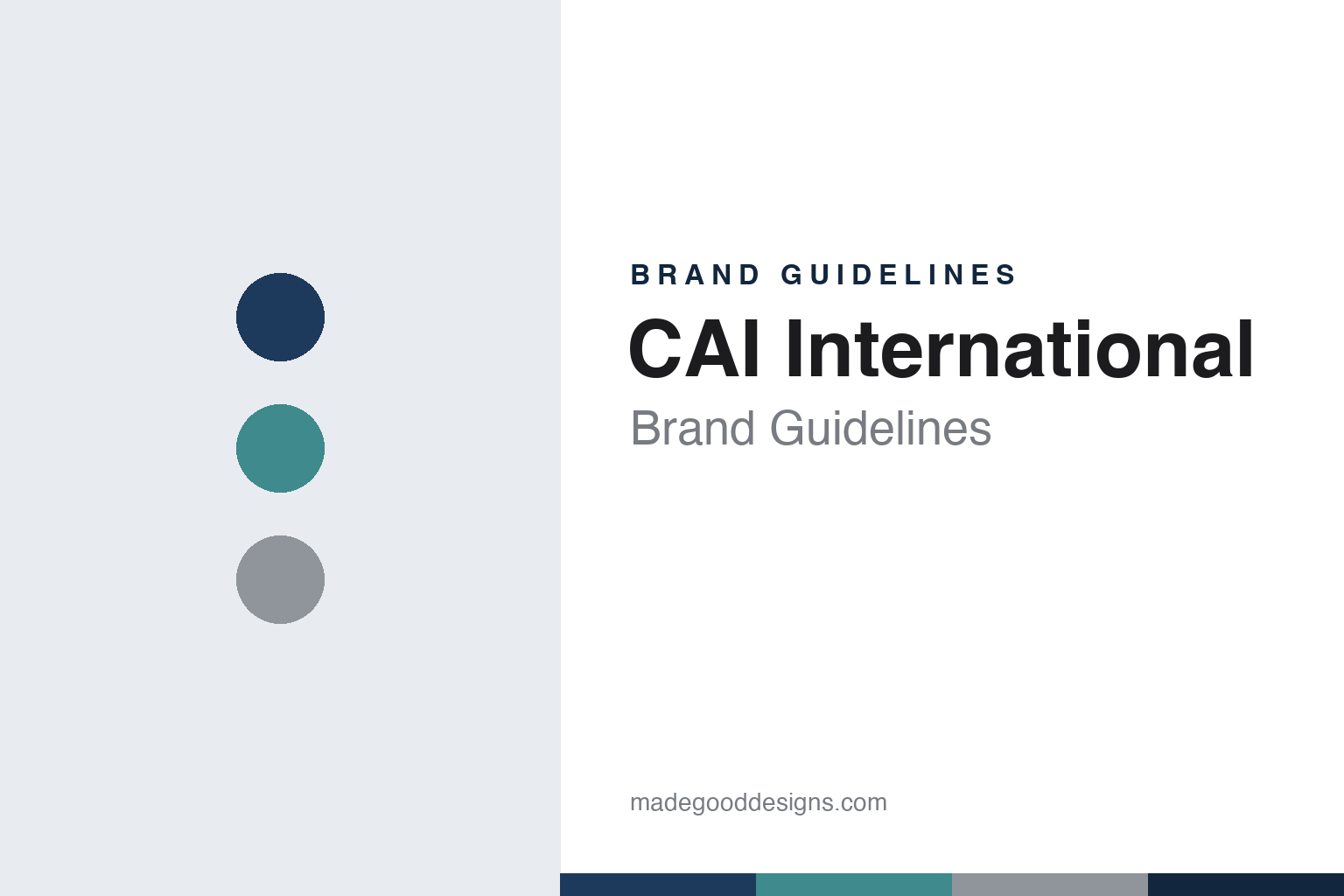
Two constants: a harbour navy, container teal and steel grey palette and a geometric sans register. Abstract homage — not a CAI International container or mark; no box, logo or livery is reproduced.
San Francisco, 1989
A container lessor founded by Hiromitsu Ogawa.
CAI International was set up in San Francisco in 1989. Mitsubishi HC Capital’s 2021 notices give its date of establishment as 3 August 1989, and FreightWaves reported in July 2007 that Hiromitsu Ogawa, then executive chairman, had founded the company that year. Its trade was the leasing of intermodal shipping containers: steel boxes that a lessor buys from manufacturers and rents to shipping lines and other operators, which use them without having to own them.
The company went public in May 2007. FreightWaves listed its share offering that July among a run of deals in the container and chassis trade, alongside sales and reviews at several other lessors, and gave CAI’s fleet at the time as 684,000 containers. Its shares then traded on the New York Stock Exchange under the symbol CAI, as later trade reports and Mitsubishi HC Capital’s notices record.
For a time CAI was broader than a container lessor. In December 2019 FreightWaves reported that, besides a fleet of nearly 1.7 million TEU, it had a logistics subsidiary and a railcar leasing business of just over 5,500 railcars that it planned to sell, and that its board had hired the adviser Centerview Partners to explore “strategic alternatives.” Mitsubishi HC Capital’s 2021 notice records what followed: CAI sold its logistics business in August 2020 and its railcar leasing business in December 2020. Its chief executive, Timothy Page, described the move in June 2021 as a return to CAI’s “core container leasing business,” gCaptain reported.
Colour
Boxes for every cargo.
CAI describes its fleet by box type rather than by product name. Its equipment page starts with the standard and high-cube dry vans in 20- and 40-foot lengths, the everyday container of international shipping, and then adds more specialised types. For bulky and oversized loads there are open tops, covered by a heavy tarp over removable bows, and flat racks, with a wood deck and steel end panels for building products and machinery. Refrigerated containers, known as reefers, carry fresh or frozen food, and diesel generator sets power them on road and rail, away from a ship’s own supply, the company explains.
Part of the range is aimed at Europe. CAI lists palletwide containers, which have two extra inches of internal width so that two Euro pallets sit side by side; swap bodies, dry vans built for land transport within Europe and often fitted with special doors or garment rails; and rolltrailers, flatbed trailers used in terminals and on roll-on roll-off ships. The company says it buys new equipment through a procurement programme with a select group of manufacturers, and that technical staff around the world check the condition of the fleet and follow advances in container materials and design.
The leasing side is set out in the same plain terms. CAI says its fleet now exceeds 4 million TEU, the twenty-foot-equivalent unit the industry counts in, and serves more than 300 leasing customers, among them large shipping lines, shippers and logistics companies. It says it works with more than 300 depots in 48 countries, has offices in Europe, Asia-Pacific and North America, and runs a real-time equipment-control system that lets lessees follow their units online. A container sales service sits beside leasing on the same site.
Typography
Design and documentation.
Container lessors own the steel boxes that shipping lines fill and move. A carrier that does not want to buy every box it needs can lease them for a few months or many years, return them at a depot and lease again somewhere else. The lessors earn their names on the boxes themselves: a company wordmark, often in a strong blue, orange or green, painted on the doors and sides of containers that travel the world’s ports and railways for years.
Their websites are built around that fleet. Most sort it by box type: standard and high-cube dry containers for general cargo; refrigerated containers, or reefers, for chilled and frozen goods; tank containers for liquids; and specials such as flat racks, open tops and palletwide boxes for cargo that does not fit a standard van. Photographs of stacked dry, reefer and tank containers, as the companies publish them, do much of the visual work, together with technical sheets that give each box’s dimensions and standards.
The next layer is the network. Lessors publish depot maps and depot finders, lists of regional offices and customer portals where shipping lines can book, return and track their units. Many also sell boxes: pages for the sale of used containers offer units at the end of their marine life for storage, conversion or one more trip, and some lessors invite outside investors to own container portfolios that the lessor manages.
Behind the boxes sits finance. Container leasing is a business of long-lived assets and long contracts, so ownership matters, and many of the companies in this series have been merged, listed, taken private or folded into larger groups. Their investor pages and press releases are where those changes are recorded, and this guide sets out what each company’s own pages and dated reports show.
Aa
A geometric sans for a three-letter name. (Specimen set in Archivo, a sans STAND-IN; NOT the CAI International logo.)
CAI International
From a listed lessor to a Mitsubishi HC Capital company.
The sale of CAI was announced on 18 June 2021. That day the Tokyo leasing group Mitsubishi HC Capital said it had signed a definitive agreement to buy all of CAI’s shares and make it a wholly owned subsidiary. Citing Drewry research, the group ranked CAI fifth among container lessors and its own Beacon Intermodal Leasing, bought in 2014, sixth. Mitsubishi HC Capital had itself been formed on 1 April 2021 from the merger of Mitsubishi UFJ Lease & Finance and Hitachi Capital. At the time, gCaptain reported, CAI ran about 1.8 million TEU through 13 offices in 12 countries, and its headquarters were to stay in San Francisco. The group said it completed the purchase on 22 November 2021.
A second step followed. On 18 October 2022 Mitsubishi HC Capital resolved to merge CAI and Beacon Intermodal Leasing, with CAI as the surviving company, and CAI’s website says the merger took effect on 1 January 2023. The combined business kept the CAI name and its San Francisco base; it now describes itself as the fourth-largest container leasing company by its own count, with a fleet of more than 4 million TEU. The earlier history of the other half is told in the Beacon Intermodal brand guide.
On its own site CAI speaks in short lines. “Global fleet, local service” and “Goods in motion” sit beside a third line, “You may not know it, but you saw us today.” The site is offered in German, Spanish, Korean, Portuguese and Chinese as well as English, and its pages are arranged by service and equipment type rather than by campaign.
For a design guide, CAI International shows how a lessor that few people outside shipping ever see presents itself: a three-letter name, plain taglines and equipment pages organised box by box, with the fleet counted in TEU. Compare it with Textainer, which FreightWaves also placed in San Francisco in 2007, and with Triton International. For this guide we use a harbour navy, a container teal and a steel grey with a geometric sans, an unofficial interpretation; no product or logo is reproduced.
Explore & save
Keep CAI International’s identity on hand — save it to a board in the Made Good inspiration library.
CAI International identity set
Pin the CAI International harbour navy, container teal and steel grey palette and the geometric sans register to your own board.