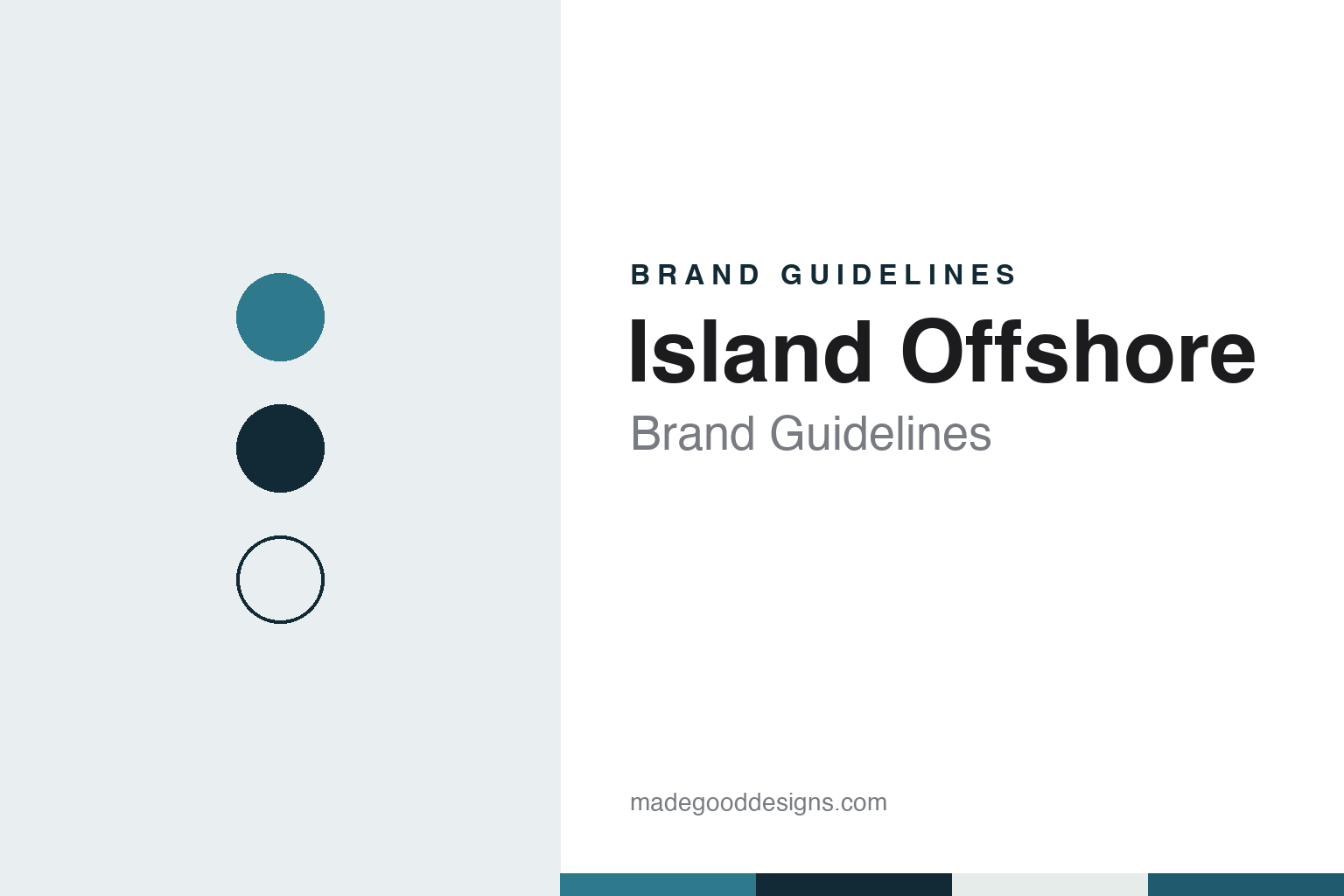
Island Offshore Brand Guidelines
An Ulsteinvik management company that turned one well-intervention ship into a fleet of Islands.
Aa
Two constants: a teal and night-water palette and a maritime sans register. Abstract homage — not an Island Offshore vessel or mark; no ship, logo or funnel is reproduced.
Island Frontier
A management company with one ship and four staff.
Island Offshore is based in Ulsteinvik, in Møre og Romsdal on Norway’s north-west coast. The company says Island Offshore Management was established on 14 April 2002, but that nobody worked for it until 1 April 2004, when it began crewing its first ship, the Island Frontier, and the owners decided to set up their own management company. It took over formal responsibility for running that vessel on 27 April 2004, the date it now marks as the start of its life as a shipping company.
The beginnings were small. The company says a team of four settled into offices at Stålhaugen in Ulsteinvik while the Island Frontier was being completed at Søvik Yard, and that the ship marked the start of well intervention from a single-hull vessel as a service. Asked about the future, the group’s chairman, Morten Ulstein, said the plan was to run the Island Frontier well and perhaps one day manage a vessel or two for the Edison Chouest Offshore group, the company recalls.
Growth came quickly. That summer the company ordered several new ships; the first, the Island Scout, was delivered at the start of 2005, followed that year by the Island Trader, Island Pride, Island Spirit and Island Ranger, according to the company.
Colour
Two vessel-building families behind one fleet.
The owners explain much of the company’s character. Island Offshore says the group is majority-owned by the Ulstein and Chouest families, who have built and managed offshore service vessels since the early 1970s, directly and through industrial partnerships. gCaptain put it in corporate terms in August 2024: the company was majority-owned by the Norwegian shipbuilding group Ulstein and the US-based Edison Chouest Offshore, and operated a fleet of 19 vessels at that time.
The fleet is broad. The company lists its services as riserless light well intervention, deep-water installation, walk-to-work, well stimulation, subsea construction, platform supply and anchor handling. Its website in November 2026 counts six platform supply vessels, three anchor-handling and deep-water installation vessels, two walk-to-work ships, two riserless light well intervention vessels, three subsea construction vessels and three well-stimulation vessels, and speaks elsewhere of 18 vessels in operation, after what it calls downsizing in recent years. Its about page lists its locations as Norway and Portugal. It says it has about 50 employees in the main office, a crewing department in Lisbon, Portugal, and more than 900 employees in all.
Its own stories name the work: the walk-to-work vessel Island Diligence on Vattenfall’s Kriegers Flak wind farm in the Baltic Sea from August 2020, and the Island Victory on anchor-handling work at the Johan Castberg field in the Barents Sea in 2020.
Typography
How offshore support vessel operators present themselves.
Offshore support vessel operators sell a service rather than a product, so their public face is the fleet itself. Their websites lead with photographs of platform supply vessels, anchor-handling tugs, fast crew boats and liftboats as the companies publish them, usually at sea or alongside a quay, with the working deck and the bridge in view.
Behind those photographs sits the fleet list. Operators sort their vessels by type, from supply vessels and anchor handlers to crew boats, liftboats and specialist ships, and give each class a short description, a named example and a length or deck size. Vessel names often run in families, such as a shared prefix, a family surname or a set of animal or place names, and those naming habits become part of how an operator is recognised in port and on charter lists.
Colour plays a similar role. Hull paint, superstructure colour and the mark on the funnel or the side of the bridge are what people see first from a distance, and many operators repeat the same few colours across a whole fleet. In this guide those colours are described in plain words rather than copied, and the palettes shown are our own interpretation.
The rest of an operator’s identity lives in plainer pages: contract and charter news, regional contact lists, sustainability reports and, for listed companies, investor pages with results and presentations. Ownership in the sector has changed often through mergers, restructurings and sales, so each guide sets out who owns the company today, what it says about its fleet, and which facts come from the company and which from independent reports.
Aa
A maritime sans for a fleet named after islands. (Specimen set in Barlow, a sans STAND-IN; NOT the Island Offshore logo.)
Built in Romania, finished in Norway
Two new construction vessels from VARD.
The company’s newest ships follow a pattern it has used for two decades. In May 2024 it ordered an ocean energy construction vessel, the Island Evolution, from the shipbuilder VARD, with options for two more; in August 2024 it confirmed the first option, a sister ship later named the Island Explorer, gCaptain reported, with both then scheduled for delivery in the first quarter of 2027. Managing director Tommy Walaunet told the publication that a better market allowed the company to invest, and chairman Morten Ulstein said the order showed faith in the market outlook and a commitment to renewing the fleet. The ships use the VARD 3 25 design, developed together with Island Offshore, and are meant for subsea inspection, maintenance and repair, pipe laying, diving support and offshore wind work such as walk-to-work and cable repairs.
MarineLink reported that steel was cut for the Island Evolution in Romania in March 2025, and that the 120-metre hull was launched at Vard Brăila in February 2026, with a 250-tonne heave-compensated crane, a 1.7 MWh energy storage system for hybrid propulsion and accommodation for up to 130 people; it was due to move to Vard Langsten in Norway in June for final outfitting. Island Offshore’s own news post put the vessel’s arrival in Norway at the turn of July and August. MarineLink also reported in 2025 that VARD acts as total provider on the pair, delivering the design, building hull and outfitting, and integrating and commissioning the ships. Island Offshore’s project manager told the same publication that all the company’s hulls built at VARD had been constructed at Brăila and Tulcea before being towed to Norway for completion. Steel cutting for the Island Explorer at Vard Tulcea followed on 1 July 2025, the company says.
The naming is the brand. Every vessel named in the company’s history and news carries the “Island” prefix, from the Island Frontier of 2004 to the two newbuilds. The company’s home page adds a short line of its own, describing Island Offshore as “known to think differently,” and the same page carries launch and steel-cutting photographs credited to VARD.
For a design guide, Island Offshore shows how a single repeated word can hold together a fleet whose majority owners are two families that build and manage offshore vessels, one Norwegian and one American. Compare Edison Chouest, one of its owners, and Eidesvik, another west-coast Norwegian fleet with a shared ship prefix. For this guide we use teal, deep teal and a night-water tone with a sans, an unofficial interpretation; no product or logo is reproduced.
Explore & save
Keep Island Offshore’s identity on hand — save it to a board in the Made Good inspiration library.
Island Offshore identity set
Pin the Island Offshore teal and night-water palette and the maritime sans register to your own board.