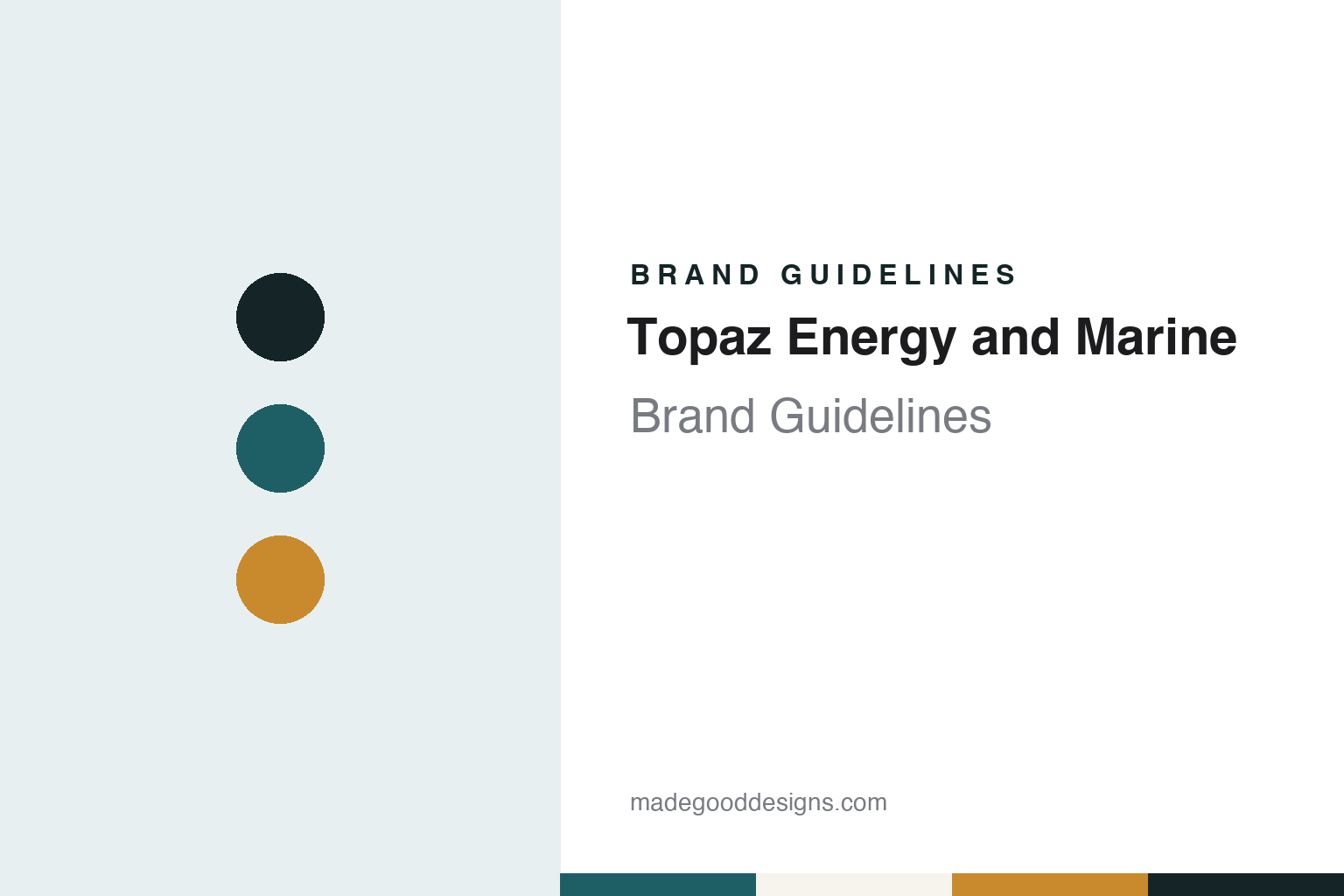
Topaz Energy and Marine Brand Guidelines
A Dubai supply-vessel owner built on the Caspian, then folded into DP World.
Aa
Two constants: a teal, amber and sand palette and an engineering sans. Abstract homage — not a Topaz vessel, livery or mark; no logo, funnel or hull marking is reproduced.
Dubai and the Caspian
A Gulf supply-vessel owner with a Caspian base.
Topaz Energy and Marine was an offshore support vessel owner headquartered in Dubai. In November 2013 the company described itself, in a statement carried by the Azerbaijani news agency Trend, as headquartered in Dubai with 40 years of experience in the Middle East, operating a fleet of more than 90 offshore support vessels with an average age of seven years and serving energy companies with a main focus on the Middle East and the Caspian Sea.
For most of its modern history Topaz belonged to Renaissance Services, the group listed on the Muscat Securities Market in Oman. Proactive Investors reported in March 2011 that Topaz was then an indirect, wholly owned subsidiary of Renaissance, and that the Dubai-headquartered group was already a major operator in the Caspian and in the Middle East and North Africa region, with plans to expand and modernise its fleet and move into deeper-water work. By 2019, gCaptain reported, Renaissance shared ownership of Topaz with Standard Chartered Private Equity and Affirma Capital.
The Caspian became its signature region. Trend reported that Topaz had operated in the Caspian since buying BUE Marine in 2005. In 2013, it said, Topaz acquired two European-built platform supply vessels, each with dynamic positioning, for five-year BP contracts in Azerbaijan, which would take its fleet in Azerbaijani waters to 26 vessels. The two vessels were to support BP’s work at the Azeri-Chirag-Guneshli field block and the second phase of the Shah Deniz development, with deliveries in late 2013 and the second quarter of 2014.
The company traded under the full name and under the shorter Topaz Marine: in Saudi Arabia, for example, its fully owned subsidiary was Topaz Marine KSA.
Colour
Supply vessels, subsea ships and module carriers.
Topaz’s fleet moved during the 2010s from supply work into more specialised ships. In September 2015 the Norwegian shipbuilder Vard took its first order from Topaz: two offshore subsea construction vessels of the VARD 3 08 design, 98.1 metres long and 20 metres wide, built for crane work, light subsea construction and intervention, with a heave-compensated offshore crane, a moonpool and space for two remotely operated vehicles. They were to be delivered from Vard Brattvaag in Norway in 2017, with hulls built at Vard Tulcea in Romania and design by Vard Design in Ålesund, gCaptain reported. At that time gCaptain described the company’s focus as the Caspian, the Middle East and West Africa, with subsea operations in the North Sea and the Gulf of Mexico.
A larger order followed in May 2016: 15 module carriers, each 123 metres long and 16.5 metres wide, designed to carry deck loads of up to 1,800 tonnes of modules along shallow inland waterways to oilfields in Kazakhstan. Five were to be built at Vard Braila and four at Vard Tulcea in Romania, and six at Vard Vung Tau in Vietnam, for delivery between 2017 and 2018. Topaz was to operate them through a consortium led by Blue Water Shipping for the end client Tengizchevroil, gCaptain reported, and Vard said at the time that Topaz already ran three Vard-built vessels in the Caspian.
Topaz also trained local crews. In a sponsored article in Arab News in July 2017, its subsidiary Topaz Marine KSA said it had welcomed 25 graduates of the Faculty of Maritime Studies at King Abdulaziz University in Jeddah for two months of practical training on its vessels in Saudi Arabia, under an agreement with the faculty first signed in December 2014. After the training, the article said, the graduates could receive a Saudi seafarer’s certificate of competency.
Typography
How supply-vessel owners present themselves.
Offshore support vessel operators sell a service rather than a product, so their public face is the fleet itself. Their websites lead with photographs of platform supply vessels, anchor-handling tugs, fast crew boats and liftboats as the companies publish them, usually at sea or alongside a quay, with the working deck and the bridge in view.
Behind those photographs sits the fleet list. Operators sort their vessels by type, from supply vessels and anchor handlers to crew boats, liftboats and specialist ships, and give each class a short description, a named example and a length or deck size. Vessel names often run in families, such as a shared prefix, a family surname or a set of animal or place names, and those naming habits become part of how an operator is recognised in port and on charter lists.
Colour plays a similar role. Hull paint, superstructure colour and the mark on the funnel or the side of the bridge are what people see first from a distance, and many operators repeat the same few colours across a whole fleet. In this guide those colours are described in plain words rather than copied, and the palettes shown are our own interpretation.
The rest of an operator’s identity lives in plainer pages: contract and charter news, regional contact lists, sustainability reports and, for listed companies, investor pages with results and presentations. Ownership in the sector has changed often through mergers, restructurings and sales, so each guide sets out who owns the company today, what it says about its fleet, and which facts come from the company and which from independent reports.
Aa
A technical sans for vessel lists and contract notices. (Specimen set in IBM Plex Sans, a sans STAND-IN; NOT the Topaz logo.)
Into DP World
From Topaz to P&O Maritime Logistics to Maritime Solutions.
On 1 July 2019 gCaptain reported that the Dubai port operator DP World had acquired 100 percent of Topaz from Renaissance Services and its private-equity co-owners. At the time Topaz operated 117 offshore vessels, mainly in the Caspian Sea, the Middle East and North Africa, and West Africa, and DP World named its long-standing customers as including BP, Chevron, ExxonMobil and Tengizchevroil. DP World said the purchase complemented its P&O Maritime Services business, which then maintained more than 300 vessels, and pointed to the Caspian as a region of particular interest.
The Topaz name did not last long inside the new owner. English Wikipedia, citing Splash247 of 17 December 2019, says that after the acquisition Topaz and P&O Marine were merged to create P&O Maritime Logistics, a business that has since worked in offshore renewables as well as oil and gas. On 9 December 2025 DP World announced that P&O Maritime Logistics would become Maritime Solutions, one of three marine services businesses — with Shipping Solutions, formerly Unifeeder, and Multimodal Solutions, formerly P&O Ferrymasters — brought under the single DP World brand. It said Maritime Solutions manages a fleet of more than 400 vessels, and that the legacy names would move to the DP World identity across digital, physical and customer touchpoints over the following months, with the same leadership and teams in place.
Topaz Energy and Marine therefore no longer trades under its own name. Its fleet and staff passed into P&O Maritime Logistics after 2019, and that business has operated as DP World’s Maritime Solutions since the December 2025 announcement. The former Topaz web address now forwards to DP World’s Maritime Solutions pages, which describe offshore energy, renewable-project, port and specialised logistics work.
For a design guide, Topaz Energy and Marine shows a regional fleet brand absorbed in two steps by a larger group, first into a combined marine name and then into the parent’s own identity. Compare Gulf Marine Services, another Gulf-based offshore vessel company, and Tidewater. For this guide we use a teal, an amber and a sand with a sans, an unofficial interpretation; no product or logo is reproduced.
Explore & save
Keep Topaz Energy and Marine’s identity on hand — save it to a board in the Made Good inspiration library.
Topaz Energy and Marine identity set
Pin the Topaz teal, amber and sand palette and the engineering sans to your own board.