Direct Rail Services Brand Guidelines
The nuclear industry’s rail arm that learned to carry supermarket freight.
Aa
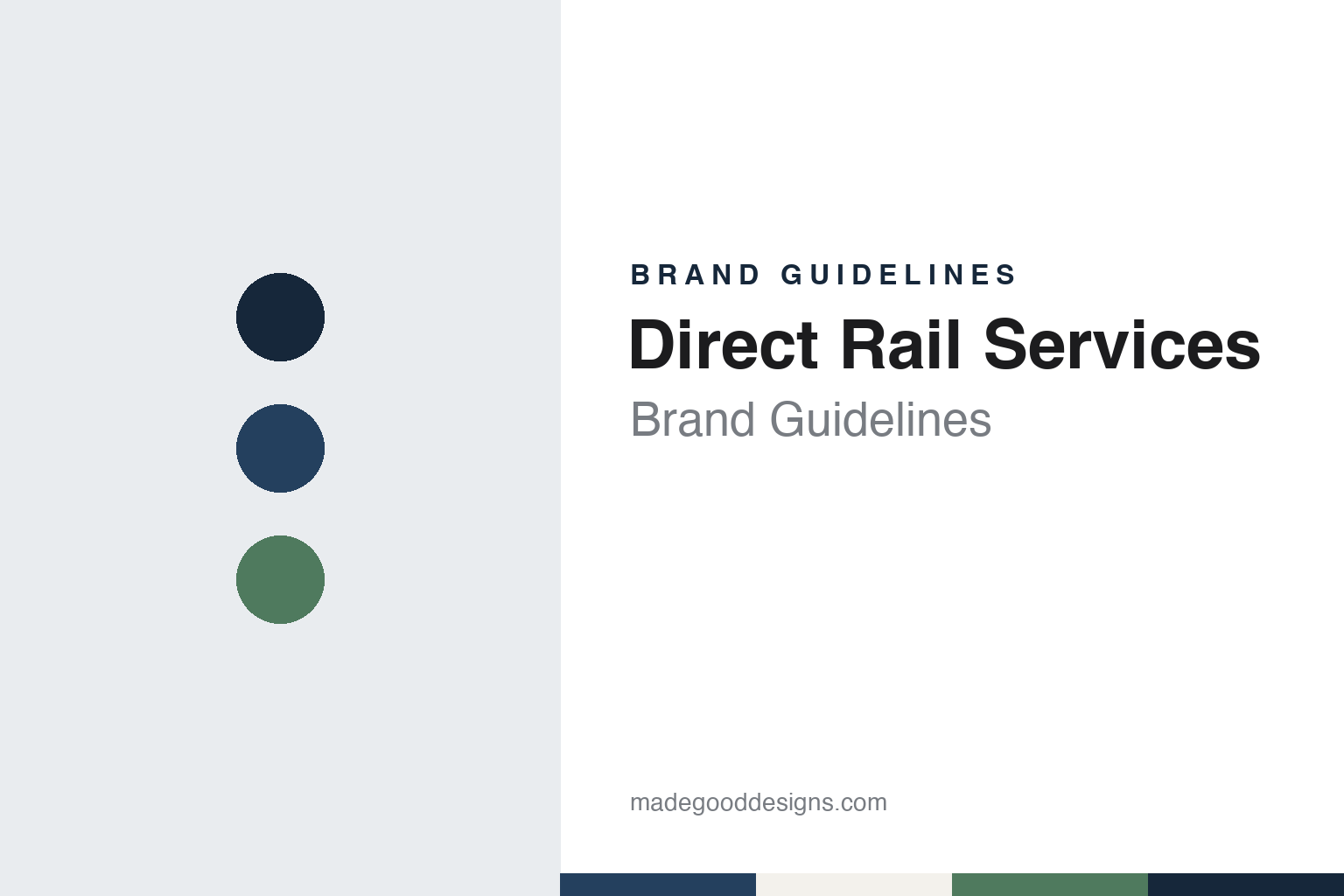
Two constants: a deep blue, fell green and slate palette and an industrial sans register. Abstract homage — not a Direct Rail Services asset; no locomotive, livery, logo or mark is reproduced.
BNFL’s rail arm
A nuclear fuel company takes its trains in-house.
Direct Rail Services, usually shortened to DRS, is a rail freight company with its head office in Carlisle, in Cumbria. English Wikipedia says it was created as a wholly owned subsidiary of British Nuclear Fuels Ltd (BNFL) in late 1994, and gives February 1995 as the start of its operations, citing the company register; the company itself says it was established in 1995 as lead supplier of rail transport and associated services to the nuclear industry.
The trigger was the privatisation of British Rail. BNFL had long relied on British Rail to haul its nuclear flask traffic, and as British Rail was broken up it announced in October 1994 that it would run rail transport itself, according to Wikipedia, which cites Rail magazine of 26 October 1994. The new company started with a small fleet of five Class 20 diesel locomotives, overhauled for the work at Brush Traction in Loughborough.
At first its nuclear work covered fuel arriving from overseas for processing at Sellafield. In 1998, Wikipedia says, DRS took over the movement of fuel from nuclear power stations across Britain, from Heysham and Hunterston in the north to Dungeness and Sizewell in the south. The same year it left its first base at Sellafield and moved into Carlisle Kingmoor depot, which had stood disused since 1987. A second depot opened at Crewe Gresty Bridge in March 2007, on the site of a former wagon works, and the company also works from Motherwell.
Ownership has followed the nuclear industry. When the Nuclear Decommissioning Authority (NDA) was created on 1 April 2005 under the Energy Act 2004, DRS passed from BNFL to the new body. In February 2020 the NDA announced that it would bring its transport and logistics subsidiaries together in one division, and in April 2021 DRS, International Nuclear Services and Pacific Nuclear Transport Ltd were grouped as Nuclear Transport Solutions (NTS), according to NDA announcements published on gov.uk. DRS describes itself today as a wholly owned subsidiary of the NDA, operated by NTS.
Colour
From milk trains to supermarket containers.
DRS began to look beyond nuclear work within a few years. In 1997 it won a contract to haul milk traffic from Penrith to Cricklewood, and in 2002 it began running intermodal container trains from Grangemouth to the Daventry International Rail Freight Terminal, carrying containers for the Malcolm Group and Asda, English Wikipedia says. In May 2020 it launched an electrified freight route between Daventry and Mossend Yard, outside Glasgow.
Its longest customer relationship in that market is with Tesco. In 2006 DRS started the “Tesco Express” on behalf of the Eddie Stobart Group, moving containers from Daventry to Mossend and Inverness behind a Class 66 locomotive in Stobart colours, Wikipedia says; that contract moved to DB Schenker in January 2010 and came back to DRS in the summer of 2011. In January 2022 DRS and Tesco signed a three-year extension, when the company was moving roughly 12,000 Tesco containers a month. In September 2026 the two marked 20 years of working together: DRS says it now runs up to ten services a day for the retailer, and on 22 September it named its Class 88 locomotive 88010 Tesco 20 years of rail freight at Tesco’s Daventry terminal.
The company has also run passenger trains. Wikipedia lists locomotives for the luxury Northern Belle charter train from 2011, Class 68s hauling Chiltern Railways services out of London Marylebone from December 2014, and loco-hauled trains on the Cumbrian Coast Line between 2015 and 2018. DRS also supports Network Rail’s infrastructure trains and offers maintenance for other operators at its depots in Carlisle, Crewe, Motherwell and Sellafield, the company says.
Recognition has come from the rail trade. A June 2021 NDA announcement said DRS had won its eighth successive Golden Whistle award, given by the Institute of Railway Operators with Modern Railways on the basis of operating statistics. The company lists the Freight and Logistics Achievement of the Year award at the National Rail Awards in 2022, and again in 2026 with Tesco.
Typography
Design and documentation.
Rail freight operators sell a service that most people only glimpse from a level crossing or a station platform, so their identities lean heavily on the one thing everyone does see: the locomotive. Liveries, fleet numbers and named engines carry the brand across a whole network, and operators publish photographs of their fleets on their websites, in press releases and on social channels. A repaint for a customer, a partner or an anniversary is usually announced as news in its own right.
The second visual constant is the map. Operators that sell regular routes tend to show them as network diagrams, with ports, terminals and inland hubs joined by lines, much like a passenger timetable. Those that run trains to order describe their work in service categories instead, such as intermodal container trains, block trains for bulk goods, single wagonload and first- and last-mile shunting, and the wording on those pages is the company’s own description of what it offers.
Fleet pages are a genre of their own. Many operators list their locomotive classes with build dates, power systems and the routes they work, and new orders are presented as milestones, often with the builder and the leasing company named alongside. Numbers on these pages, from staff and trainloads to tonnage and market share, are figures the companies give about themselves at a particular date, and they change from year to year.
Sustainability pages have become standard across the sector. They usually set out targets, partnerships and new traction such as electric, bi-mode or biofuel locomotives, each tied to a dated announcement. In the guides that follow, those pages are treated as statements of what each company says it is doing and when, alongside its ownership history and the names it has traded under.
Aa
An industrial sans for a freight railway. (Specimen set in Barlow, a sans STAND-IN; NOT the Direct Rail Services logo.)
Direct Rail Services
Class 20s to Class 88s.
The fleet tells the company’s story in locomotive classes. After its first Class 20s, DRS bought six Class 37s from Eurostar in 1997 and built up fleets of Class 37, 47 and 57 locomotives from several sources, English Wikipedia says. On 12 September 2013 it was announced as launch customer for Vossloh España’s Euro Dual dual-mode locomotive, which became the Class 88; the diesel-only Class 68, a sister design, arrived first, from February 2014. DRS says its Class 88 entered service in 2017, developed with Stadler in Valencia, and that it was the first rail freight operator in the UK to introduce a mainline bi-mode locomotive that can run from overhead wires.
Older stock has since been sold. Wikipedia records disposals of Class 20s, 37s and 47s and Mark 2 coaches from 2016, Class 66s passing to GB Railfreight at the end of 2022 and the sale of the last Class 57s in 2026. Its fleet table lists 19 Class 66s in use with DRS in 2024, 20 Class 68s in 2026 and ten Class 88s. The company says it employs more than 480 people and works from over 20 locations across Great Britain.
For a design guide, Direct Rail Services shows how a carrier set up for one specialist industry can take a plain, descriptive name into supermarket, infrastructure and passenger work. Compare GB Railfreight, another British freight operator, and Genesee & Wyoming, a railroad group from the United States. For this guide we use a deep deep blue, a fell green and a slate grey with a sans, an unofficial interpretation; no product or logo is reproduced.
Explore & save
Keep Direct Rail Services’s identity on hand — save it to a board in the Made Good inspiration library.
Direct Rail Services identity set
Pin the Direct Rail Services deep blue, fell green and slate palette and the industrial sans register to your own board.