Staffmark Brand Guidelines
One name for a staffing network, built around the word heart.
Aa
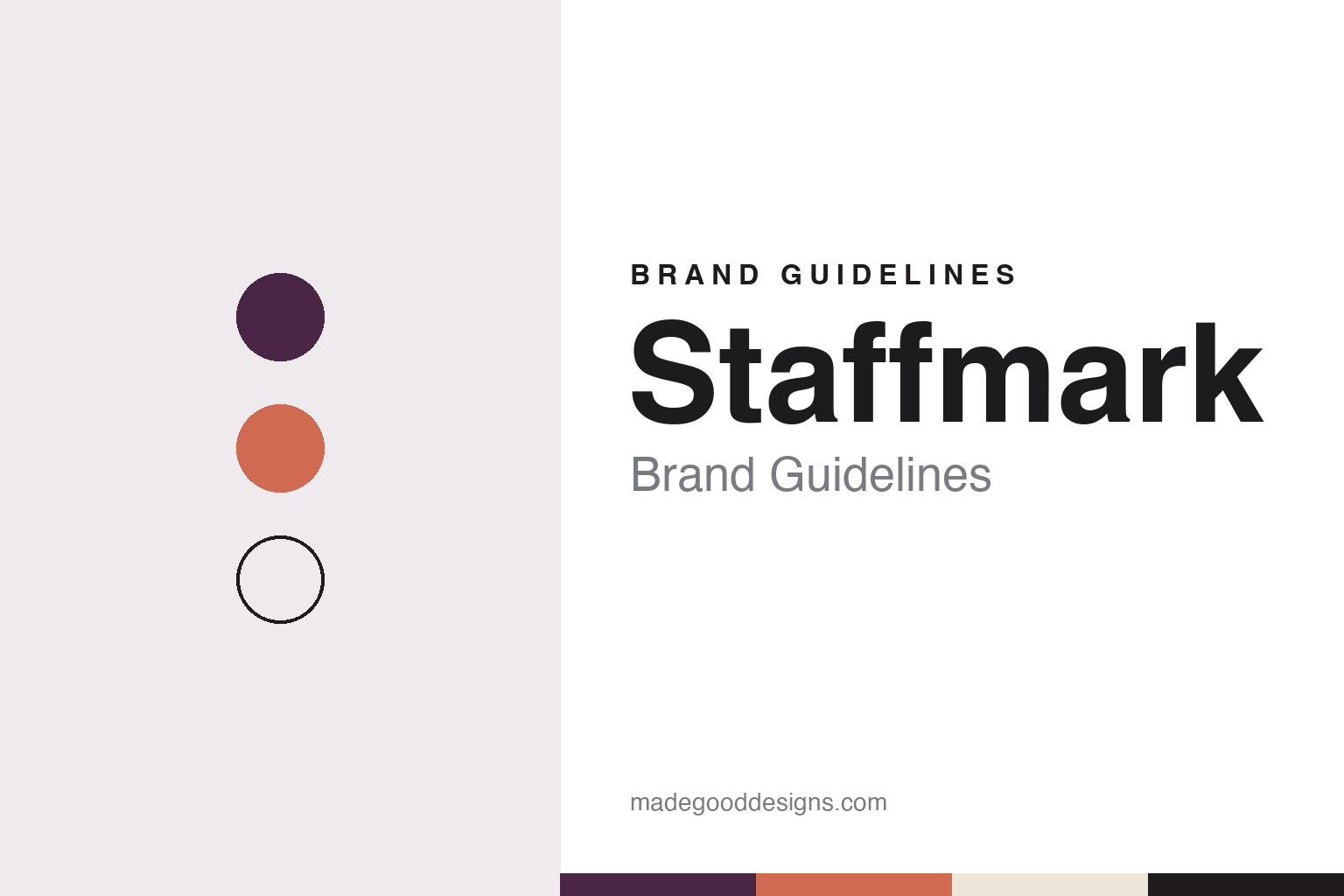
Two constants: a plum, coral and sand palette and a rounded geometric sans register. Abstract homage — not a Staffmark asset; no logo, icon or brand mark is reproduced.
Staffmark Group
A Cincinnati staffing group inside Recruit.
Staffmark is the main brand of Staffmark Group, a staffing business headquartered in Cincinnati, Ohio, and owned by Japan’s Recruit. The group dates its story to 1969: its website says that “since 1969” it has been “defying norms” in the staffing trade, and its April 2025 announcement described more than 55 years of staffing work. It calls itself one of the largest staffing companies in the United States, a claim it makes in its own press releases.
Ownership places Staffmark inside a much larger network. Staffmark Group describes itself as part of RGF Staffing, the network of HR service providers within Recruit Holdings, the Tokyo group that also owns the job site Indeed. Staffing Industry Analysts (SIA), the staffing trade research firm, described Staffmark as “a division of Recruit” in April 2025 and ranked Recruit as the 19th-largest staffing firm in the United States. Recruit’s own history page records how its staffing arm grew through acquisitions: the US staffing company The CSI Companies, Peoplebank Australia and Chandler Macleod in Australia in 2015, and the European group USG People, now RGF Staffing B.V., in 2016.
The group itself is a cluster of names. Its website lists Staffmark alongside Advantage Technical, Employee Management Services, Hunter Hamilton and Digital People, covering commercial staffing, IT and engineering, and professional services. It says it runs more than 300 branches and 250 on-site locations and places more than 125,000 people a year. Its April 2025 press release gave higher figures, more than 400 branches and 175,000 placements a year, so the counts differ with the date and the page.
Colour
A new look, then one name.
The most visible change came in 2025. SIA reported that in January 2025 Staffmark launched a new website, logo and brand identity, together with new marketing material. Three months later, on 3 April 2025, the company announced that two of its other staffing brands, Advantage Resourcing and Pro Staff, had moved to the Staffmark name. SIA reported that those two brands made up about a fifth of the company’s physical offices, that they were already operating as Staffmark, and that office signage was being changed on a rolling basis. After the merger Staffmark counted about 400 locations in 38 states, according to both the company and SIA.
The reasoning was set out in plain business terms. Staffmark’s marketing chief told SIA that the merged brands offered services similar to Staffmark’s and that a single name would let the company concentrate its effort on one brand, adding that there was an advantage in telling the company’s story through a simpler brand strategy. She also described the research behind the refresh: focus groups linked the Staffmark name with creative problem solving, with delivering with heart and authenticity, and with the confidence to be bold and different.
The company’s own release called the move “more than a name change” and said updated branding, signage and digital tools would roll out over the following months. Its chief executive said in the release that uniting under the nationally recognised Staffmark name, and investing in recruiting technology, would widen access to talent and make hiring faster for employers and job seekers alike. It framed the merger around technology as much as appearance, promising AI-driven matching of workers to jobs and a national talent network. For the people who see the brand most, job seekers walking into a branch or opening the website, the result was one name and one look where there had been three.
Typography
How staffing firms present themselves.
Executive search and staffing firms sell judgement about people, so their public material leans on people too. Spencer Stuart’s website points visitors to a directory where they can find an expert and to a list of global locations, while Egon Zehnder’s invites them to meet its consultants and find its offices. Consultant profiles and office pages, rather than products, carry most of the visual weight, and the photography on them is whatever each firm chooses to publish.
Candidate-facing design is one of the points this guide compares across the category: the job boards and application portals of staffing companies on one side, and on the other the careers pages, alumni network and client log-in that Spencer Stuart lists in its own site menus. Each site is described as the company presents it, without judging how well it works.
Thought leadership supplies much of the category’s printed and digital output. Spencer Stuart says it published its first US Board Index in 1987 and now produces more than 20 Board Indexes a year, and in October 2026 it released a survey of more than 1,400 board chairs, directors and CEOs. Egon Zehnder publishes CEO studies, a podcast and HBR Executive, a partnership with Harvard Business Review. Report covers, chart styles and survey branding therefore do much of the work that packaging does in consumer categories.
Ownership is part of the story, and each firm states it differently. Spencer Stuart says its founder offered his whole shareholding to a group of employees in 1974, and German Wikipedia says Egon Zehnder’s international partners own that firm in equal stakes. For listed staffing groups, investor and stock-listing pages form a further part of the corporate presentation this guide looks at. This guide sets out who founded each firm, who owns it and what it says about itself, and marks clearly what rests only on the company’s own word.
Aa
A rounded geometric sans for a brand built on warm, plain words. (Specimen set in Outfit, a sans STAND-IN; NOT the Staffmark logo.)
Staffmark
The heart between people and jobs.
Staffmark’s words do much of its identity work. The group describes its purpose as being “the heart between people and jobs,” its story page carries the headline “Coloring Outside the Lines,” and Staffmark’s own site sets out three values: people come first, heart drives purpose, and jobs ignite potential. The services pages separate job seekers from employers and run from on-site workforce management and driver staffing to manufacturing and logistics, administrative and call-centre staffing, and technical and professional recruiting.
The same theme carries into the group’s research and campaigns. In September 2026 Staffmark Group published what it called its first annual Heart of Work Index, a survey of 3,746 workers across eight industries, which sorted respondents into four hiring personas with names such as the “Face Timer” and the “AI Autopilot.” The company says the survey found that most workers still want a person guiding them at the stages of hiring that matter most to them, and its chief executive summed it up as wanting a person in their corner rather than a chatbot. On the index’s scale, where 0 stands for an all-digital hiring experience and 100 for an all-human one, the company says workers’ preferred experience scored 71, and that 70% wanted human-led support in the anxious stretch between applying and being interviewed. The index borrows its name from the brand’s central word, heart.
For a design guide, Staffmark shows how a staffing group can fold regional names into one national brand and build its tone around a single warm word. Compare Recruit Holdings, the Tokyo group that owns it, and TrueBlue, an American staffing group that keeps its brands separate under one parent name. For this guide we use a deep plum, a warm coral and a sand neutral with a sans, an unofficial interpretation; no product or logo is reproduced.
Explore & save
Keep Staffmark’s identity on hand — save it to a board in the Made Good inspiration library.
Staffmark identity set
Pin the Staffmark plum, coral and sand palette and the rounded geometric sans register to your own board.