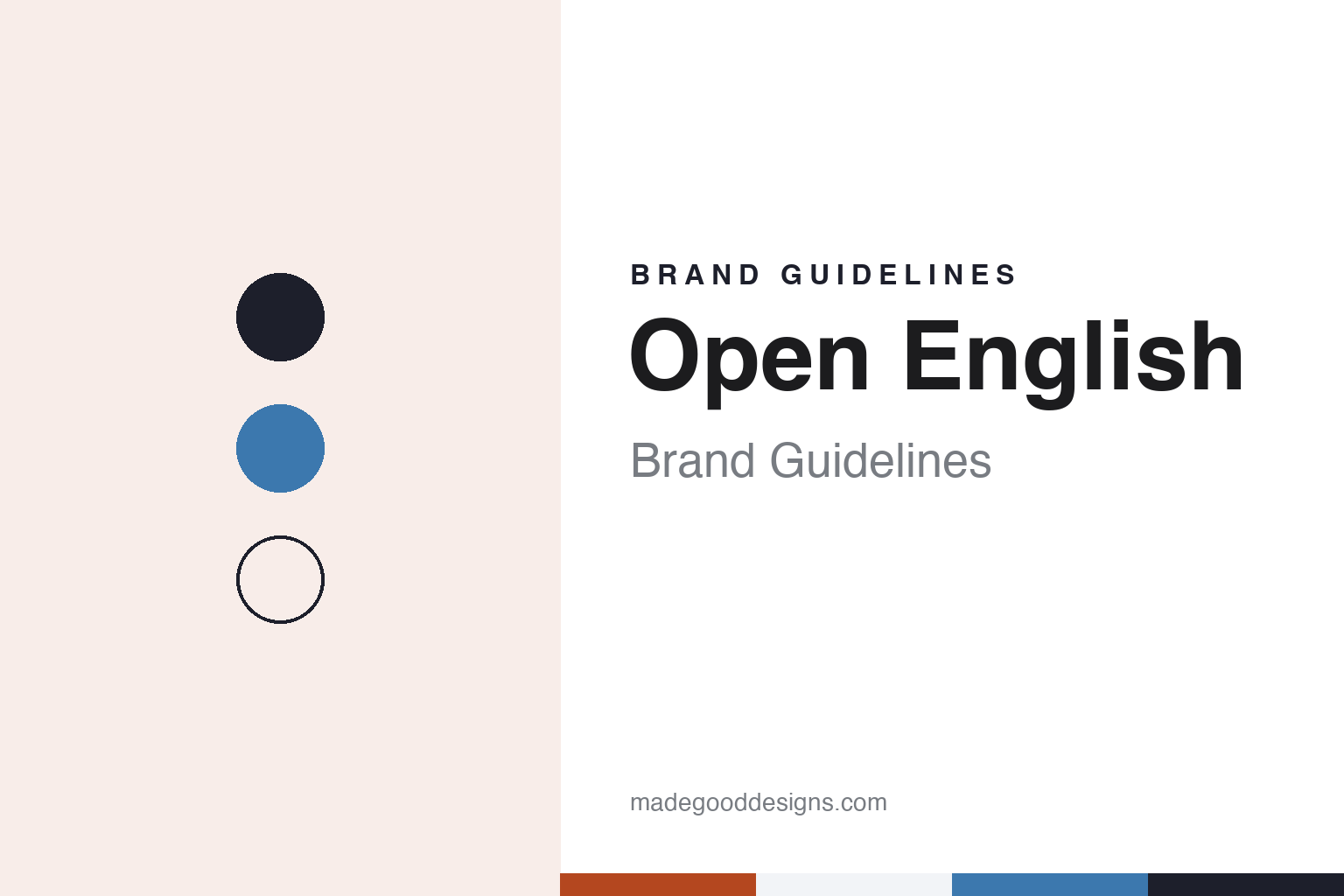
Open English Brand Guidelines
A Caracas start-up, live online classes and a Miami base.
Aa
Two constants: an ember orange, night ink and lesson blue palette and a rounded sans register. Abstract homage — not an Open English product or mark; no logo or app screen is reproduced.
Caracas
From a classroom school to an online one.
Open English started in Caracas, Venezuela. English Wikipedia gives its founding year as 2006 and its founders as Andrés Moreno, Nicolette Rankin and Wilmer Sarmiento. ABC News, in a June 2013 profile, described Moreno and his friend Sarmiento launching the business about eight years earlier, and said Moreno had earlier run a conventional English school in Caracas, flying recent US college graduates to Venezuela to teach company executives. Deciding that model could not grow, the team switched to teaching entirely online, ABC News said.
BBC Mundo, in an October 2017 interview, gave Moreno’s account of the early years: the business began in a small apartment in Caracas with about fifteen programmers, mostly friends, and tried several models, among them free content paid for by advertising and a classroom school, before settling on online courses in 2007, when the technology for connecting people by screen had spread. Short of local funding, Moreno went to California to look for investors, both reports say, and angel investors there backed an early version of the site, according to ABC News.
In 2009 Open English moved its headquarters to Miami, Florida, English Wikipedia says. ABC News visited the company’s offices in Coral Gables, in the Miami area, for its 2013 profile, and BBC Mundo listed offices in Miami, Bogotá, São Paulo, Caracas and Buenos Aires in 2017.
Colour
Live classes on a screen and a founder in the adverts.
The core product is a live English class taught online. English Wikipedia describes classes with native-speaking teachers available around the clock, aimed mainly at learners in Latin America and Hispanic Americans in the United States. In 2017 BBC Mundo called Open English the largest online English course company in Latin America and said it had reached close to 500,000 customers in ten years; English Wikipedia puts total enrolment at more than 2 million students.
Much of the brand’s public image came from television. BBC Mundo described simple, light-hearted commercials in which Moreno himself was the face of the brand, and ABC News reported in 2013 that Nicolette, then the company’s chief product officer, played a character called “Jenny” in its quirky, home-made adverts. BBC Mundo said Moreno became known across Latin America through those commercials. The same interview noted that some customers had criticised the company’s automatic renewal clauses, under which the monthly charge continued unless a student cancelled.
The range widened over time. BBC Mundo reported in 2017 that Moreno had set up Next University, an online school for digital skills such as web development, mobile apps, e-commerce and digital marketing, which Moreno said had more than 30,000 students, and in 2015 a holding company, Open Education, for the group’s online education businesses, and that Open English Junior had launched in Bogotá for children aged 7 to 14. English Wikipedia adds Open English Business, for company training, and says the platform tailors lessons to each student, and Open Mundo, with live classes in French, Italian, Spanish and Portuguese.
The school won the e-learning category of the International E-Learning Awards in 2011, according to the International E-Learning Association’s list of past winners; the awards were presented in Piešťany, Slovakia, on 22 September 2011. English Wikipedia lists two further recognitions from the same year, the David Riley Award for Innovation in Business English and an Education Software Review award, and notes coverage of the company in TechCrunch, the Miami Herald and Colombian business press.
Typography
How language schools present themselves.
Language schools sell something that is hard to photograph: progress in a language. Their websites tend to show the setting instead. ELS, for example, describes its centres as sitting on American college campuses and points to shared lounges, cafeterias and computer labs, while inlingua’s international site sorts its courses for adults, companies and children and names the local centre, such as inlingua Berlin or inlingua Utah, beside each student quote.
Course and level names do much of the identity work. The Common European Framework of Reference for Languages offers a shared scale of six levels, from A1 to C2, and inlingua organises its own course books by those codes. Others number their own ladders: ELS teaches in 12 class levels and says more than 600 colleges recognise its level 109 or 112.
Much of the booking and some of the teaching happen online. Schools such as inlingua and ELS carry placement tests, application pages and branded learning platforms on their sites: inlingua runs a family of “my.” products for e-learning and virtual classrooms, and ELS offers a free online English test and a WhatsApp chat with admissions staff.
Owners, networks and accreditations appear on the schools’ corporate pages. inlingua licenses its name to independently owned centres, a franchise model the Swiss newspaper 20 Minuten described in 2024. ELS names its accreditation by ACCET, and since 2022 has belonged with ILSC and Berlitz to Language Education Holdings, The PIE News reported. This guide sets out what can be checked about each brand, and marks clearly what rests on the company’s own word.
Aa
A rounded sans suited to a friendly online school. (Specimen set in Nunito Sans, a sans STAND-IN; NOT the Open English logo.)
Open English
Turkey, India and more than 30 countries.
From its Latin American base Open English moved into new regions through acquisitions. In November 2021 the Turkish newspaper Habertürk reported that it had bought English Ninjas, a Turkish start-up that had offered speaking-focused online English lessons for more than five years, and that Open English then worked in more than 30 countries; the newspaper described the deal as the start of the company’s growth in the Turkish market. English Wikipedia describes the purchase as the base for a presence in Turkey and the wider Middle East. English Wikipedia lists a further purchase, of the Indian mobile learning app Enguru, in September 2022, and gives offices in Mexico City, Bogotá, Buenos Aires, Istanbul, Bangalore and São Paulo, as well as in Vietnam, alongside the Miami headquarters.
Figures on size come from press reports and English Wikipedia. ABC News reported about 2,000 employees in 2013, and described a company culture it compared with large technology firms, down to the hiring of a “Director of Happiness” to look after staff. English Wikipedia says Open English has more than 2,000 corporate clients and a network of more than 2,000 native English-speaking teachers, and that it has enrolled more than 2 million students since it began. The same source says the company has worked on scholarship and course-donation projects, among them a 2023 partnership with the Brazilian footballer Richarlison to give English courses to young people in Brazil. Through all of this the product described in 2013 and 2017 is the same one: live lessons with a teacher on a screen, sold to adults, children and employers.
For a design guide, Open English shows how an online school can build recognition through television adverts and a founder on screen, with a plain, descriptive name. Compare Wall Street English, another English-teaching brand for adults, and Duolingo, a language brand built online. For this guide we use ember orange, night ink and lesson blue with a sans, an unofficial interpretation; no product or logo is reproduced.
Explore & save
Keep Open English’s identity on hand — save it to a board in the Made Good inspiration library.
Open English identity set
Pin the ember orange, night ink and lesson blue palette and the rounded sans register to your own board.