Eurest Brand Guidelines
A European joint venture that became Compass Group’s workplace catering name.
Aa
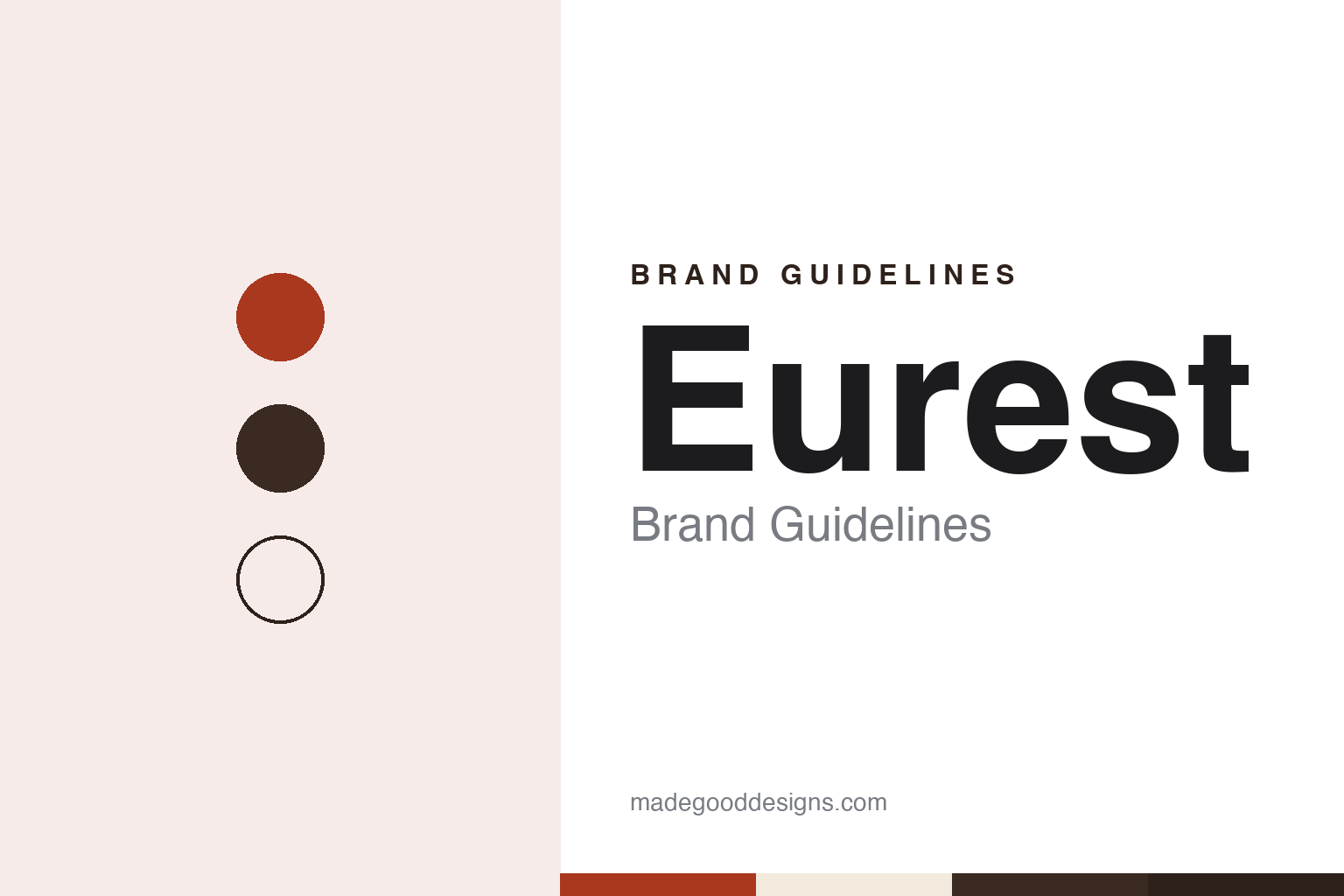
Two constants: a tomato red, espresso and oat palette and a sturdy grotesque register. Abstract homage — not a Eurest product or mark; no logo, menu or packaging is reproduced.
Europäische Restaurations
A joint venture, then Accor, then Compass.
Eurest is the workplace catering brand of Compass Group, the British contract caterer, and it is used in several countries for staff restaurants, coffee bars, vending and on-site catering. Its roots are continental rather than British. German Wikipedia says the German company was founded in 1974 as Europäische Restaurations GmbH Eurest Deutschland by Nestlé and Wagons-Lits; the short form, Eurest, is the name that survives.
German Wikipedia also traces its growth. After ten years Eurest Deutschland had 1,500 staff and 111 clients. The French Accor group took over Eurest in 1991, and staff numbers then rose to more than 5,300; by 2005, under Compass, the German company employed more than 9,000 people. On 1 October 2006 HSG Höchst Service Gastronomie of Frankfurt, which Eurest had owned outright since 1 January 2001, was merged into Eurest Deutschland, which is based at Eschborn, in Hesse.
Compass bought the business in September 1995. Its own history describes the purchase of Eurest International from Accor as the deal that took Compass into mainland Europe, and says Accor had reach into 45 countries. French Wikipedia adds that Compass bought Eurest France in 1996, and lists Eurest as the group’s brand for business and industry clients, alongside names such as Restaurant Associates for fine dining and Chartwells for education.
English Wikipedia says Eurest was launched in the United States in 1996 to provide dining services to local, regional and national companies, including employee dining centres, on-site catering, vending and executive dining. The brand therefore reached America through its British owner, not through its European founders.
Colour
National businesses under one name.
Today Eurest runs as a set of national businesses inside Compass rather than as one global company. French Wikipedia lists subsidiaries carrying the name in Germany, as Eurest Deutschland GmbH and Eurest Services GmbH, in Spain, as Eurest Colectividades, and in the Netherlands, as Eurest Services BV. In Germany, German Wikipedia says, the company runs more than 80 coffee bars and 400 staff restaurants, figures it gives as the company’s own.
In Britain, Eurest presents itself as a workplace contract caterer. Its website groups its services into corporate and office catering, industry catering, coffee and café services, and vending and micromarkets, and it names in-house concepts such as Crafted Deli Bar and Cook & Granger, alongside weekly themes called Wellness Wednesday and Eco Thursday. It lists awards as part of its own record, including an Operations Director of the Year title at the Contract Catering Awards and a CSER award at the Foodservice Cateys, and it runs its own Street Food and Chef of the Year competitions for its kitchen teams. On sourcing, the British site says Eurest knows where its ingredients come from and how they are grown, raised and made, and that it works with UK producers; that is the company’s own account of its supply chain.
In the United States, Daily Coffee News reported in January 2025 that Eurest USA, based in Charlotte, North Carolina, had launched a coffee brand of its own, Direct Coffee Roasters, developed with the Texas-based coffee supplier Farmer Brothers. The line started with 11 blends from light to dark roast, including flavoured coffees, cold brew and decaf, and had been introduced at 75 locations, according to Eurest USA. The company continued to run a separate coffee bar division serving coffees from other national, regional and local roasters, the publication said. Some products in the line carry third-party certifications such as Rainforest Alliance or USDA Organic, it reported, and the line supports Farmer Brothers’ D.I.R.E.C.T. sourcing initiative, which the supplier says is meant to build long-term relationships with green coffee producers.
Typography
Design and documentation.
Contract caterers sell a service that happens inside someone else’s building, so their brands have to work in two places at once: on the corporate pages where owners and clients read about them, and on the counters, menus and uniforms that guests see. Most of their public material shows food and venues rather than the company itself. Delaware North’s history page, for example, tells its story as a slide show of dated photographs, and Levy’s press room is a run of venue announcements.
Large groups split that work into sectors. Compass Group says it organises its business by market, a model it calls “sectorisation,” delivered through a portfolio of brands; its sectors include business and industry, healthcare and senior living, education, and sports and leisure. In that model a workplace canteen, a school kitchen and a stadium concourse can each carry a different name, even when one parent owns them all.
Some companies go the other way. In November 2014 Delaware North announced one global identity, dropped “Companies” and the DNC initials from its logo, and folded most of its operating units into a single name, keeping Sportservice as a named exception. Levy, owned by Compass since 2006, has instead added named units of its own, from E15 to Rank + Rally, each with its own launch year.
For a reader trying to understand these brands, the most useful sources are the companies’ own history and ownership pages, read alongside dated reporting. This guide gives founding dates, owners and contracts only as those sources state them, attributes each claim, and treats the visual identity described here as an unofficial interpretation rather than a reproduction of any company’s mark.
Aa
A sturdy grotesque for menus, coffee bars and signage. (Specimen set in Archivo, a sans STAND-IN; NOT the Eurest logo.)
Eurest
“Work hard. Break brilliantly.”
Eurest’s British voice is informal and direct. Its home page opens with “Fuelling people, properly,” and its About page argues that “the workplace break got broken,” before closing on “Work hard. Break brilliantly.” and “It’s time the break got the respect it deserves.” The copy is built around the break rather than the canteen: the break, the page says, “brings people together,” and the menu is framed as part of that.
That framing runs through the British site’s concept names. A deli bar, a home-baking theme and two weekday themes each carry a name of their own, so the brand speaks through several small labels rather than through the Eurest name alone. In the United States the coffee line does the same: Direct Coffee Roasters is a name in its own right, which Eurest USA places at drip-coffee stations and in its catering, according to Daily Coffee News.
The brand also shows how ownership can sit in the background. Eurest began with two continental partners, passed to Accor in 1991 and to Compass in 1995, yet the name stayed in use through each change, and Compass kept it as one of its sector brands instead of renaming the business. Its British website still sends cookie and policy questions to Compass Group UK, which is where the ownership shows.
For a design guide, Eurest shows how a name born in a European joint venture can become one sector brand inside a larger group while keeping a voice of its own in each market. Compare Compass Group, its owner since 1995, and Chartwells, the group’s education catering brand. For this guide we use a tomato red, an espresso brown and an oat cream with a sans, an unofficial interpretation; no product or logo is reproduced.
Explore & save
Keep Eurest’s identity on hand — save it to a board in the Made Good inspiration library.
Eurest identity set
Save the Eurest tomato red, espresso and oat palette and the sturdy grotesque register to your own board.