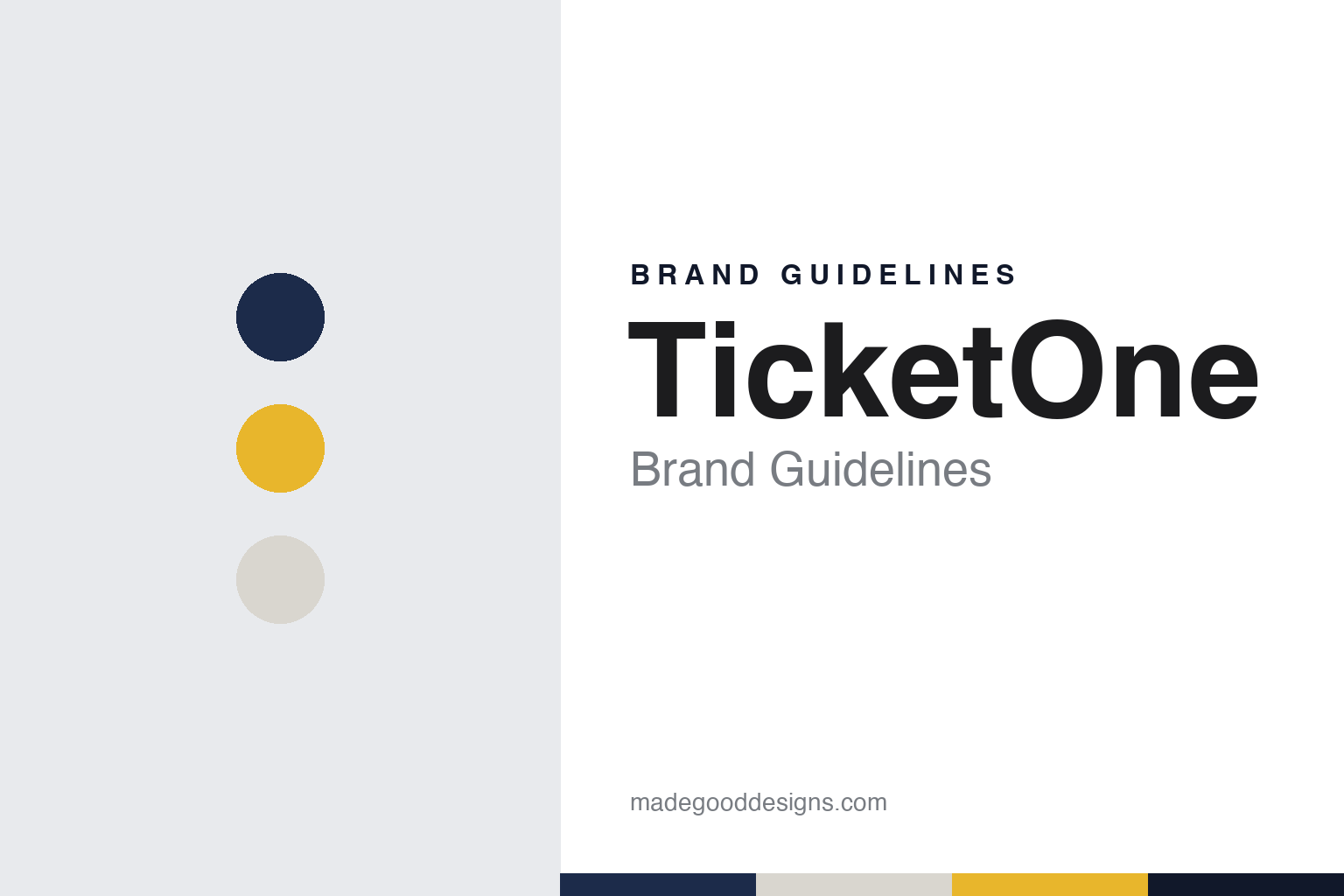
TicketOne Brand Guidelines
Milan’s online box office for concerts, stadiums and museums since 1998.
Aa
Two constants: a TicketOne ink blue, yellow and grey palette and a grotesque sans register. Abstract homage — not a TicketOne product or mark; no ticket, logo or screen is reproduced.
Milan, 1998
An early Italian online ticket seller.
TicketOne was founded in Milan in 1998, according to both Italian Wikipedia and a July 2026 profile in Il Sole 24 Ore. The business paper described it as the first Italian company to specialise in selling tickets through a digital platform, and as the leading Italian operator in its sector today. It sells tickets for concerts, sport, theatre and cultural events, and by the paper’s account the bulk of the Italian ticketing market for those events passes through it.
Since 2007 TicketOne has belonged to CTS Eventim, the German ticketing and live-entertainment group whose shares trade on the Frankfurt Stock Exchange. Italian Wikipedia gives 2007 as the year it joined the group, and Il Sole 24 Ore gives the same date; English Wikipedia’s list of CTS Eventim companies shows a holding of 99.7 per cent in TicketOne. The Milan company keeps its own Italian name and website inside the German group.
It is not large in head count. Il Sole 24 Ore put its staff at around 140 people across two Italian offices in 2026. Those staff sell millions of tickets each year through several channels: the official website, an app, a network of authorised sales points and, for some events, the telephone. For almost 30 years, the paper said, hundreds of event organisers have used TicketOne to manage their sales, planning marketing, presale schedules, pricing and special phases for fan clubs together with the company.
Colour
Concerts, stadiums, circuits and museums.
Music is the most visible part of the business. Il Sole 24 Ore said TicketOne works with all the leading Italian promoters, and named summer events such as Firenze Rocks, Rock in Roma, I-Days Milano and the Lucca Summer Festival among those whose tickets appear on its screens. For concerts with very high demand it runs a virtual queue that places buyers in a digital line so that its servers are not overloaded, then gives each buyer a limited time to finish a purchase before the chosen seats are released again.
Sport is the second pillar. The same report listed the Italian Tennis Federation and the Italian Rugby Federation among its clients, together with 23 football clubs across Serie A, Serie B and Lega Pro, and the circuits that host the Italian rounds of Formula 1, MotoGP and Superbike. Theatres, musicals, cabaret, family shows, exhibitions and museum circuits make up the rest, many of them handled through a subsidiary called TOSC. The wider group also invests in the venues themselves: Il Sole 24 Ore noted that CTS Eventim had recently acquired the Arena Santa Giulia in Milan.
Resale runs on a separate site. TicketOne points fans to FanSale, which Il Sole 24 Ore described as the official platform for reselling tickets at capped prices, and its managing director told the paper that the company keeps reporting unauthorised resale platforms and urges the public not to use them. Buyers can pay by card, PayPal, Klarna or Satispay, according to the same profile, and TicketOne collects the money from the public before passing it on to organisers.
Typography
How ticketing platforms present themselves.
Ticketing and event platforms sit between the people who put on events and the people who go to them, and their design has to serve both sides at once. Some are primary agents that sell on behalf of promoters, venues and festivals; others run resale marketplaces where fans and traders list tickets they already hold. Each kind presents itself differently, and each is worth reading on its own terms rather than as a single category.
The interface is where most of the brand lives. Event pages, seat maps, ticket wallets and checkout screens carry the name more often than any advertisement does, and the companies publish these flows in their own apps and help pages. In the United Kingdom, a 2018 court order secured by the Competition and Markets Authority required one resale site to show seat details, face value and the identity of the seller, so for resale brands some page elements are set by regulators as well as by designers.
Around the interface sit the smaller marks: app icons, short wordmarks and the photography used on event listings. Much of that photography belongs to artists, promoters and venues rather than to the platform, which means the platform’s own colours and type often act as a frame around other people’s posters, line-ups and stage shots.
Corporate pages tell a further story about owners and markets. Ticketing brands are often bought and sold, merged into larger live-entertainment groups or kept as separate names inside one company, and their about pages, trade-press announcements and regulator filings are the plainest record of who owns what, and where each name trades. The guides in this group read those records alongside each brand’s public identity; every palette shown is our own unofficial interpretation.
Aa
A compact grotesque for a busy national box office. (Specimen set in Archivo, a sans STAND-IN; NOT the TicketOne logo.)
TicketOne
A dominance case, and its annulment.
TicketOne’s place in Italian concert ticketing has also been tested by the competition authority. According to a February 2021 commentary by the law firm Bird & Bird, the Italian Competition Authority (AGCM) opened an investigation into TicketOne and its parent CTS Eventim in September 2018 under the EU rules on abuse of a dominant position. In a decision dated 22 December 2020 it found that the group had abused a dominant position in ticketing for pop and rock concerts, citing exclusive agreements with promoters and the group’s purchase of four national promoters, among them Friends & Partners and Vivo Concerti, and it imposed a fine. The remedies required the group to let competing ticket sellers sell at least 20 per cent of the tickets for pop and rock events on fair, reasonable and non-discriminatory terms, Bird & Bird said.
The decision did not stand. Bird & Bird reported in November 2022 that the regional administrative court of Lazio had annulled it, and that on 24 October 2022 the Consiglio di Stato, Italy’s highest administrative court, upheld the annulment. In that court’s view the authority had not examined closely enough the group’s argument that the acquisitions served a lawful purpose: offering artists one integrated service covering the organisation, promotion and ticketing of live events. The court linked those purchases to the arrival in Italy of the Live Nation and Ticketmaster group, which had begun selling tickets there after starting out in concert promotion.
Visually, TicketOne works in the register of a national box office rather than a boutique one. Its public face, as Il Sole 24 Ore described it, is a set of sales screens, a queue and an app that millions of Italians see when a stadium tour or a summer festival goes on sale.
For a design guide, TicketOne shows how a ticket seller can stay a local name for almost three decades while sitting inside a larger European group. Compare it with its parent’s Eventim guide and with See Tickets. For this guide we use an ink blue, a warm stub yellow and a stone-like piazza grey with a grotesque sans, an unofficial interpretation; no product or logo is reproduced.
Explore & save
Keep TicketOne’s identity on hand — save it to a board in the Made Good inspiration library.
TicketOne identity set
Pin the TicketOne ink blue, yellow and grey palette and the grotesque sans register to your own board.