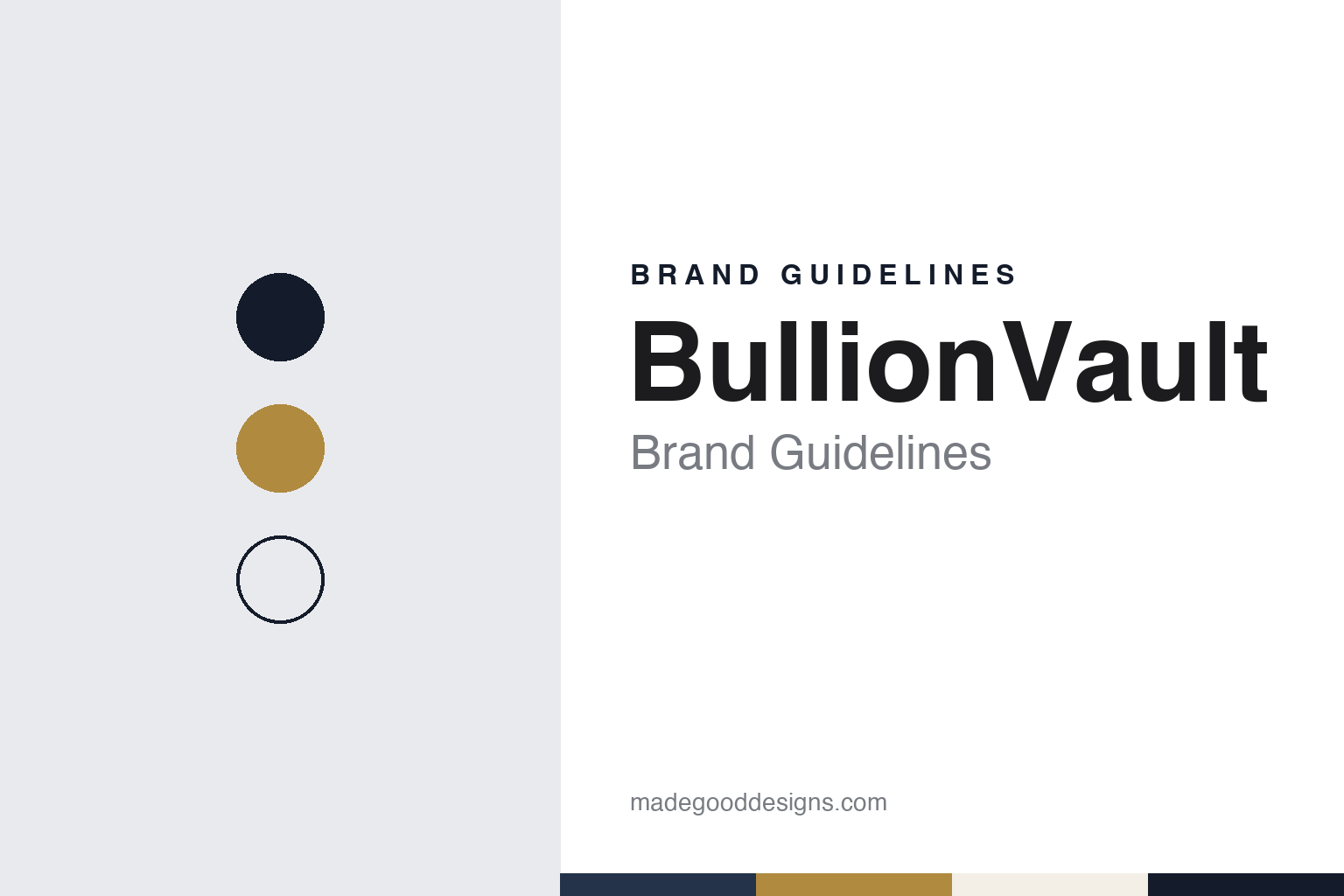
BullionVault Brand Guidelines
A London market that opened the professional bullion trade to private buyers.
Aa
Two constants: an ink blue, gold and parchment palette and a ledger serif register. Abstract homage — not a BullionVault product or mark; no bar, logo or screen is reproduced.
Galmarley
A software engineer who wanted a simpler way to buy gold.
BullionVault is an online market where private investors buy, sell and store physical gold, silver, platinum and palladium held as bars in professional vaults. The service belongs to Galmarley Ltd, a London company that the UK register Companies House lists as incorporated on 27 October 2003 and still active in November 2026.
BullionVault’s own company history says Galmarley was founded that October by the software engineer and entrepreneur Paul Tustain, who had been unable to find a simple, low-cost way to buy gold for his own savings. After two years of research, the company says, he hired two young software engineers to build the service, which opened in April 2005, and he ran the business as chief executive for its first decade.
Money raised when Galmarley was set up paid for the planning and the software, the company says; over the two years from March 2005 the business raised further equity, which it put into gold bars and currency to give it the stock it needed to operate. It says it has traded profitably every year since it opened, and it lists four sources of income: commission on trades, custody fees for stored metal, interest receipts and the “trading turn,” the gap between buying and selling prices.
The company name has its own story. BullionVault explains “Galmarley” as a tribute to three writers on money whose names it blends: the twentieth-century economist Galbraith; Del Mar, a nineteenth-century scholar of monetary history; and Smitley, a 1930s writer who ran a business bookshop on Wall Street and wrote about investor behaviour and what he called popular financial delusions.
Colour
Five vault cities and an open order board.
BullionVault presents itself as a way into the professional bullion market rather than a coin shop; its investor Augmentum describes it as “a physical gold and silver market for private investors online,” open to buyers across 175 countries. Its home page says bars are kept in professional-market vaults in Zurich, London, Toronto, Singapore and New York, and that each customer chooses where; Augmentum’s portfolio page lists the same five cities. Customers trade with each other on a live order board, can sell at any time and can withdraw their bars, the company says, and it publishes vault bar lists and its client bank statement as a “daily audit” that sits near the centre of its pitch.
The company says it was elected into the London Bullion Market Association on 1 September 2008, and its home page now calls it a full member. It joined the London Platinum and Palladium Market in January 2017, ahead of offering platinum in partnership with the World Platinum Investment Council, it says.
Recognition has come through the UK’s business awards. BullionVault says it has won the Queen’s Award for Enterprise three times: for innovation in April 2009, for its use of technology in bringing the professional bullion market to private customers, and for international trade in 2013 and again in 2022. It says it has more than 130,000 active customers in over 175 countries.
The website reads as much like a publisher as a shop. Alongside the order board it runs Gold News, with price news, market commentary, opinion and infographics, and a Gold Investor Index; it offers live price charts for each of the four metals, a cost calculator and a long gold guide. In 2015, the company says, it launched a sister business, WhiskyInvestDirect.
Typography
Bullion dealers, refiners and mints.
Bullion dealers, refiners and mints sell goods that are deliberately standardised: a one-ounce coin or a kilo bar is defined by its metal, weight and purity before any design choice is made. So their identities live in a narrow set of places — the way products are photographed, the marks struck into the metal, the shop interface and the pages that explain who owns whom.
Product photography in this category is usually plain and repetitive by design. Companies tend to show each coin or bar on its own against a light or neutral background, often obverse and reverse side by side, sometimes still in a sealed card or capsule, so that the buyer can read the design, the weight and the fineness at a glance. Special editions are told apart by small details, such as the privy marks that mints add to coins for a particular dealer or occasion.
On the metal itself, the hallmark does the branding. A refiner’s bar typically carries its maker’s mark, its weight, its fineness and a serial number, and minted bars are often sold in an assay card that repeats those details. Accreditation is part of the same language: English Wikipedia, for example, lists the Swiss refiner MKS PAMP on the London Bullion Market Association and London Platinum and Palladium Market Good Delivery lists.
Online, the price chart sits close to the logo. Gold.com, the owner of JM Bullion, runs a strip of gold, silver, platinum and palladium prices across the top of its corporate site, and JM Bullion has kept separate sites named for gold and silver prices. Corporate pages carry the rest of the story: Gold.com publishes a year-by-year timeline of its acquisitions, and Bullion International Group, the owner of APMEX, signs its site “An MKS PAMP GROUP Company,” linking a retail name to a refinery.
Aa
A ledger serif for a market built on published records. (Specimen set in Source Serif 4, a serif STAND-IN; NOT the BullionVault logo.)
BullionVault
Outside shareholders since 2010.
Outside investors arrived in 2010. On 17 June that year, the company says, the World Gold Council and Augmentum Capital each bought an 11.4% stake in Galmarley; Augmentum’s portfolio page lists BullionVault with “partners since 2010.” On 12 April 2016 the World Gold Council moved its holding to the Gold Bullion Investment Trust (GBIT), a connected organisation, and in March 2018 Augmentum Fintech plc took over the Augmentum Capital fund and, with it, the stake, BullionVault says. Its home page now describes the company as part-owned by GBIT and Augmentum Fintech.
Leadership changed in August 2016, when Robert Glynne, who had joined from the betting exchange Betfair in 2011 as chief operating officer, became chief executive and joined the Galmarley board, the company says. The website itself is run by a wholly owned subsidiary, BullionVault Ltd, set up under Galmarley, the company says. Galmarley keeps its offices in West London, where it says visitors can call in during office hours; the company says its computers are managed from there, with the live service hosted in the cloud and back-up systems in other countries, and that it publishes its most recent audited accounts online.
The home page leads with a headline offer and live prices for gold, silver, platinum and palladium, then a feed of latest trades and figures on clients and assets held, followed by the three Queen’s Awards and the LBMA membership. Product photography plays a smaller part than numbers, tables and charts.
For a design guide, BullionVault shows how a bullion business can build its identity around a trading screen and published records rather than a shopfront. Compare Goldmoney, another online precious-metals business in this series, and Kitco, a dealer that also runs a news service. For this guide we use an ink blue, a bullion gold and a pale parchment with a serif, an unofficial interpretation; no product or logo is reproduced.
Explore & save
Keep BullionVault’s identity on hand — save it to a board in the Made Good inspiration library.
BullionVault identity set
Pin the BullionVault ink blue, gold and parchment palette and the ledger serif register to your own board.