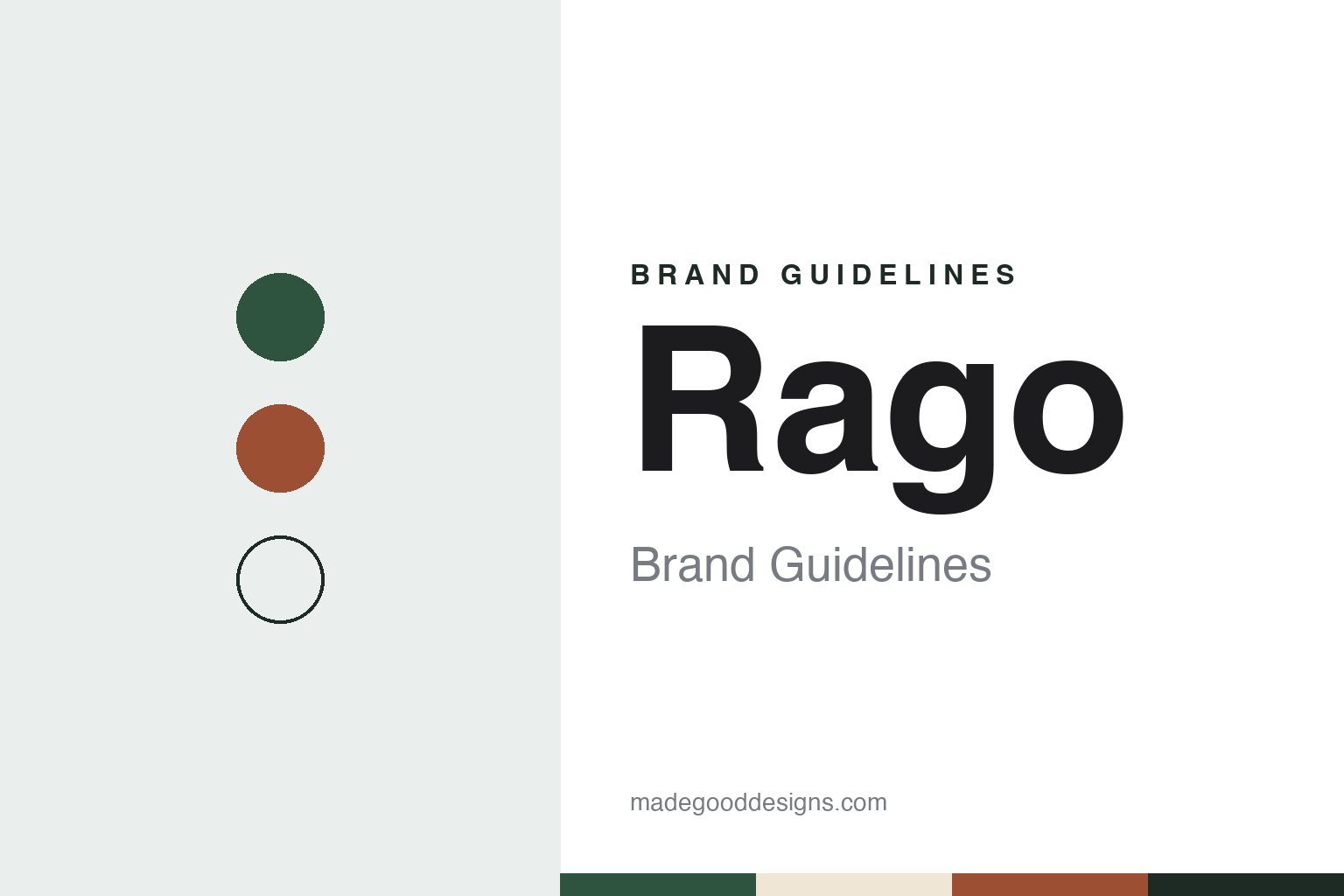
Rago Brand Guidelines
A pottery dealer’s auction house in Lambertville, New Jersey.
Aa
Two constants: a kiln green, clay and brick palette and a catalogue serif register. Abstract homage — not a Rago asset; no catalogue, logo or lot image is reproduced.
Lambertville
A ceramics dealer builds an auction house.
Rago is an auction house in Lambertville, New Jersey, built around the work of its founder, David Rago, a dealer in American decorative arts. The biography that PBS publishes for its series Antiques Roadshow names him as the founder of the Rago Arts and Auction Center, calls it “one of the country’s principal specialty auction houses,” and describes him as a specialist in American and European 20th-century decorative arts and furnishings and “a leading dealer” in American Arts and Crafts.
His route into the trade ran through pottery. The College of New Jersey, announcing in June 2022 that he had been elected to the board of its foundation, said he began dealing in American decorative ceramics at the age of 17, and described him as the owner of the Lambertville auction center. The same announcement said he had appeared on Antiques Roadshow since the programme began, which the college dated to 1996.
The PBS biography gives a sense of how much of the house’s identity rests on its founder’s writing. It credits him with more than 500 magazine and newspaper articles and five books, among them The Arts and Crafts Collector’s Guide and an official price guide to American Arts and Crafts published by Random House, and says he published two nationally distributed magazines: Style: 1900, on the Arts and Crafts period, and Modernism, on modernist design. It also says he holds 20 auctions a season at the Lambertville center.
The center has also hosted exhibitions. English Wikipedia says the painter Robert Beck showed “Lambertville Portfolio,” a series of 50 small paintings of the town, at the Rago Arts and Auction Center in 1998, and that its success led to two more annual exhibitions there.
Colour
Pottery, Arts and Crafts and modern design.
Rago’s specialities have been described in similar terms over the years. In an episode published in February 2019, the New Jersey public television programme State of the Arts described the Rago Arts and Auction Center as a national player specialising in ceramics, glass and modern design, with a busy headquarters in Lambertville. When Antiques and The Arts Weekly reported the merger with Wright in June 2019, it summed up Rago’s range as art, jewelry, ceramics and estates.
American art pottery is the thread that runs through its catalogues and its founder’s writing. English Wikipedia’s article on Frederick Hurten Rhead, the English-born ceramicist of the Arts and Crafts movement who later designed Fiesta ware, says a Rhead vase sold at Rago on 10 March 2007 set a record for a piece of American art pottery, and cites a report of a Rhead tile panel sold at Rago in October 2012. The PBS Antiques Roadshow pages for David Rago include a 2013 essay by him on the potter George Ohr, and a feature in which he tells the story of the coppersmith Dirk van Erp’s brief partnership with the designer D’Arcy Gaw.
State of the Arts framed its 2019 episode as a look behind the scenes at what goes into a sale, and at what had driven David Rago as he built the business.
Rago’s identity is a matter of name as much as image. The 2019 television episode and the college’s 2022 announcement both use the full name, Rago Arts and Auction Center, while trade reports from 2019 onward use the short form, Rago, and the joint name Rago/Wright for the combined business.
Typography
Auction houses and their presentation.
Auction houses and online auction platforms sell other people’s objects, so most of what they publish is about the lots rather than about themselves. The catalogue is the core document: a printed or online book for each sale, with a cover image chosen from the lots, a number and a description for each piece, and notes on where it came from. Many houses now publish the same catalogue as a web page and as a download, and some give a single important lot a catalogue of its own.
Lot photography sets much of the tone. Paintings are usually shown flat and square to the camera, furniture and objects against a plain ground, and jewellery and small pieces close up, so that a bidder in another city can judge them from a screen. The saleroom itself is the other stage: a rostrum, rows of chairs, a wall or screen for the lot on sale and a bank of telephones for absent bidders, as the houses show it in their own photographs and broadcasts.
Online bidding has added a third face. Houses and platforms publish apps and web pages for live and timed sales, with a lot image, the current bid, a countdown or a live video feed, and buttons for bidding and watching lots. Their sites also carry the practical pages, such as viewing hours, addresses of offices and salerooms, and how to consign or collect.
Corporate pages are usually short. They give a founding date, the offices and salerooms, and sometimes the names of owners or of the group a house now belongs to. This guide sets out what can be checked about each house — who founded it, who owns it and where it sells — and marks clearly what rests only on the company’s own word.
Aa
A catalogue serif for a house rooted in Arts and Crafts collecting. (Specimen set in Libre Caslon Text, a serif STAND-IN; NOT the Rago logo.)
Rago/Wright
Two houses, then three, under separate names.
In June 2019 Rago and Wright, the design auction house in Chicago and New York, announced that they would merge their business operations, Antiques and The Arts Weekly reported on 11 June 2019. Both houses kept their own names while sharing technology, expertise and marketing. Richard Wright became chief executive of the combined companies, with David Rago and Suzanne Perrault as presidents, and the joint team numbered 75. The paper set Rago’s range of art, jewelry, ceramics and estates beside Wright’s focus on design and on inventive presentation. In a later report the same paper referred to “the Rago/Wright merger in 2020,” so the announcement dates from 2019 and the combined business from 2020.
The group grew again in August 2021, when Los Angeles Modern Auctions (LAMA) joined Rago/Wright. English Wikipedia says LAMA was founded by Peter Loughrey and held its first auction in October 1992. Antiques and The Arts Weekly reported on 10 August 2021 that all three houses would keep their own names and share technology, expertise and marketing, with Richard Wright staying on as chief executive; the report said that in 2020 Rago/Wright, with a team of 55 in Chicago, Lambertville and New York, offered nearly 16,000 lots across 56 auctions.
In late July 2024 Landry Pop Auctions, the comics, games and pop-culture house run by the Antiques Roadshow appraiser Travis Landry, joined what Antiques and The Arts Weekly called the Rago/Wright/LAMA consortium. Its first sale, on 8 October 2024, was held in David Rago’s Lambertville facility, the paper reported that month.
For a design guide, Rago shows how a regional auction house can build a national name from one specialist field, and then share its back office with other houses while keeping its own name. Compare Wright, its partner in Chicago, and Hindman, another American auction house in this series. For this guide we use a kiln green, a clay buff and a brick red with a serif, an unofficial interpretation; no product or logo is reproduced.
Explore & save
Keep Rago’s identity on hand — save it to a board in the Made Good inspiration library.
Rago identity set
Pin the Rago kiln green, clay buff and brick palette and the catalogue serif register to your own board.