Scaleway Brand Guidelines
A product name for ARM servers that became the name of the whole company.
Aa
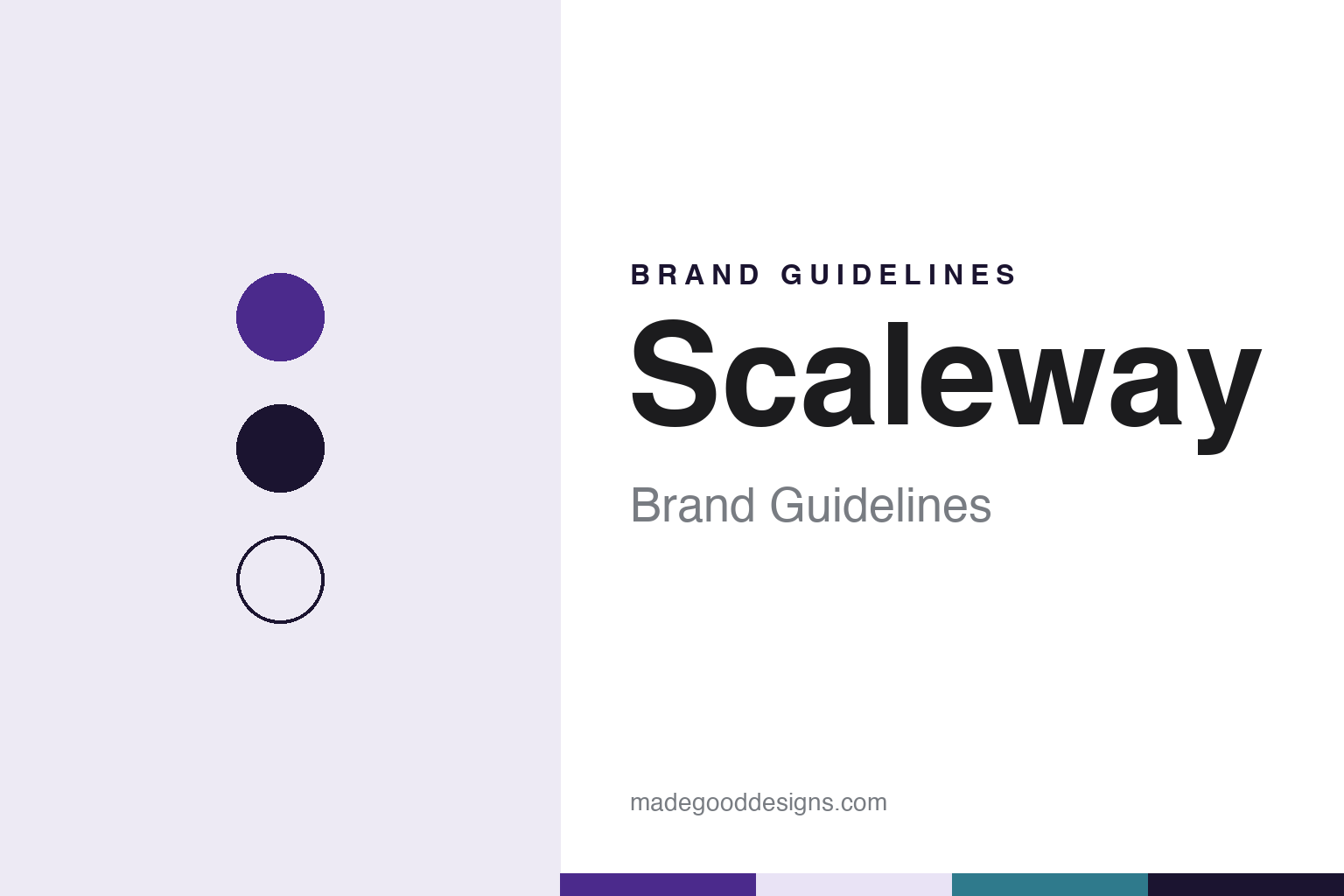
Two constants: a deep violet, ink and lilac palette and a geometric sans register. Abstract homage — not a Scaleway product or mark; no logo, interface or server is reproduced.
Online.net
A Paris host that grew inside the Iliad group.
Scaleway began as Online, a French web-hosting company that English and French Wikipedia both say was founded by Xavier Niel in 1999; Niel is also the founder of the Iliad group and its internet brand Free. The French public company register lists the present legal entity, with its seat in Paris, as created in August 2000, under a name that still joins its brands: BookMyName, Dedibox, Scaleway and Online. In its early years Online sold shared web hosting and domain-name registration. In August 2002 Iliad bought the domain registrar BookMyName from its rival LDCom, French Wikipedia says.
The step that made Online known among developers came in May 2006, when the group launched Dedibox, a line of rented dedicated servers. French Wikipedia says the Dedibox business started with five employees, led by Arnaud de Bermingham, who had earlier founded the telecom operator Ovanet. In December 2008 Iliad took over Alice ADSL and, with it, a data-centre business launched by ISDNet in 1999; Iliad called that branch Iliad Datacenter. In April 2010 Online merged with Dedibox, bringing the group’s hosting activities into a single company.
Online built its own sites around Paris. English Wikipedia says its third data centre, a building of 11,800 square metres in Vitry-sur-Seine, opened in 2012 after eleven months of building work, and that since 2012 the company has published the energy-efficiency figure of its data centres, known as PUE, in real time. Another site, known as DC4, occupies a former underground shelter in Paris’s 15th arrondissement that the group acquired in 2011, according to French Wikipedia.
Colour
From ARM boards to a single cloud name.
The name Scaleway originally belonged to one product. In 2013 Online opened a preview, on its labs site, of an infrastructure service that ran on dedicated ARM-based hardware without virtualisation; English Wikipedia says the hardware was made in a factory near Laval in western France. When the service left beta, Next INpact reported on 3 April 2015, Online launched it publicly as Scaleway, a cloud whose “C1” instances each ran on a small dedicated server rather than a virtual machine. Online told the site that its beta had been used by more than 200,000 users over six months and that its equipment was “entirely made and assembled in France”; the company also stressed the simplicity of its management interface, which at launch was available only in English.
Over the next five years the newer name absorbed the older ones. French Wikipedia says that in December 2018 Online became “Online by Scaleway”, the data-centre offer became “Scaleway Datacenter”, and the public-cloud products were grouped under the Scaleway brand; in 2019 that cloud range took the name Scaleway Elements. On 20 February 2020, Next reported, the dedicated servers followed: the Dedibox range, which the company said counted about 100,000 machines and customers in 150 countries, became Scaleway Dedibox, after being carried initially by the Online.net brand and then by Online by Scaleway. The Free-focused news site Univers Freebox described the change that month as the last step in bringing the historic brands under one name, which since 2018 had covered cloud, servers and data centres.
Today Scaleway describes itself on its website as “Europe’s sovereign cloud and AI provider” and says it offers more than 100 cloud, AI and quantum products. Its named ranges include Elastic Metal bare-metal servers, the Kubernetes Kapsule managed service, Dedibox dedicated servers and Mac mini machines rented as cloud servers. French Wikipedia says that in 2020 Scaleway hosted more than 120,000 servers across six data centres and ranked second in its field in France, behind OVHcloud.
Typography
Hosting and cloud identities.
Web hosting and cloud companies sell something their customers rarely see: machines in buildings far away. Their identities therefore lean on what can be shown — the customer interface, the data-centre building, the names on the order page and the corporate page that says who owns the business.
The control panel is often the part of the brand customers use most. Providers give these interfaces names of their own and place them in the main menu beside the product lines: Hetzner’s website links to customer interfaces called Robot, Console and konsoleH, and OVHcloud’s to a customer account and webmail. Documentation, status pages and programming interfaces sit in the same menus, so the brand reaches into technical writing as much as into advertising.
Data-centre photography carries the physical side of the business: rows of racks, cabling and building exteriors. Hetzner’s company pages include a 360° tour of a data centre, and its press kit sets out logos and colours for journalists. Plan names do similar work in text. Some providers use letter codes for server lines, as Hetzner does with its AX and EX lines; others use words, as OVHcloud does with ranges named Kimsufi, Advance, Game and Scale. A mascot is a further option for a host’s brand.
Corporate pages answer the questions that buyers of infrastructure ask: who owns the company, and where its machines stand. Hetzner lists data-centre parks in Germany and Finland and further sites in the United States and Singapore; OVHcloud’s corporate site gives counts of data centres, customers and countries. This guide sets out what can be checked about each brand — founding, ownership and locations — and marks clearly what rests on the company’s own word.
Aa
A geometric sans for a cloud built from small servers. (Specimen set in Space Grotesk, a sans STAND-IN; NOT the Scaleway logo.)
Scaleway
An iliad Group subsidiary that now runs cloud only.
Scaleway remains part of the group Xavier Niel founded. French Wikipedia gives Iliad’s holding as 94.8 per cent, and the company’s website calls it “a subsidiary of the iliad Group.” In July 2023 Scaleway separated its data-centre activities into a new company, OpCore, led by Arnaud de Bermingham, French Wikipedia says. Iliad then agreed to sell half of OpCore to the French infrastructure investor InfraVia; Next reported on 4 April 2025 that the sale had been completed, describing OpCore as the former Scaleway Datacenter. Since then, French Wikipedia says, Scaleway has concentrated on cloud services, from infrastructure to AI and managed services, while OpCore runs the buildings and counts Scaleway among its customers.
The company also gathers its users in person. French Wikipedia says the Scaleday of February 2020, held to mark the company’s twenty years, brought more than 1,500 people to the DC4 site, and that since November 2023 Scaleway has organised the ai-PULSE conference at Station F in Paris. On its website Scaleway lists operations in France, Poland, Italy and the Netherlands; French Wikipedia records a Warsaw site from 2020 and three sites in the Milan area opened in 2026. Leadership has changed as the business has grown: French Wikipedia says Damien Lucas became chief executive in 2023.
For a design guide, Scaleway shows how a product name can grow into a company name: a 2015 label for ARM servers became, within five years, the single banner over Online, Dedibox and the data centres. Compare OVHcloud, another French hosting and cloud company, and DigitalOcean, a cloud aimed at developers. For this guide we use a deep violet, an ink and a pale lilac with a geometric sans, an unofficial interpretation; no product or logo is reproduced.
Explore & save
Keep Scaleway’s identity on hand — save it to a board in the Made Good inspiration library.
Scaleway identity set
Pin the Scaleway deep violet, ink and lilac palette and the geometric sans register to your own board.