netcup Brand Guidelines
A Karlsruhe web host that kept its name inside an Austrian group.
Aa
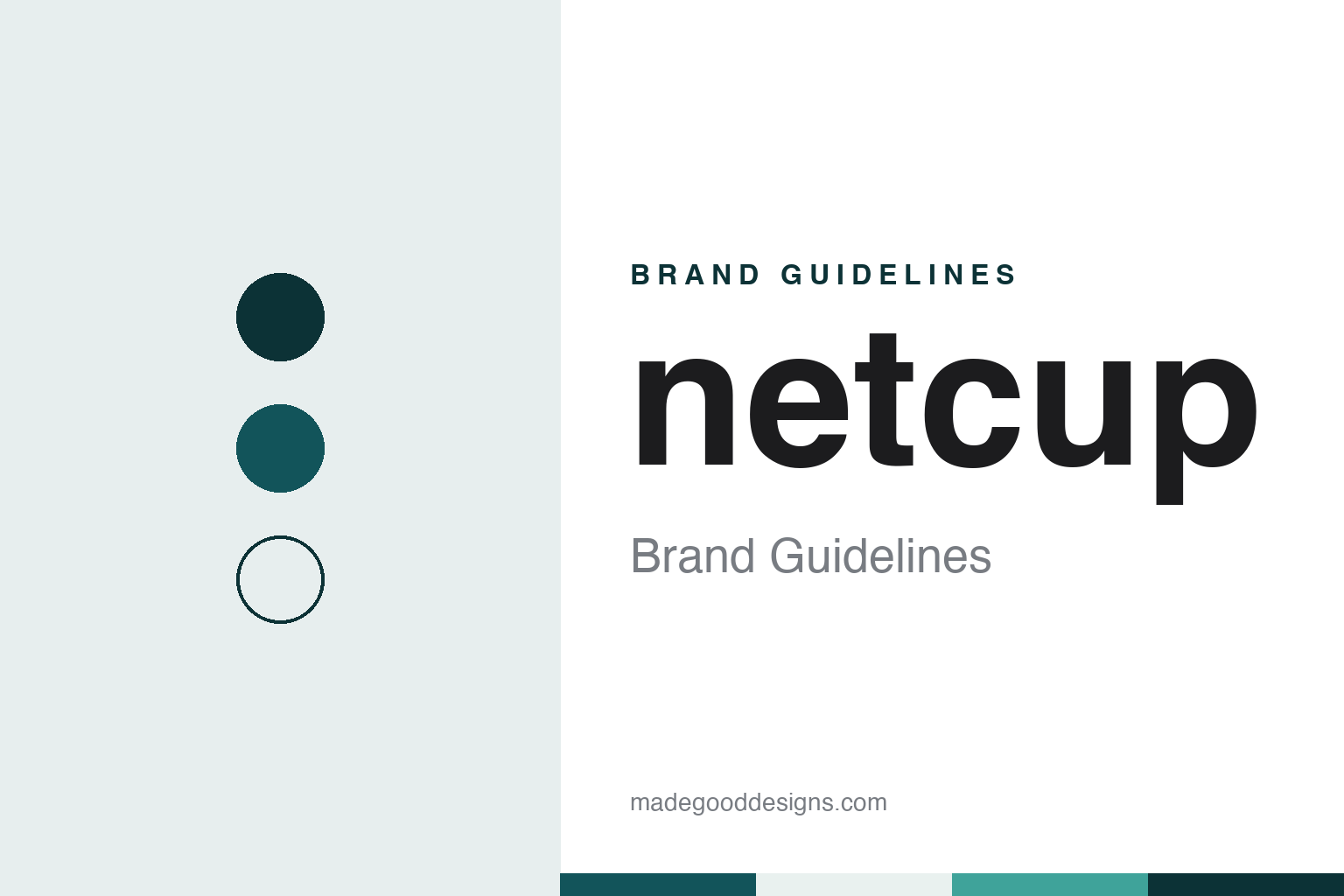
Two constants: a netcup deep teal and mint palette and a Geometric sans register. Abstract homage — not a netcup product or mark; no logo, interface or wordmark is reproduced.
A Karlsruhe host
From sole trader to netcup GmbH.
netcup is a web host based in Karlsruhe, in Baden-Württemberg, and it writes its own name in lower case. The company tells its origin briefly on its “About us” page: the business was founded by Felix Preuß as a sole trader and was taken into netcup GmbH in 2008, where Preuß served as managing director until 2020. So 2008 marks the limited company rather than the first day of trading; the same page says the business has grown “since its founding more than 20 years ago,” without giving the year the sole trader began.
The company describes itself as an internet service provider that sells and looks after web hosting accounts, domains and servers, for private customers as well as businesses. It says it is a member of RIPE, the regional internet registry for Europe, of DENIC, the registry for German .de domains, and of eco, the German internet industry association.
Its pitch, in its own words, rests on a wide product range, high quality standards and low prices: the about page says netcup counts among the more affordable internet service providers on the market, and that it uses only branded hardware with every component duplicated. Those are the company’s claims, and this guide gives them as such. It also says it runs on 100 per cent renewable electricity wherever possible.
The same page sets out what the company calls its quality principles. The first, it says, is listening: regular contact with customers is meant to keep quality up. It adds that customers’ servers are looked after only by staff with technical training or a degree, that service-desk staff receive regular further training and answer by email or telephone, and that every product is designed to be scaled up when a customer outgrows it.
Colour
The Anexia deal of 2016.
The key change in netcup’s history came in November 2016. The Austrian IT company Anexia, founded in 2006 by Alexander Windbichler and based in Klagenfurt, bought netcup with effect from 1 November 2016, IT-BUSINESS reported on 16 November 2016. The trade magazine described the Karlsruhe firm’s core business as web hosting and put its customer base at almost 50,000 business and private customers with more than 60,000 domains; connect professional, reporting the same deal, gave around 40,000 customers and more than 60,000 domains, with roughly equal numbers of private and business clients.
Both magazines reported the same plan for the brand. netcup was not to be merged into its new parent but would carry on largely independently, in a “strategic alliance” with Anexia, and its German data centre would keep running. connect professional quoted the promise that netcup would remain a German company, and named Felix Preuß and Oliver Werner as its managing directors at the time. Windbichler told IT-BUSINESS that the reasons for the purchase — netcup’s know-how and technical level — were the same reasons the host should keep its existing form. The two companies said they wanted to develop products together in cloud services, the internet of things and Industrie 4.0, and to sell netcup’s services in other markets.
Ten years later the arrangement still shows in the branding. netcup’s about page describes the company as part of the Anexia group since 2016, run by Alexander Windbichler and Oliver Werner, and its website footer carries the line “a company by” Anexia. The page says the group shares jointly developed technology and network capacity, and lists Anexia’s figures of more than 90 server locations worldwide.
netcup has also widened its geography. Its server-locations page lists data centres in Nuremberg, Vienna, Amsterdam, Manassas in Virginia and Singapore, with the Vienna site linked through the Anexia backbone, according to the company.
Typography
Design and documentation.
Web hosting and cloud companies sell something their customers rarely see: machines in buildings far away. Their identities therefore lean on what can be shown — the customer interface, the data-centre building, the names on the order page and the corporate page that says who owns the business.
The control panel is often the part of the brand customers use most. Providers give these interfaces names of their own and place them in the main menu beside the product lines: Hetzner’s website links to customer interfaces called Robot, Console and konsoleH, and OVHcloud’s to a customer account and webmail. Documentation, status pages and programming interfaces sit in the same menus, so the brand reaches into technical writing as much as into advertising.
Data-centre photography carries the physical side of the business: rows of racks, cabling and building exteriors. Hetzner’s company pages include a 360° tour of a data centre, and its press kit sets out logos and colours for journalists. Plan names do similar work in text. Some providers use letter codes for server lines, as Hetzner does with its AX and EX lines; others use words, as OVHcloud does with ranges named Kimsufi, Advance, Game and Scale. A mascot is a further option for a host’s brand.
Corporate pages answer the questions that buyers of infrastructure ask: who owns the company, and where its machines stand. Hetzner lists data-centre parks in Germany and Finland and further sites in the United States and Singapore; OVHcloud’s corporate site gives counts of data centres, customers and countries. This guide sets out what can be checked about each brand — founding, ownership and locations — and marks clearly what rests on the company’s own word.
Aa
A geometric sans — a lower-case name. (Specimen set in Sora, a sans STAND-IN; NOT the netcup logo.)
netcup
A lower-case name with reader-vote awards.
The scale the company gives today is far larger than in 2016. Its about page says more than 100 staff look after more than 300,000 customers, who use more than 400,000 hosting products and manage more than 550,000 domains; it names its web hosting and its vServers as its strongest sellers. The product menu runs from web hosting and application hosting to vServers on x86 and ARM64 processors, root servers, vGPU servers and domains, with managed servers and a netcup Enterprise line listed alongside them.
On technology and data handling, the company says it builds on KVM, the virtualisation layer in the Linux kernel, and on its own hardware and open-source software, and it presents its hosting as following the EU’s GDPR. It names ISO 27001 certification for its data centres in Germany, Austria and the US. These are company statements.
netcup’s awards page leans on reader and community votes. It lists repeated placings in the “Webhoster des Jahres” audience vote run by the German comparison site HOSTtest, including first places for vServers, and a run of Service Provider Awards from Vogel IT-Akademie: gold for web hosting in 2021, for cloud servers in 2022 and for cloud hosting in 2023, silver in 2024, gold for managed hosting in 2025 and platinum in that category in 2026. The page notes that these awards are decided by reader votes.
The brand itself is plain: a lower-case wordmark, a teal-and-dark-blue website with light, dark and high-contrast display modes, and copy that speaks to customers informally, in the German “du” form. The company also sells merchandise and offers promotional material for partners from its about menu.
For a design guide, netcup shows how a regional host can keep its own name and voice after joining a larger group. Compare Hetzner, another German host with its own data centres, and IONOS, the German host that grew out of 1&1. For this guide we use a deep teal, an ink green and a mint with a geometric sans, an unofficial interpretation; no product or logo is reproduced.
Explore & save
Keep netcup’s identity on hand — save it to a board in the Made Good inspiration library.
netcup identity set
Pin the netcup deep teal and mint palette and the Geometric sans register to your own board.