Mpix Brand Guidelines
A Kansas portrait studio’s lab, opened to everyone in 2003.
Aa
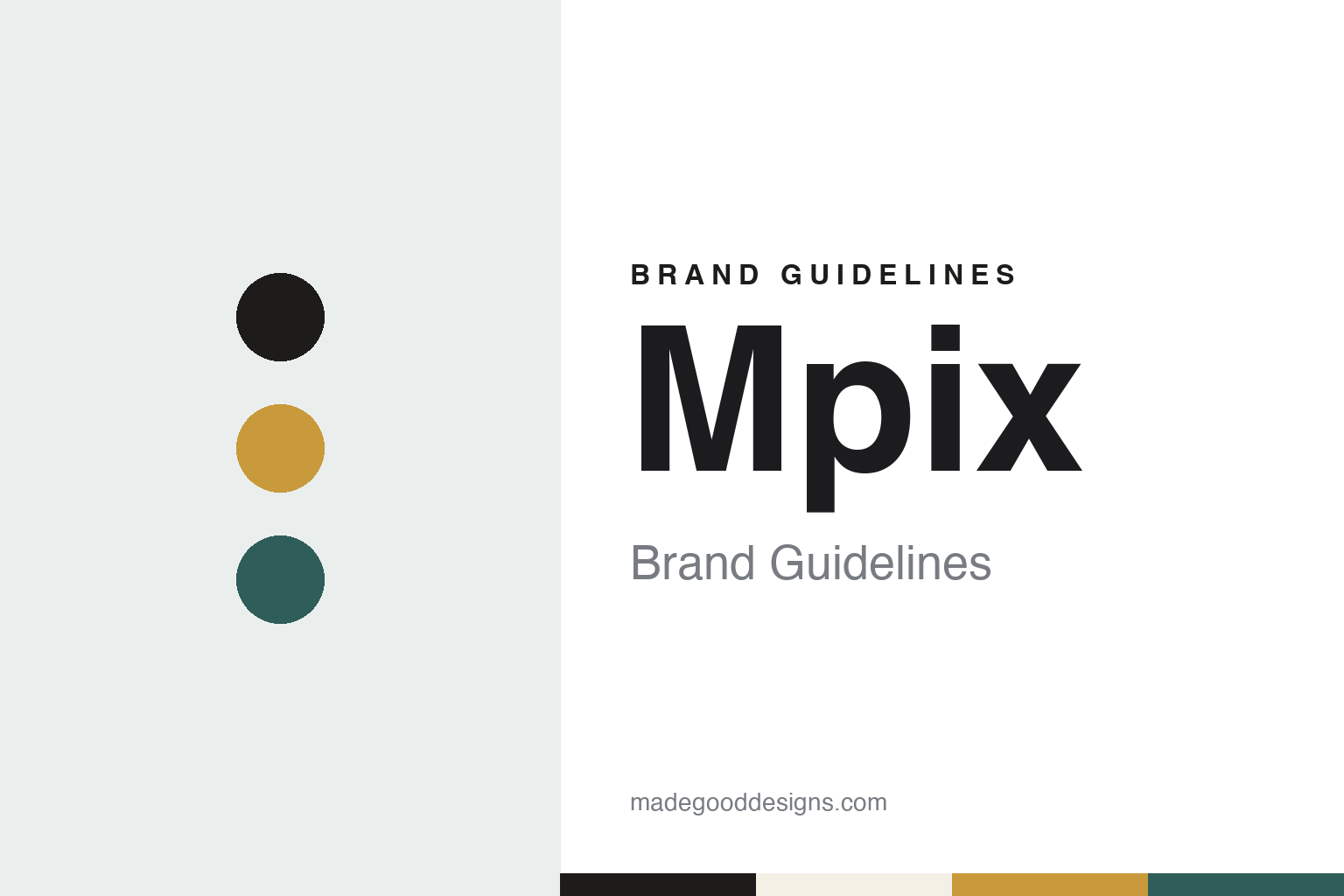
Two constants: a darkroom brown, cream and prairie gold palette and a studio serif register. Abstract homage — not an Mpix product or mark; no print, book or logo is reproduced.
A studio in Pittsburg
From Bill Miller’s portrait studio to a lab for everyone.
Mpix grew out of a portrait studio. In its own telling, the story begins in Pittsburg, Kansas, where Bill Miller opened a portrait photography studio in 1939, bought equipment to develop film, and began printing for other photographers in the area. That studio, Mpix says, grew into its parent company, Miller’s Professional Imaging, which it dates to 1964 and describes as a full-service photo lab built for professional photographers. The company says it learned the trade “the old-fashioned way,” by doing the work.
Mpix itself came later. The company says it launched Mpix in 2003 to bring the same professional printing to everyone, not only to photographers: a storefront for the public in front of a lab that already served the trade. Its About page speaks of “more than 60 years” of honing the craft, counting from the parent lab, and says many of its staff bring decades of experience to the work.
The ownership link is documented outside the company. On 5 November 2025 the University of Missouri’s athletics department, Mizzou Athletics, described Mpix as “a digital photo printing company owned by Miller’s Professional Imaging,” and named Richard Miller as chief executive of Miller’s. The occasion was a sponsorship: Mizzou Athletics announced that the Mpix logo would appear on Norm Stewart Court at Mizzou Arena in Columbia, along the north sideline near the visitors’ bench, from the opening of that season’s men’s and women’s basketball schedules; the announcement set their debut for the men’s home opener against Southeast Missouri State on 7 November 2025, followed by the women’s home game against Arkansas State on 11 November. It called Mpix and Central Bank long-standing partners of its teams. “Mpix and Miller’s are proud to call Columbia home,” Richard Miller said in the announcement.
Colour
Two labs in the Midwest.
Mpix says its products are made in the Midwest. It names two labs, in Pittsburg, Kansas, and Columbia, Missouri, where its teams “print, inspect, and assemble every order”; it says production is entirely in-house in the two states, that it does not outsource the work, and that every Mpix order is handmade in those labs. The company also says each photo is reviewed by trained colour technicians before printing, and that most orders are printed and shipped within 24 hours.
The range runs from prints and wall art to photo books, cards and gifts, with separate sections for sports and business printing. The photo books fall into four named lines. Signature Photo Albums are presented as the top of the range, “made to honor your biggest and brightest moments.” Premium Photo Books are described as handcrafted from start to finish, with full-page spreads and a choice of covers that includes linen and fabric, as well as softcover books and guest books. Classic Books are a simpler hardcover with magazine-style or hinged pages, and Slip-In Photo Albums hold loose prints in 40 pocketed pages, with room for up to 120 horizontal 4×6-inch prints. Books are built in an online editor where photos are dragged into place and captions and backgrounds can be added.
The press has followed its wall-art launches. In April 2024 The Phoblographer wrote about Mpix’s Framed Textile prints, which the company describes as an “ultra-soft pigment coated fabric featuring a matte finish and subtle fine art texture,” held in a metal frame in black or aluminium that the customer puts together; the magazine reported sizes from 40×60 inches up to 60×90 inches, and said the smallest size is the 40×60. In July 2024 the same magazine covered Birch Photo Blocks, picture panels about an inch thick that stand on a tabletop with a stand rather than hang on a wall.
Typography
Books, prints and the labs behind them.
Photo-book and photo-printing services sell something the customer has already made: the pictures. Their own sites therefore tend to lead with the customer’s photographs rather than with the company. Home pages show open books, framed prints and wall pieces in ordinary rooms, often styled around an occasion such as a wedding, a new baby, a holiday or the end of a year, and the product sits in the frame as a finished keepsake.
The making itself is shown through the tools. Most of these companies offer an online editor and a phone app, and they describe both in plain, step-by-step language: upload, choose a size and cover, arrange the pages, order. Automatic layouts, themes and templates are presented as time-savers, while desktop editors with grids, rulers and finer controls are offered to people who want to place every picture themselves.
Product naming follows the physical object. Ranges are sorted by format, page count, binding and cover — soft cover, hard cover, fabric, leather, lay-flat — and by paper finish, with words such as matte, lustre or gloss doing most of the work. Wall pieces are named by their material, from stretched cotton and acrylic to metal, wood and framed prints, so the label tells the buyer what will hang on the wall.
Behind the consumer brands sit the labs and the owners. Corporate pages explain which group a label belongs to, where its printing sites are and how its brands divide up the countries they serve, while lab-led services describe their printing methods and papers in more detail. For a designer, the useful lessons are in that split: a warm, occasion-led consumer voice on top, and a precise, material-led vocabulary underneath.
Aa
A studio serif for a lab with a portrait-studio past. (Specimen set in Source Serif 4, a serif STAND-IN; NOT the Mpix logo.)
Mpix
Print what matters most.
The brand speaks plainly. Its home page carries the line “Print what matters most,” and its About page returns again and again to people and places rather than machines: photographs “worth keeping,” teams in Kansas and Missouri, colour experts and production staff “who know their craft.” It promises that a customer with a question will reach someone who knows photo printing, “not just someone reading from a script.” The name is written as one word with a single capital, Mpix, on the company’s own pages, and the parent name, Miller’s, appears beside it in the Mizzou Athletics announcement and in the site’s own story.
The two names split the audience. On the company’s account, Miller’s began as a lab for professional photographers, and Mpix was launched in 2003 to offer the same kind of printing to everyone; the About page says it uses the papers and materials trusted by professional photographers, then prints, inspects and finishes every order with the same attention to detail. The Mizzou sponsorship shows the consumer name being put in front of a regional audience, on a basketball court in the city where one of the two labs stands.
For a design guide, Mpix shows how a trade lab can talk to the public in a plain, workmanlike voice that leads with where things are made and who makes them. Compare Shutterfly, the American photo-book service founded in 1999, and Artifact Uprising, the Denver photo-book maker. For this guide we use darkroom brown, archival cream and a prairie gold with a serif, an unofficial interpretation; no product or logo is reproduced.
Explore & save
Keep Mpix’s identity on hand — save it to a board in the Made Good inspiration library.
Mpix identity set
Pin the Mpix darkroom brown, cream and prairie gold palette and the studio serif register to your own board.