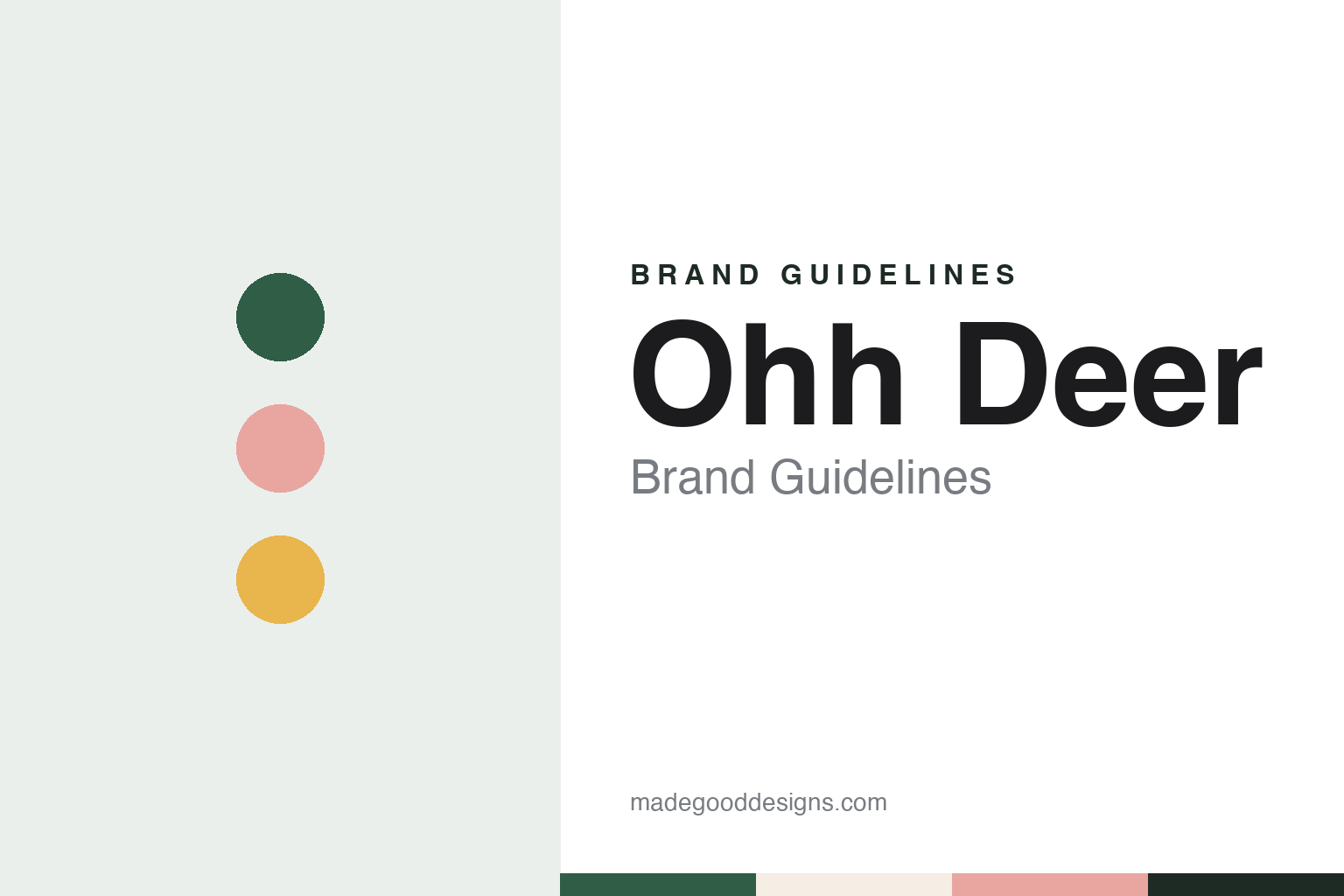
Ohh Deer Brand Guidelines
A 2011 illustration blog that became a Loughborough card company.
Aa
Two constants: a fern green, blush and mustard palette and a Rounded sans register. Abstract homage — not an Ohh Deer product or mark; no card, illustration or logo is reproduced.
From blog to shop
Two Kingston graduates and an illustration blog.
Ohh Deer is a British greeting card, stationery and gift company. The company says it was founded in 2011 by Jamie Mitchell and Mark Callaby, who met at Kingston University, where Callaby studied illustration and Mitchell studied architecture. The UK register of companies, Companies House, records Ohh Deer Ltd as incorporated on 8 August 2011, with its registered office in Loughborough, Leicestershire; the register lists the company as active, with its business described under wholesale, online retail and artistic creation.
The company tells its start as a move from writing to selling. In 2011, it says, Ohh Deer was a blog about illustration and art, and an interest in designing products soon turned the blog into a shop. Its earliest stockist, by its own account, was the Kingston alumni shop. The Loughborough Echo reported in December 2016 that Mitchell started the company with Callaby after leaving his job in architecture at the end of 2011, and gave their roles at that time: Mitchell as co-founder and creative director, Callaby as co-founder and managing director.
The name itself is a pun on a mild exclamation, spelled with a double “h” and attached to a deer. Its web address follows the same spelling, ohhdeer.com, which is worth keeping apart from shops and products named “Ohh Dear” that have no connection to the company.
Colour
A roster of illustrators, paid by the sale.
The business model rests on outside artists. Ohh Deer says it works with a roster of more than 100 creatives based around the world, and that a share of the revenue from each product goes directly to the artist behind it. The Loughborough Echo gave an earlier snapshot in December 2016: the company, then about five years old, worked with more than 35 illustrators across several countries, each taking a direct cut from the sales of their products.
The range has grown well beyond the card. Its website today sorts products into cards, stationery, gifts, gift bags and wrap, and art prints, with card types including birthday, Christmas and pop-up cards as well as jigsaw cards. Its card menu is organised around the calendar of sending occasions, with separate sections for Valentine’s Day, Mother’s Day and Father’s Day, and a postcard range alongside. It also sells licensed stationery ranges under the Laura Ashley and Cath Kidston names, which appear as their own collections on its site.
Shop counters came early. By 2016, according to the Echo, Ohh Deer had worked with retailers including ASOS, Urban Outfitters and Paperchase. That December it moved its head office to the centre of Loughborough and opened a flagship shop in the town’s Rushes shopping centre, filled with stationery, cards, gifts and a quantity of cacti. Mitchell, a Loughborough local, told the paper the founders had not long wanted a shop, but that many stockists took only a small part of the range, and a shop let the company show all of it; he compared fitting it out to designing its trade-show stands.
Callaby told the Echo that the shop gave staff a clearer sense of how the products fit into the market. The company’s registered office remains in Loughborough today, according to Companies House.
Typography
Design and documentation.
Greeting card brands sell something small and personal, and the way they present themselves follows from that. Card shops lean on the card wall: rows of designs grouped by occasion, from birthdays and anniversaries to weddings and Christmas, with signage that sets the tone before a shopper reaches the shelves. When The Guardian compared two British card chains on the same London afternoon in January 2012, it judged them on range, pricing, staff and the feel of the shop as much as on the cards themselves.
Online card services present the same product through photographs and screens. Each card appears as the company chooses to photograph it, and the design often matters more than the brand around it. Some services credit the illustrators and photographers behind their cards, and a marketplace such as Thortful builds its whole offer around independent creators, presenting the range by maker as well as by occasion.
Personalisation is the shared interface. Websites, apps and in-store kiosks let buyers add names, photos and messages, choose whether a card goes straight to the recipient or to themselves, and see a posting cut-off for same-day dispatch. Several companies describe these steps plainly on their own sites and app listings, together with how and where cards are printed, which paper they use and whether cards are sold wrapped.
Behind the shop fronts sit corporate pages and public records. Company registers show who owns a card business, when it was incorporated and what it was once called, and they can tell a quieter story than the brand voice: a cheeky high-street name may be a founder-held family company, and a young app may sit on a company formed a year before its public launch. This guide sets out what can be checked about each brand and marks what rests on the company’s own word.
Aa
A rounded, friendly sans — the tone of an illustrated card. (Specimen set in Fredoka, a sans STAND-IN; NOT the Ohh Deer logo.)
Ohh Deer
Paper first, plastic out.
Much of what Ohh Deer says about itself concerns materials. The company says its paper products use sustainably sourced materials and are lithographically printed, and that all its cards are plastic-free; it describes itself as the second company in the UK to remove plastic completely from its greeting cards. In September 2021, it says, it stopped producing cards with a clasped seal. Its gift wrap, by its own account, is made from 100 per cent recycled paper, foil is kept to no more than 30 per cent of a product, and where glitter is used it is a biodegradable type. These are the company’s statements.
On manufacturing, Ohh Deer says its manufacturers are audited and hold the correct accreditations, and that they recycle paper waste, including envelope paper and cardboard, every day. It does not name the countries or printers that make its cards. The company also says it has planted more than 150,000 trees with the charity Tree Aid, and has raised donations for other causes through its checkout. It adds that it has donated thousands of greeting cards to organisations so that they can raise funds through sales in their own stores. Its Companies House filings show a financial year that ends in February, with the latest accounts made up to February 2025.
The visual identity is set by its illustrators more than by a single house style: each range carries the hand of the artist who drew it, and the brand acts as the publisher and shop front around them. The name, with its doubled letter, does the rest of the work, and the website’s navigation sorts the range by occasion and by product type rather than by artist alone.
For a design guide, Ohh Deer shows how a card publisher can build a brand around a roster of illustrators rather than one signature style. Compare Paperchase, a British stationery chain that stocked its products, and Card Factory, another British card business on a much larger scale. For this guide we use a fern green, blush pink and mustard with a rounded sans, an unofficial interpretation; no product or logo is reproduced.
Explore & save
Keep Ohh Deer’s identity on hand — save it to a board in the Made Good inspiration library.
Ohh Deer identity set
Pin the Ohh Deer fern green, blush and mustard palette and the Rounded sans register to your own board.