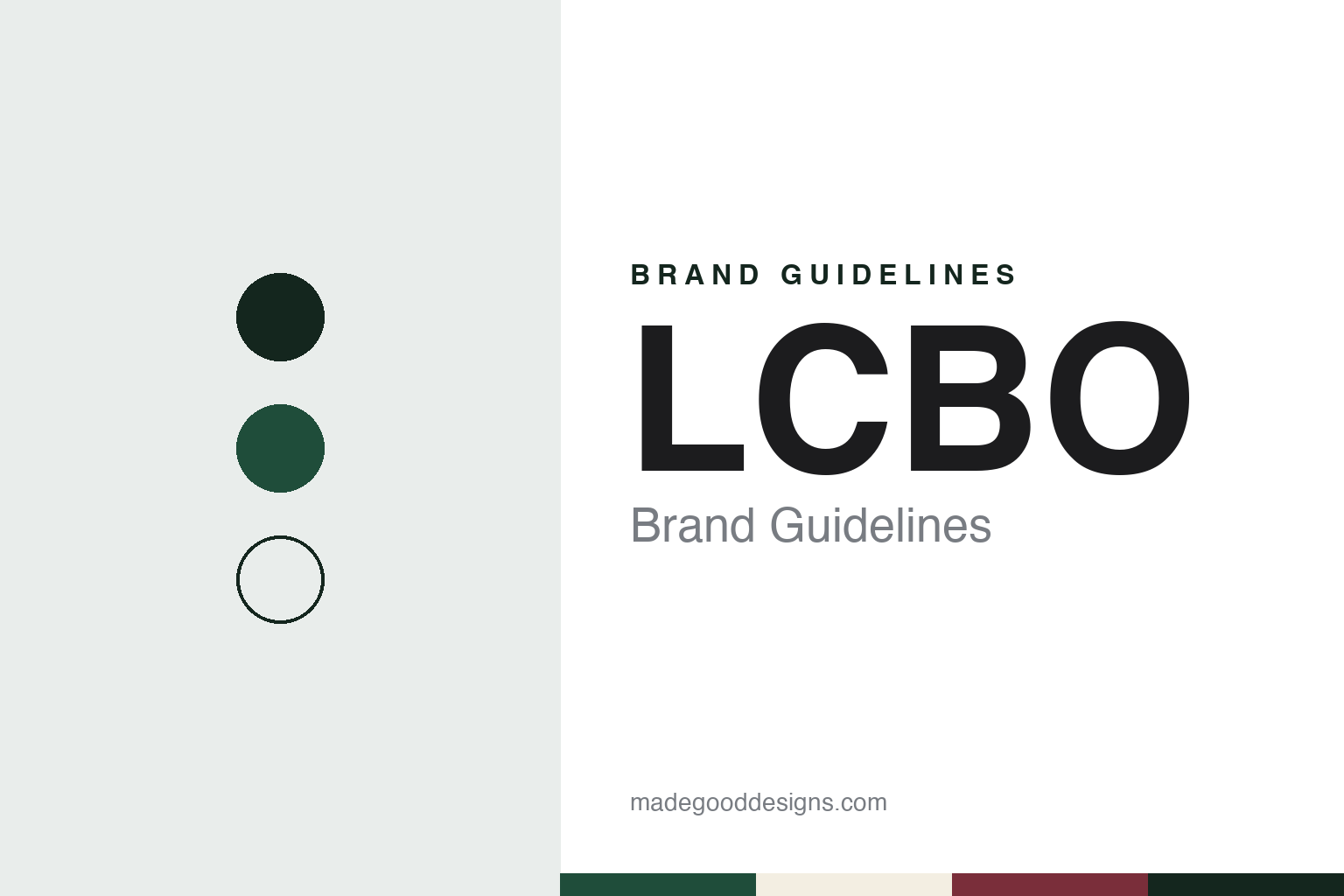
LCBO Brand Guidelines
Ontario’s 1927 Crown retailer, glass shop fronts and a house label.
Aa
Two constants: a green, cream and claret palette and a plain civic sans register. Abstract homage — not an LCBO product or mark; no logo, label or sign is reproduced.
A Crown agency
Eighteen stores behind clear glass.
The Liquor Control Board of Ontario was created in 1927, when Ontario ended the ban on liquor sales it had introduced in 1916. English Wikipedia says the Liquor Control Act, 1927, passed under the government of Premier Howard Ferguson, authorised the new board to “control the sale, transportation and delivery” of alcoholic drinks across the province. Its French name is the Régie des alcools de l’Ontario, and in everyday use it is simply the LCBO.
The first 18 stores opened on 1 June 1927. Citing an LCBO document, English Wikipedia says they were all designed with a clear glass shop front, so that the process would look open and carry “a complete absence of mystery.” Beer was handled alongside by Brewers Retail, and wineries and breweries could sell from a limited number of their own shops, English Wikipedia says. By the end of 1927 the province had 86 LCBO stores and three mail-order offices. For decades the shops worked over the counter: until 1962 a buyer needed an individual permit, at first a small passport-sized book and from 1957 a card, and filled in a purchase order form that staff stamped and kept. Those forms stayed in use into the 1970s, when the stores moved to self-service.
The board is a Crown agency, accountable to Ontario’s Legislative Assembly through the minister of finance. Its board members are appointed by order in council, and its annual report is tabled in the legislature, English Wikipedia says. The LCBO’s own pages now cite the Liquor Control Board of Ontario Act, 2019, and its head office is in Toronto, on the waterfront.
Colour
A house label, Vintages and agency stores.
For much of its history the LCBO also bottled its own spirits. In a May 2025 article for blogTO, Chris Middleton, drawing on an LCBO spokesperson, wrote that from 1930 the board bottled and sold a product labelled simply “Alcohol,” later printed bilingually as Alcohol/Alcool. The range grew to labels such as Canada Select and Extra Special Scotch Whisky, sourced mostly in Canada and, where needed, from countries including Australia, Guyana and Barbados. At its peak, the article says, the bottling line at the old Toronto head office filled more than 50 brands, about 4.5 million litres a year; every bottle was tested and carried a seal, and the in-house labels were phased out by the mid-1990s.
The shop itself changed more slowly. English Wikipedia dates the first self-service LCBO store to 1969; in the 1970s the stores gained decorative displays, and in the 2000s many were renovated and enlarged to hold more stock. Most larger stores now have a Vintages section, a rotating selection of wines and spirits made in small volumes, and the LCBO promotes Vintages releases to its email subscribers. In the 1990s, English Wikipedia says, the board removed the Ontario coat of arms and the words “Liquor Store” from its shops in favour of a stylised LCBO logo. Its signage policy requires bilingual operational signs, from permanent shop signs to aisle notices, in each of Ontario’s 25 designated French-language areas.
The network is broad. English Wikipedia counted 651 liquor stores in September 2017; the trade title Just Drinks gave 669 retail stores in July 2024. In small towns far from a full store, privately run LCBO Agency outlets, chosen through a competitive process, sell its range. The LCBO is also the main wholesale supplier to Ontario’s bars and restaurants. On its own website it says it offers more than 38,000 products a year from more than 80 countries, citing its 2024–25 annual report, and it links purchases to the Aeroplan loyalty scheme.
Typography
How alcohol retailers present themselves.
Wine merchants and alcohol retailers sell a product that shoppers cannot always taste before they pay, so their identities lean on words, place and guidance more than on packaging of their own. A shop name, a fascia and a few lines of handwriting on a card next to a bottle carry much of the work. For a designer, the useful material is what these companies show in public: their shop fronts, shelf cards, tasting areas, catalogues and the corporate pages that explain who founded and who owns them.
The physical shop is the first layer. Some chains began in warehouse-style units where wine was stacked in cases, and later refits moved towards shelving and tasting areas, as Decanter reported of one British chain in 2019. Shelf talkers, the small cards that describe a wine’s style and origin, sit beside the bottles and can be written in a personal, conversational voice. Tasting counters and by-the-glass machines turn part of the shop into a place to try before buying.
Mail-order and online merchants work through a different set of objects: printed catalogues, mixed cases, club mailings and order pages. Their own-label wines, sold under invented names rather than the merchant’s own, are part of the range and are presented much like any producer’s bottle. A founder’s story, such as a first trip to a vineyard or a single van, can be retold in these materials.
Corporate pages fill in the rest: founding dates, changes of ownership, parent groups and, for state retailers, the legal basis on which they operate. This guide uses dated, independent sources for those facts and treats the company’s own descriptions as its own words. The palette and type on each page are an unofficial interpretation chosen for the guide, not a copy of any retailer’s signage, labels or logo.
Aa
A plain civic sans, for a public retailer’s signs. (Specimen set in Archivo, a sans STAND-IN; NOT the LCBO logo.)
LCBO
A market that opened around it, and a first strike.
Ontario’s alcohol market has opened around the LCBO in stages. In December 2015 some supermarkets were authorised to sell cider, wine and beer, English Wikipedia says. In 2024 the provincial government went further: Just Drinks reported in July 2024 that the government had said every eligible convenience, grocery and big-box store could choose to sell beer, cider, wine and ready-to-drink products by the end of October that year, while spirits such as vodka, gin and whisky stayed with the LCBO, which the government said would remain a public wholesaler and retailer.
That change formed the background to the board’s first strike. CBC News reported on 21 July 2024 that about 10,000 LCBO workers represented by the Ontario Public Service Employees Union had walked out on 5 July, closing hundreds of stores; during the stoppage, Just Drinks reported, retail customers were served online through LCBO.com. Workers ratified a three-year agreement on 21 July, and the LCBO said it planned to reopen all closed stores on Tuesday, 23 July. According to the LCBO, as quoted by CBC News, the agreement included converting 1,000 casual workers to permanent part-time status and no retail store closures related to the market expansion for the life of the agreement. Just Drinks added that the LCBO’s Convenience Outlets programme, which lets independent local retailers sell alcohol where there is no LCBO shop nearby, was capped at 400 stores.
For a design guide, the LCBO shows how a public retailer can carry four plain initials across hundreds of shops, English and French signage and nearly a century of changing formats, from glass-fronted counters to self-service aisles and an online shop. Compare Vinmonopolet, Norway’s state wine retailer, and Systembolaget in Sweden. For this guide we use a deep green, a warm cream and a claret red with a sans, an unofficial interpretation; no product or logo is reproduced.
Explore & save
Keep LCBO’s identity on hand — save it to a board in the Made Good inspiration library.
LCBO identity set
Pin the LCBO green, cream and claret palette and the plain civic sans register to your own board.