Arlo & Jacob Brand Guidelines
A Long Eaton sofa workshop given its own name and its own showrooms.
Aa
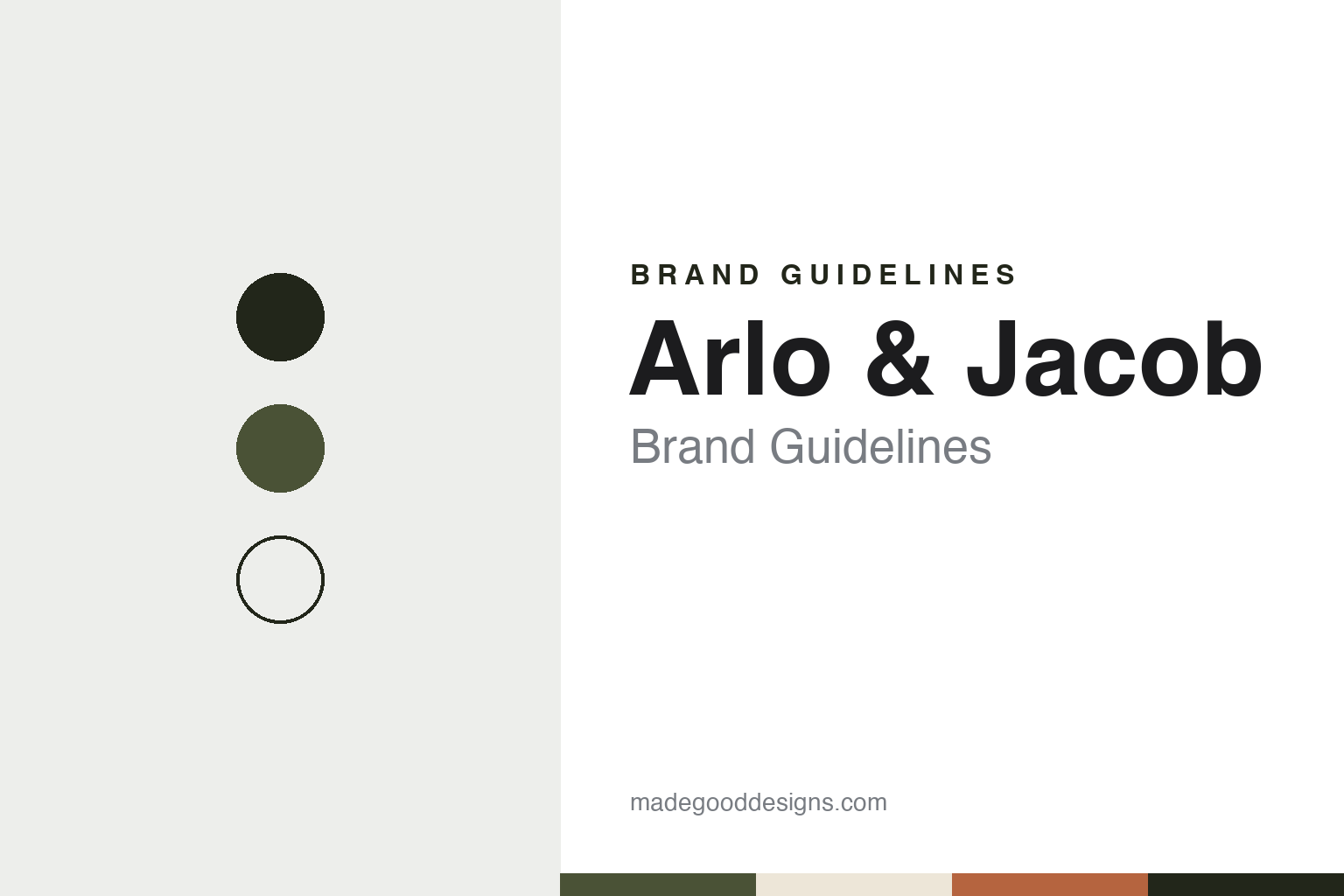
Two constants: an olive, terracotta and oatmeal palette and a soft display serif register. Abstract homage — not an Arlo & Jacob product or mark; no sofa, fabric or logo is reproduced.
Long Eaton
A factory brand that went straight to the customer.
Arlo & Jacob started as a way for an old upholstery factory to sell to the public. Nick Wasey, its founder and managing director, told Furniture News in October 2018 that he launched it as an online business in 2015, inside the JDP Group, a Nottinghamshire upholstery maker whose other names included Celebrity, Cintique and Wade Upholstery. The group made almost every Arlo & Jacob model in Long Eaton.
Wasey gave Retail Gazette the same account in June 2018. The factory, he said, had been running for nearly 90 years and sold mainly to other businesses; the new brand gave it a direct route to customers, with a range designed for a different shopper from the group’s existing trade buyers. The name, he said, began as a working title taken from his own family and stuck when no alternative did. Once the idea was settled, he said, the team hired a group of outside agencies, a branding agency among them, to turn the concept into a consumer brand.
The brand started as an online shop and then took showrooms. Furniture News reported a London base in Fulham by 2018, new showrooms in Bristol and Harrogate that year, and, in November 2019, a fifth showroom at Islington Square in north London, its second in the capital; the Islington shop was trading by April 2020, when an official notice listed it. That Islington showroom, the paper said, covered about 4,700 square feet on one floor and was designed with a children’s play house and a café beside the sofas and chairs.
Online, the brand leaned on rendered images rather than photography alone. Wasey told Furniture News in 2018 that the website carried more than 100,000 high-definition CGI renders of its products, so that customers could see a model in different fabrics before visiting a showroom, and that staff in the shops would use an app to build and edit a customer’s order on the spot.
Colour
Administration, a rescue and a year inside a group.
The JDP years ended in 2020. A notice in The Gazette, the official public record, shows that administrators were appointed on 2 April 2020 to the company trading as Arlo & Jacob, then listed with shops in Fulham, Bristol, Harrogate, Marlow and Islington. TheBusinessDesk reported on 28 May 2020 that the business, part of the JDP Furniture Group, had been sold by the administrators to a company controlled by the furniture retailer Mark Smith.
A year later the brand changed hands again inside the same circle. Furniture News reported in June 2021 that TCM Living, a sofa maker whose names included Alstons, Ashley Manor and Alexander & James, had bought Arlo & Jacob from Mark Smith, TCM Living’s chief executive, and Julie Smith, who had bought it out of administration in May 2020; TCM Living’s parent, TCM Corporation, is listed in Thailand. At that point the brand ran five shops, in Bristol, Fulham, Harrogate, Islington and Marlow, and had launched a quicker-to-deliver line called Ready Made, with Julie Smith overseeing product design, textiles and creative direction.
The arrangement was brief. In February 2022 Furniture News reported that Mark and Julie Smith had reacquired the business from TCM Living, less than a year after selling it to the group. A month later it described a trade service, Arlo & Design, which turned the Fulham showroom into a studio where interior designers could specify sofas in designer fabrics, and said the sofas were made at a workshop in Nottinghamshire.
In September 2022 the company moved its headquarters from Fulham to Melbourne in the East Midlands, near the local workshop where its furniture is made, with a display of its range open to visitors.
Typography
Category
British sofa, furniture and bed retailers sell large, slow purchases, and most of them present themselves through the showroom before anything else. Several chains grew on out-of-town retail parks, where a single unit can hold many sofas set out as room sets, and their websites send shoppers back to those floors with store finders, appointment booking and the offer of a specialist who will walk them through sizes, fabrics and leathers.
The fabric swatch sits at the centre of the sale. Many ranges are made to order, so one sofa design is shown in a single cover on the shop floor and offered online and in store in a long list of fabrics and finishes; one UK chain’s website, for example, lists more than 200 fabrics and leathers. Alongside in-house ranges, several retailers sell collections made with magazine titles, fashion labels or long-established furniture makers, and credit those partners by name.
Advertising is seasonal and public. Television campaigns have been part of the category’s face for decades, and retailer websites carry named sale events in the same banner space as their ranges. The store fascia, the advert and the website usually share one short brand name, often a set of initials or a plain phrase about sofas or beds.
Behind the shop window sits a separate corporate voice. Listed groups publish investor sites with dated history timelines, founder stories, the brands they own and the number of showrooms each one runs; private-equity and overseas owners enter the same record through takeovers, administrations and changes of name. This guide follows that record: who founded each company, who owns it now, and how its name and look have changed along the way.
Aa
A soft display serif — the quiet, editorial voice of a showroom brand. (Specimen set in Cormorant Garamond, a serif STAND-IN; NOT the Arlo & Jacob logo.)
Arlo & Jacob
A maker that sells only its own sofas.
The thread through each change of owner is that Arlo & Jacob makes what it sells. The company says it owns its whole UK manufacturing chain: a woodmill making sofa frames, an interiors factory filling seat cushions with feather and fibre, and a finished-goods workshop for made-to-order and bespoke upholstery, as Furniture News reported in September 2025. Its range is described in the trade press as sofas, armchairs, footstools and tables.
Its showroom network grew after the move to Melbourne. As of November 2024, Furniture News listed showrooms in London, Bath, Bristol, Ely, Guildford, Harrogate, Marlow, Solihull and Wilmslow, alongside the display at the Melbourne headquarters and workshop. In August 2024 the paper described it as a small, modern family business with its roots in the East Midlands. The Bath showroom, the paper reported in August 2024, took a Grade II listed building on Broad Street. In September 2025 the same paper described the business as owned by Mark and Julie Smith, with a long-standing team that included its chief executive, Lisa Broad, who had earlier been managing director under TCM Living.
For a design guide, Arlo & Jacob shows a factory brand built around a name, a showroom style and a single category. Compare Loaf, another British sofa brand built on a distinctive showroom voice, and Sofology. For this guide we use olive, terracotta and oatmeal with a serif, an unofficial interpretation; no product or logo is reproduced.
Explore & save
Keep Arlo & Jacob’s identity on hand — save it to a board in the Made Good inspiration library.
Arlo & Jacob identity set
Save the Arlo & Jacob olive, terracotta and oatmeal palette and the soft display serif register to your own board.