Havertys Brand Guidelines
The 1885 Atlanta furniture store that dropped its apostrophe.
Aa
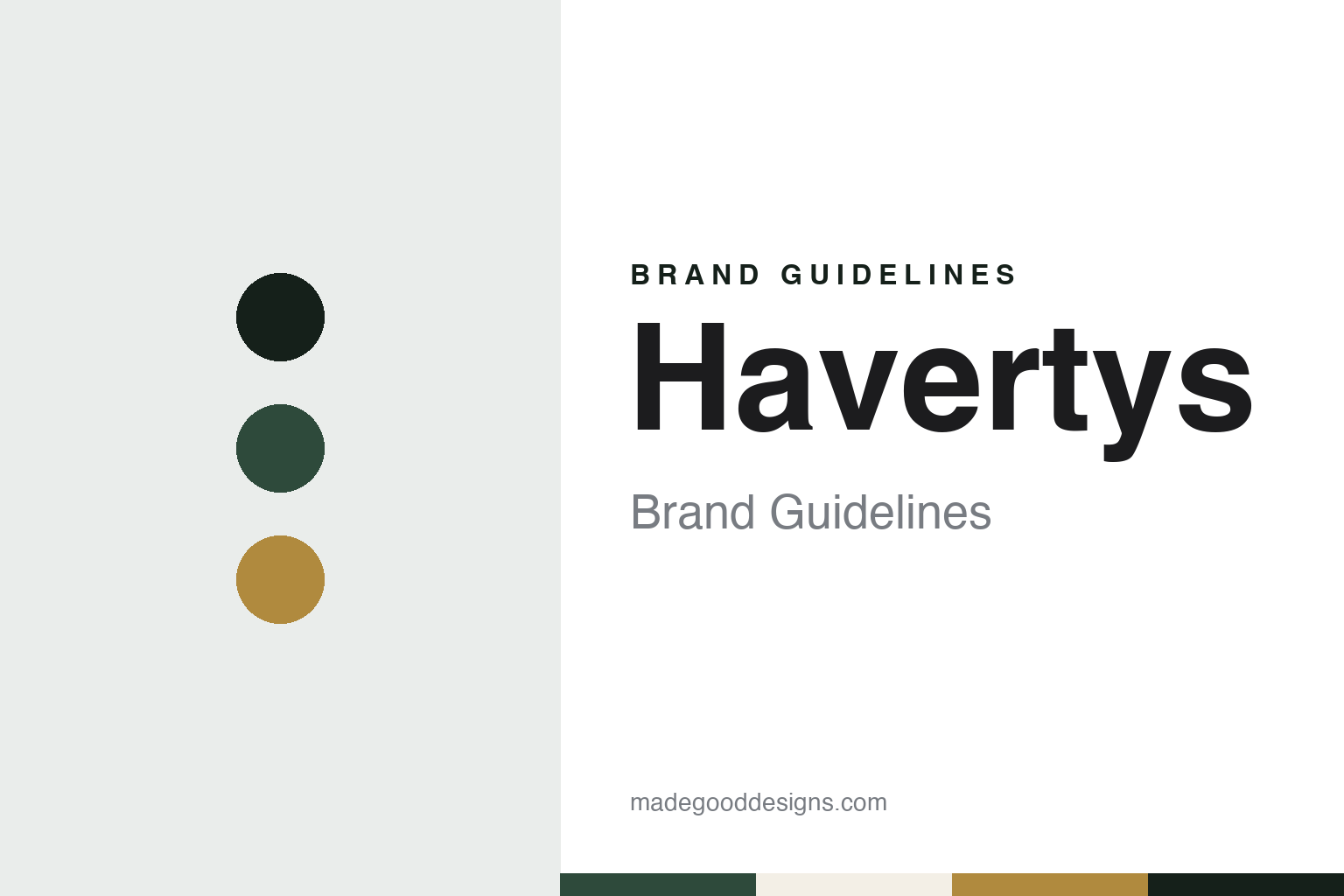
Two constants: a forest green, linen and brass palette and a store serif register. Abstract homage — not a Havertys product or mark; no store sign, logo or product is reproduced.
Haverty Furniture Company
Two brothers and one store in downtown Atlanta.
Havertys began in Atlanta in 1885, when James Joseph (J.J.) Haverty and his brother Michael opened a furniture store downtown, according to English Wikipedia and the International Directory of Company Histories. The directory says the opening year’s trade was modest, but that by the third year the business had moved to larger premises.
In 1889 the brothers joined the owner of a neighbouring furniture store, Amos G. Rhodes, to form the Rhodes-Haverty Furniture Company. The directory describes how the partners sold in those years: salesmen went from door to door with photographs of the furniture styles on offer, delivery was free, and illustrated newspaper advertisements carried the stock to a wider public. J.J. Haverty spent several years in St. Louis expanding the business before returning to Atlanta for good in 1894, Georgia Trend reported in 2012.
By 1908, the directory says, the partnership had 17 stores. That year J.J. Haverty’s son Clarence wanted a larger role, and the partners split on friendly terms; the directory says the stores were divided through a series of coin tosses, and that the Havertys bought the main Atlanta store outright and went back to the name Haverty Furniture Company. Georgia Trend reported that the two firms then divided cities and territories so as not to compete directly, and coexisted in Atlanta for about a century. Haverty and Rhodes formed another partnership in the 1920s to put up the Rhodes-Haverty Building in Atlanta, which English Wikipedia and the directory say stayed the city’s tallest building until the mid-1950s.
Colour
A share sale in October 1929.
Havertys moved its Atlanta headquarters into a larger six-storey building in 1924. The directory quotes a newspaper section announcing the move, which promised that every article in the store was “marked in Plain Figures.” Stores followed in the mid-1920s in cities including Little Rock, Chattanooga, Charlotte and New Orleans.
The company went public on 1 October 1929 as Haverty Furniture Companies, Inc., the directory and English Wikipedia say, about four weeks before the stock-market crash. Georgia Trend called it in 2012 one of the few existing companies to have gone public before the Great Depression, and quoted chief executive Clarence H. Smith, J.J. Haverty’s great-grandson, saying the company had been “very lucky” with the timing. The directory says the chain had 23 locations by 1931 and 42 stores in ten states by 1960, and that in 1961 it bought ten National Biederman stores in the Houston area and gave them the Haverty name.
Wartime rationing of furniture materials cut into trade in the early 1940s, both English Wikipedia and the directory say, and after the war older stores were remodelled and new ones opened. In the late 1960s the main Atlanta store moved from downtown to the area around the Lenox Square mall, and the last downtown Atlanta store closed in 1986, according to the directory. That year the company recapitalised with two classes of stock. From the late 1980s, the directory says, most stores were upgraded over the following decade, with better lighting and display areas as the main changes and some stores enlarged, and in 1990 a regional distribution centre opened in Jacksonville, Mississippi. In August 1998 its listing moved from Nasdaq to the New York Stock Exchange. Georgia Trend reported in 2012 that both classes trade there and that the family controls the majority of the voting stock, although the magazine noted that Havertys “isn’t a family business.”
Typography
The furniture showroom.
Furniture retail is a category built around the showroom. The chains in this group, from the north-eastern United States and the American South to Canada, Australia and France, sell sofas, beds, tables and storage from large stores where pieces are set out as rooms, so a customer can see a bedroom or a living room as a whole before choosing its parts.
Print came early. The International Directory of Company Histories describes an Atlanta furniture partnership of the 1880s and 1890s selling through illustrated newspaper advertisements and through salesmen who carried photographs of furniture styles from door to door. Catalogues, flyers and weekend sale pages followed in the twentieth century, and today the same chains publish websites with room planners and online showrooms alongside the stores.
Naming tends to be plain. Many of these businesses carry a founder’s surname, sometimes joined to another name after a merger or purchase, and ranges are often sold under the retailer’s own label as well as under manufacturers’ brands. Store formats are named just as directly: showrooms, outlets, clearance centres and mattress departments.
Corporate pages fill in the rest. Listed companies publish founding dates, stock-exchange listings and leadership changes for investors, while family-owned chains tell the same story through founders and generations. Purchases of one chain by another, and changes of owner, are usually dated there too. For a designer, the useful material is this mix of a long-running name, a room-set showroom and a steady flow of printed and digital promotions; the tones and typefaces in each guide here are our own reading of that, not an official system.
Aa
A bookish serif for a name with deep roots. (Specimen set in Libre Caslon Text, a serif STAND-IN; NOT the Havertys logo.)
Havertys
A name without an apostrophe.
The most visible change to the name is a missing mark. Georgia Trend reported in June 2012 that the company had dropped the possessive apostrophe from its name about 15 years earlier, so the brand is written Havertys rather than Haverty’s. The corporate name, Haverty Furniture Companies, Inc., stayed as it was.
What is sold under that name has changed too. For much of its history the chain sold furniture made by other companies. The directory records a 1992 prototype store in Naples, Florida, stocked only with Thomasville furniture, an alliance in 1998 with Thomasville’s parent, Furniture Brands International, that gave its makers up to half of the display space across the chain, and a 1999 agreement to take over a La-Z-Boy store in Memphis. English Wikipedia says Havertys began developing its own brand of furniture with a few items in February 2000. By 2012, Georgia Trend reported, the company had been building its own brand for about 12 years, putting the Havertys name on products commissioned from around the world and moving them through a distribution network that brings goods from Asia.
The stores now lean on design help. Home News Now reported in 2026 on the company’s in-store design consultants and on a design business driven by special-order upholstery. As of November 2026 the president and chief executive was Steven G. Burdette, according to the same publication. Georgia Trend counted about 120 stores in 17 states and more than 3,000 employees in 2012.
For a design guide, Havertys shows how a family surname from the 1880s can be trimmed into a single retail word, with the apostrophe taken out and the founders’ name kept on everything the stores sell. Compare Raymour & Flanigan, a family-owned chain from upstate New York, and La-Z-Boy, a furniture maker whose Memphis store Havertys agreed to take over in 1999. For this guide we use a deep forest green, linen and an old brass with a serif, an unofficial interpretation; no product or logo is reproduced.
Explore & save
Keep Havertys’s identity on hand — save it to a board in the Made Good inspiration library.
Havertys identity set
Pin the Havertys forest green, linen and brass palette and the store serif register to your own board.