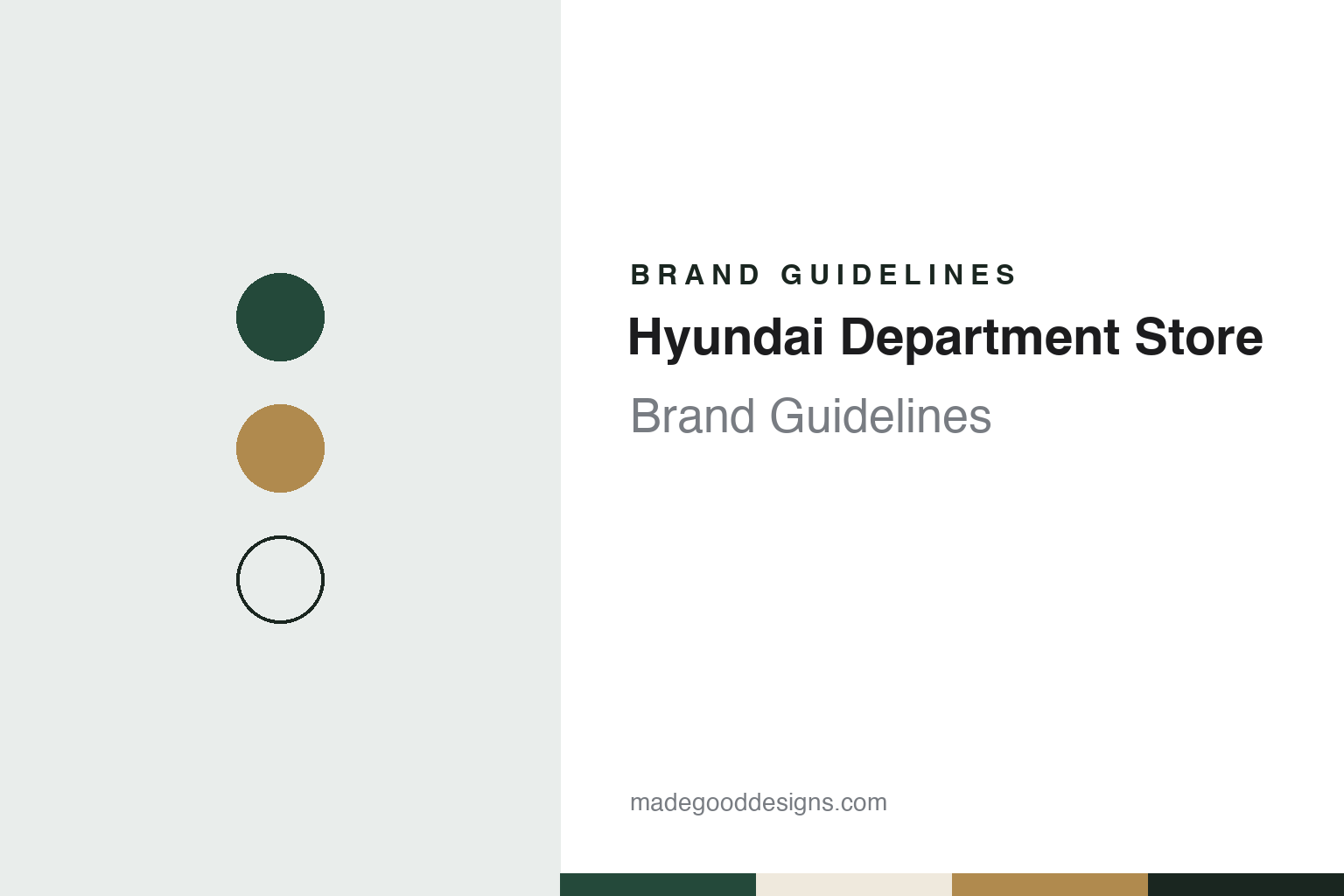
Hyundai Department Store Brand Guidelines
A Hyundai Group catering company that became a department-store chain, then dropped the word.
Aa
Two constants: a forest green, stone and brass palette and a Korean myeongjo serif register. Abstract homage — not a Hyundai Department Store product or mark; no logo, sign or shopping bag is reproduced.
Geumgang Development
A catering company that became a store group.
Hyundai Department Store is one of South Korea’s main department-store chains, run by Hyundai Department Store Co. within the wider Hyundai Department Store Group. It shares its name and early history with the Hyundai business group, from which it was separated in April 1999, according to the company’s own published history.
The company traces its start to 15 June 1971, when Geumgang Development Industry Co. was founded, the group’s history says. The business publication Bizwatch, reporting on the group’s 50th anniversary in June 2021, described the company in those years as one that handled staff welfare, group catering and work uniforms for the Hyundai Group; the group’s timeline adds a catering division set up in June 1973. Korean Wikipedia gives the company’s founding year as 1968, while the group’s timeline and Bizwatch both give 1971.
Retail came gradually. In 1975, Bizwatch reported, the company took on the running of a supermarket in the shopping arcade of a large apartment complex that Hyundai Construction was building in Apgujeong-dong, in Seoul’s Gangnam district. The first store bearing the Hyundai name in the group’s timeline opened in Ulsan: on 20 July 1977 the company’s Ulsan office opened the Hyundai Shopping Center in Ulsan, according to the group. It is today’s Ulsan Dong-gu store, and Korean Wikipedia says it served in effect as the main store until 1985. In April 1979 the company opened the Geumgang Shopping Center in Apgujeong-dong.
The department-store name arrived on 1 December 1985, when the Apgujeong main store opened, the group says. Bizwatch wrote in 2021 that the store drew attention by presenting itself as a “culture department store”, built on the idea that a store should suggest a way of living rather than simply sell goods. The company listed its shares in June 1989 and changed its name from Geumgang Development Industry to Hyundai Department Store Co. on 1 April 2000. In November 2002 it split its non-department-store businesses into a separate company, Hyundai Department Store H&S, the group’s timeline says.
Colour
Stores, outlets and acquisitions.
The chain grew store by store through Seoul and the regions. The group’s timeline lists the Trade Center store in Samseong-dong on 3 September 1988, Busan in August 1995, Cheonho in August 1997, the Ulsan store in March 1998 and Sinchon in September 1998, followed by Mia in 2001 and Mokdong in 2002. Korean Wikipedia says the Sinchon store was the former Grace department store, which the company took over in 1998, and that the Ulsan store came from the local Juriwon store, bought in March 1998.
From 2009 the company added younger formats and new regions. The first U-Plex young-fashion annex opened at Sinchon in August 2009, followed by stores at Kintex in 2010, Daegu in 2011, Chungcheong in Cheongju in 2012 and Pangyo, south of Seoul, on 21 August 2015, where the Hyundai Children’s Book Art Museum opened at the same time, according to the group. Outlets came with the Hyundai City Outlet at Gasan in May 2014 and the Hyundai Premium Outlet at Gimpo in February 2015.
Some stores closed. Korean Wikipedia lists the Bupyeong store, closed in July 2003 when the Jungdong store in Bucheon opened; the Banpo store, closed in January 2005; the Gwangju store, which the company ran under a management contract from 1998 until June 2013; and the D-Cube City store at Sindorim in Seoul, leased from 2015 and closed on 30 June 2025. In Busan, the store shut at the end of July 2024 for renovation and reopened in September 2024 as Connect Hyundai, the same source says.
The group also widened beyond department stores. Its timeline records the purchase of the furniture maker Livart in February 2012 and the fashion company Handsome in March 2012, the launch of the online mall thehyundai.com in January 2016, a duty-free company set up in August 2016 and the H.Point membership programme in August 2017.
Typography
Design and documentation.
South Korea’s large retailers tend to present themselves through formats before slogans. A single group may run hypermarkets, warehouse stores, supermarkets, convenience stores and online malls side by side, each with its own name on the fascia, and corporate pages usually open with a timeline: the first branch, the district it stood in, the year it opened, and then each new format as it was added.
The big-box stores carry much of their identity on the shelf. Hypermarkets sell groceries alongside clothing, household goods and electronics under one roof, and own labels give them names to point to in the aisle, from value ranges to premium ready meals. Warehouse formats lean on large packs and goods shown in boxes or on pallets, so that the display itself signals the way the store sells.
Department stores and convenience chains work at opposite scales. Department-store groups put their weight into the building, the façade and the flagship in a city centre, while convenience chains rely on a short name and a bright fascia that has to read from a street corner and repeat across a large network of small shops. Beauty and lifestyle chains, and the apps that sit alongside all of these stores, carry the same names into a much smaller frame.
Behind the shop fronts sit corporate structures that the companies set out in plain terms: founding groups, spin-offs, joint ventures with foreign retailers, private-equity owners and listings on the Korea Exchange. Names have changed as partners arrived or left, and some chains have gone through court-supervised rehabilitation. For a designer, that history explains why a fascia, a logotype or an own-label pack looks the way it does today.
Aa
A Korean myeongjo serif for a store that sells a way of living. (Specimen set in Nanum Myeongjo, a serif STAND-IN; NOT the Hyundai Department Store logo.)
The Hyundai
Dropping “department store” from the name.
The clearest change to the brand came in Yeouido, in western Seoul. On 26 February 2021 the company opened The Hyundai Seoul in the Parc.1 complex, leaving out the words “department store”, used in its store names since the Apgujeong store opened in 1985, The Asia Business Daily reported in January 2021. The paper said the store ran from seven basement levels to eight floors above ground, with a sales area of 89,100 square metres, under the theme “Sound of the Future”.
The design leaned on daylight and planting. Floors one to five were laid out around an oval circuit that the paper compared to a large cruise ship, with walkways up to eight metres wide; the ceilings were glazed, and voids opened the building from the roof down to the first floor to let in natural light. On the first floor stood a 12-metre artificial waterfall and a Waterfall Garden, and on the fifth an indoor park called Sounds Forest, of about 3,300 square metres, with grass, around 30 trees and flowers. The basement food hall was named Tasty Seoul, a nod to the foreign visitors the company hoped to draw, the paper said.
The Korea Times, reporting in January 2021, described the building as decorated with futuristic and nature-friendly concepts and mentioned robots to guide shoppers to their destinations. It also quoted an industry source who doubted the idea was new, pointing to Shinsegae’s Starfield mall in Hanam, opened in September 2016, and to the IFC Seoul mall across the street.
The shorter name has since spread. Korean Wikipedia lists the Daegu store as The Hyundai Daegu, and the Busan store reopened in 2024 under the Connect Hyundai name.
For a design guide, Hyundai Department Store shows how a store brand can drop its category word and let architecture, daylight and planting carry the identity instead. Compare Lotte Duty Free, another Seoul retail brand, and Olive Young. For this guide we use a deep forest green, warm stone and a brass tone with a serif, an unofficial interpretation; no product or logo is reproduced.
Explore & save
Keep Hyundai Department Store’s identity on hand — save it to a board in the Made Good inspiration library.
Hyundai Department Store identity set
Pin the Hyundai Department Store forest green, stone and brass palette and the Korean myeongjo serif register to your own board.
Source & notes
Frequently Asked Questions
What font can I use to match the Hyundai Department Store look?
This guide describes Hyundai Department Store’s type as “A Korean myeongjo serif for a store that sells a way of living”. Its type specimen is set in Nanum Myeongjo from Google Fonts as a stand-in; Nanum Myeongjo is not Hyundai Department Store’s own lettering.
What colours are in the Hyundai Department Store palette?
This guide’s Hyundai Department Store palette is Forest green #24493A, Deep pine #1A2620, Warm stone #EFE9DD, Brass #B08A4E and Paper #F9F7F2. The tones are the guide’s own unofficial interpretation, not official Hyundai Department Store hex codes.