Kyobo Book Centre Brand Guidelines
Kyobo Life’s Gwanghwamun bookshop, its reading tables and its handwriting fonts.
Aa
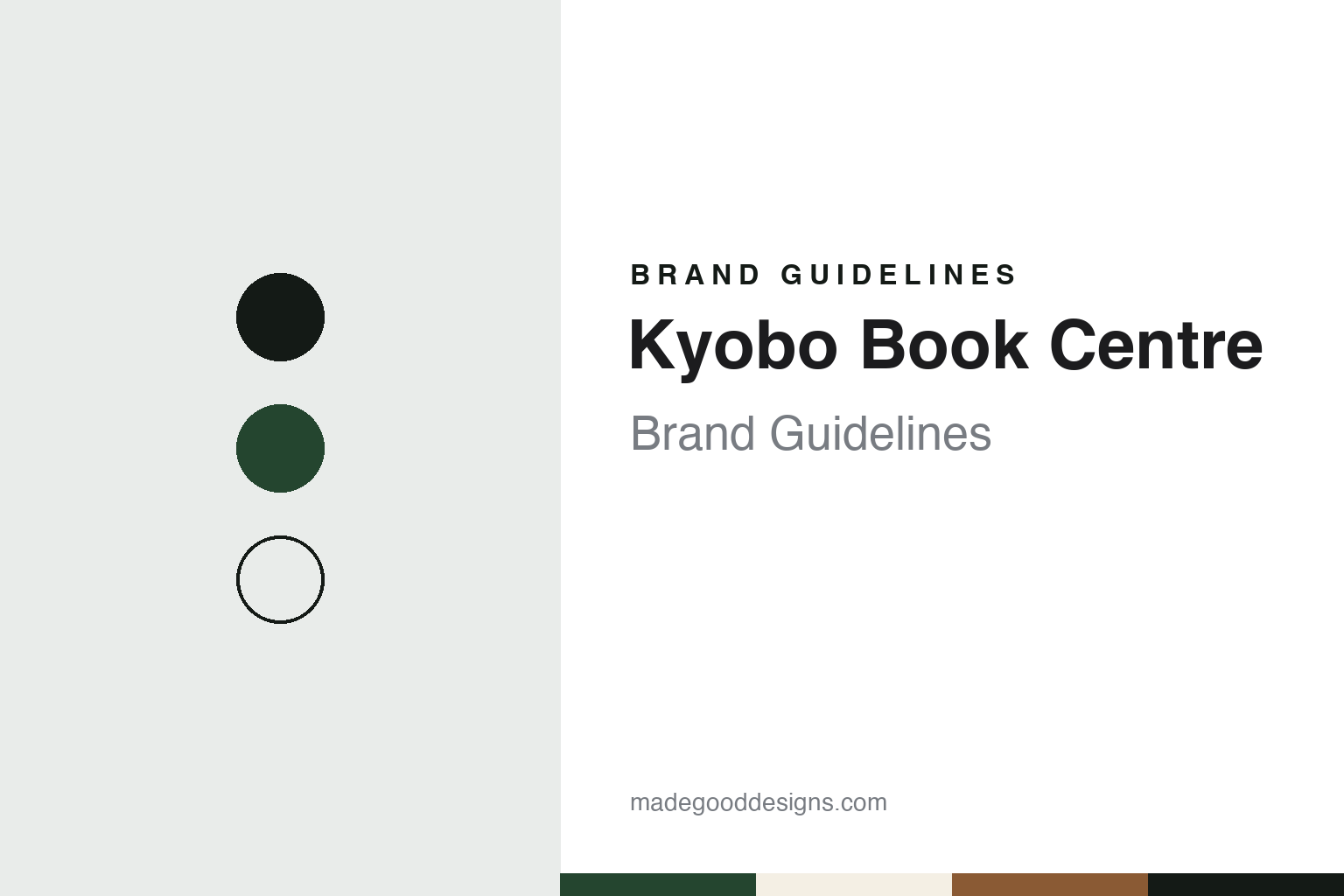
Two constants: a Kyobo forest green, paper and kauri brown palette and a Classic serif register. Abstract homage — not a Kyobo Book Centre product or mark; no logo, sign or shopfront is reproduced.
A bookshop under an insurer
Kyobo Life’s basement, 1980.
Kyobo Book Centre is the bookshop chain of the Kyobo Life insurance group, and its story starts in a basement. In 1980, when Shin Yong-ho, the founder of Kyobo Life, built the company’s new headquarters in central Seoul, he proposed putting a large bookshop in the building’s basement, Korea JoongAng Daily reported in 2005. Most of his executives objected, the paper said, because other businesses were offering a great deal to use the space, but he went ahead. Kyobo Life itself dates from August 1958, when Shin founded it as Daehan Kyoyuk Insurance — “kyoyuk” means education in Korean — and it took the Kyobo name in 1995, according to a 2009 JoongAng Daily profile.
Sources give two dates for the start because the company and the shop began at different times. The company was set up in December 1980: Korean Wikipedia gives 24 December 1980 as its founding date, and the 2005 JoongAng Daily report also places the setting-up in 1980. The shop itself opened at Gwanghwamun on 1 June 1981, The Korea Times reported on the chain’s 30th anniversary in 2011, and English Wikipedia likewise says the first store opened six months after the company was established. A 2023 Korea Times article gives 1981 as the founding year, while a June 2026 Herald Business report gives 1980.
The ownership has stayed in the group. In 2005 JoongAng Daily reported that Kyobo Life held all of the bookshop’s shares, and that an insurance rule in force since 1998 generally barred insurers from owning businesses unrelated to insurance; Kyobo Life was allowed to keep the bookshop because it had been set up before the rule took effect. Korean Wikipedia describes Kyobo Book Centre as an affiliate of the Kyobo Life group, with its head office in Paju Book City, the publishing district north-west of Seoul, and its main store still in the basement of the Kyobo Life Building at Gwanghwamun.
The chain’s motto came from the founder. Korean Wikipedia says Shin wrote the line “People make books, and books make people” when the shop opened, to encourage reading, and the Herald Business reported in June 2026 that the phrase is carved on a stone in front of the shop. Kyobo Life has separately run the large poetry board on the outside of its Gwanghwamun building since 1991, a project begun at Shin’s suggestion and changed four times a year, the Asia Business Daily reported in 2020.
Colour
Gwanghwamun, rebuilt three times.
The Gwanghwamun store has been remodelled several times. The Korea Times dated the first large renovation to 1991 in its 2011 anniversary article and to 1992 in a 2016 article, which said that refit added a music store and snack bars to the bookshop; English Wikipedia says the 1991 works enlarged the underground space to about 9,000 square metres. The chain also sells music and stationery under the Hot Tracks name, according to English Wikipedia.
In 2010 the store closed in April and reopened at the end of August after five months of work. The Korea Times reported in August 2010 that the refit was built around the ideas of “communication” and “future,” with print-on-demand for sold-out and out-of-print titles and two reading sections, Guseojae and Samhwanjae, modelled on the libraries of the Joseon-era scholars Lee Deok-mu and Chae Ji-hong. Korea JoongAng Daily described a wider glass entrance, a ceiling raised from 2.6 to 2.9 metres with an installation by the artist An Jong-yeon, marble aisles, wooden floors under the shelves and a colour-coded system for the sections — red for foreign books and yellow for children’s books, among others.
The third refit, finished on 15 December 2015, put two long reading tables at the centre of the shop, each 11.5 metres by 1.5 metres and seating 50 people, The Korea Times reported in January 2016; the bookshop said they were made of kauri pine from trees that had lain in New Zealand marshes for more than 50,000 years. The same refit added sofas and benches at about 20 spots, an art space, a children’s reading area and five book concierge desks, and the paper put average daily visitors at about 40,000.
Beyond Gwanghwamun, the chain opened a large store of about 11,900 square metres under the Kyobo Tower in Gangnam in May 2003, English Wikipedia says, connected since 2009 to Sinnonhyeon station on Seoul Metro Line 9. As of 2011 there were ten stores in seven cities, The Korea Times reported; Publishers Weekly counted Gwanghwamun and 13 other locations in March 2014; and Korean Wikipedia gives 42 stores as of January 2019. The main store has also appeared on screen: English Wikipedia notes it was a filming location for the 2007 MBC drama Coffee Prince.
Typography
Design and documentation.
South Korea’s online marketplaces present themselves first through their apps. When eBay Korea reworked Gmarket in 2021, The Korea Times reported, the change ran from the logo and a company-made typeface to icons, loading animations and a simpler home screen built around a larger search bar. In 2022 11st carried its new gradient logo onto its app icon, its in-app banners and its “buy” button, the Munhwa Ilbo reported.
Several platforms now publish their design rules. 11st opened a public design-system website in 2024, with logo rules, a house typeface and guidance on colour, grids and icons, according to the design magazine Design Compass, while Gmarket made its Gmarket Sans typeface free for anyone to use. Naming tends to be plain and descriptive. “Open market” is the usual Korean term for a platform on which independent sellers list goods, and membership schemes and sale days carry their own names, such as Gmarket’s Smile Club.
The bookshop chains in this group work across screens and shop floors alike, so their identities reach from websites and apps to delivery boxes, flagship bookshops, reading lounges and campaign graphics. Each guide describes those materials only as the companies themselves publish them, or as dated press reports describe them, and names platforms and stores in the form the companies use in English.
Ownership is part of the story across the sector. Gmarket passed from Interpark to eBay, then to Shinsegae, and into a joint venture with Alibaba; 11st moved between SK companies and outside investors before becoming a subsidiary of SK Planet at the end of 2025. Each guide sets out founders, owners and stock-market listings as dated facts from corporate pages, official registers and independent press, and marks clearly what rests only on a company’s own word.
Aa
A classic serif — “People make books, and books make people.” (Specimen set in Fraunces, a serif STAND-IN; NOT the Kyobo Book Centre logo.)
Kyobo Book Centre
Fonts drawn from readers’ hands.
Kyobo has also moved online and into digital reading. Korean Wikipedia says the chain runs the Internet Kyobo Book Centre and that on 26 May 2009 it launched Baro Dream, which lets customers order online and collect from a shop about an hour later. In February 2013 it started Sam, a subscription e-book service with its own e-reader, Publishers Weekly reported in 2014, when the chain had about 70 staff in its digital division. Korean Wikipedia adds a business-to-business reading service, Reading Tree, launched in December 2015, and a digital library service for public, school and company libraries.
For a design guide, the most useful thread is handwriting. Kyobo has run a handwriting campaign since 2015, built around the yearly Kyobo Handwriting Contest, in which entrants copy out a passage from a book by hand, and around free fonts drawn from winners’ entries, the Asia Business Daily reported in 2023. On 2 April 2020 the chain began giving away Kyobo Handwriting 2019, based on the hand of a 12-year-old who won the children’s top prize among 6,298 entries to the fifth contest. Yoon Design Group spent about three months digitising it, keeping variable character widths, a visual baseline set slightly above centre, and rounded stroke ends that recall the ink of a sign pen, the same paper reported; the font may be used in print, on the web, in advertising and in video.
The chain’s other visual cues come from its shops: the motto on its stone, the colour-coded sections of the 2010 refit, and the long kauri tables of 2015. Its own literary events are part of the record too — The Korea Times reported in 2011 that the main store marked its 30th year with talks by authors chosen in a survey of some 20,000 readers and an exhibition of 30 publishers, including Minumsa and Gimmyoung.
For a design guide, Kyobo Book Centre shows how a bookshop can build an identity from reading itself — a motto, a reading table and a typeface made from a reader’s hand. Compare Yes24, the Seoul online bookshop that later opened its own stores, and Aladin, another Korean bookseller. For this guide we use a forest green, warm paper and a kauri brown with a serif, an unofficial interpretation; no product or logo is reproduced.
Explore & save
Keep Kyobo Book Centre’s identity on hand — save it to a board in the Made Good inspiration library.
Kyobo Book Centre identity set
Pin the Kyobo forest green, paper and kauri brown palette and the Classic serif register to your own board.