Elektra Brand Guidelines
Radios from Monterrey, then a national store chain.
Aa
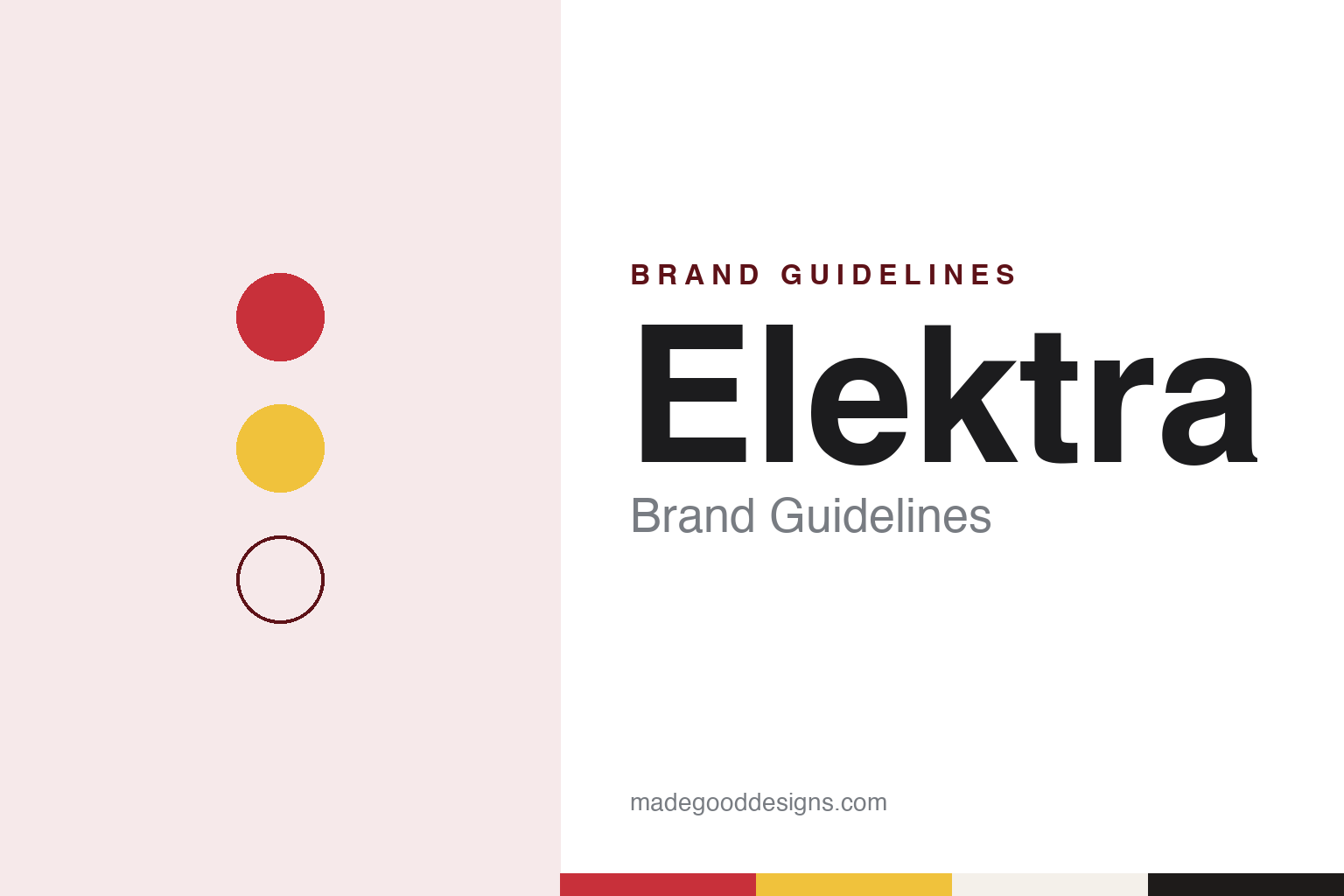
Two constants: a red, marigold and ink palette and a grotesque sans register. Abstract homage — not an Elektra asset; no logo, sign or product is reproduced.
Elektra Mexicana
Radios from Monterrey.
Elektra dates from 1950 and from Monterrey, the industrial capital of Nuevo León. English Wikipedia says the business was launched that year by Hugo Salinas Price as a small appliance store that first specialised in radio equipment. Other accounts put the weight on manufacturing and on the family firm behind it. Spanish Wikipedia says Elektra began as a factory making appliances for Salinas y Rocha, the family store chain of Salinas Price’s father, Hugo Salinas Rocha, and that Salinas Price directed the company from 1952 to 1987. A September 2026 history in El Imparcial, drawing on the chronology Grupo Salinas publishes, describes Elektra Mexicana being created in 1950 to make and sell radios and later televisions, with Hugo Salinas Price taking the leading role there in 1961.
Salinas Price recalled the early years in a 2020 interview quoted by SDP Noticias in December 2024. He became manager in 1952, at about twenty, with older men as his assistants, and the firm made radios — or, as he put it, tried to — in several forms: table sets that combined a record player and a radio, radios on their own, and larger cabinets meant to look like furniture.
The family business behind it was older still. El Imparcial says, citing Grupo Salinas, that Benjamín Salinas y Compañía was set up in 1906 selling household goods, beds above all, and that on 28 December 1917 Benjamín Salinas Westrup and his brother-in-law Joel Rocha Barocio formed Salinas y Rocha, a furniture business that began in Monterrey. By 1961, according to the same corporate history, that chain had 38 stores.
Colour
From radios to a store chain.
Elektra moved from making goods to selling them. At first, English Wikipedia says, it served only wholesalers; as that model declined, it shifted to retail, adding furniture, televisions and household goods and opening stores across the country. In the mid-1980s the management passed to Salinas Price’s son, Ricardo Salinas Pliego, who had joined in 1981 as imports manager, SDP Noticias says, and who became president in 1987. The company listed its shares on the Mexican stock exchange in 1993, English Wikipedia says.
The group then gathered other names around the stores. In 1999 Elektra won the auction for Salinas y Rocha, the family’s former chain; El Imparcial, citing Grupo Salinas, says its 96 stores returned to the Salinas family on 10 March 1999. In November 2004, English Wikipedia says, the group launched the Italika motorcycle brand with the South Korean maker Hyosung, and in 2008 it opened an assembly plant for it in Toluca, in the State of Mexico. Forbes, as quoted by English Wikipedia, has described Italika as sold in Elektra stores as well as through other retailers.
The store format reaches beyond Mexico, though not everywhere it went. English Wikipedia describes Elektra stores in Mexico, Honduras and Guatemala, selling household appliances, consumer electronics, computers, mobile phones and furniture; it says that as of March 2025 the wider group reported operations in Guatemala, Honduras and Panama as well as Mexico. In Peru, where Elektra had been the group’s main store format, the chain closed all its stores in July 2021 after 24 years there, the Lima business daily Gestión reported on 7 July 2021, quoting a short company notice thanking customers; Grupo Elektra had announced its exit from the country in November 2020.
As of January 2026 Elektra had more than 1,300 stores, La Crónica de Hoy reported, in a piece marking the company’s 75th anniversary and its start in Monterrey selling radios and televisions.
Typography
How the stores present themselves.
The department stores of Mexico and Chile are big, city-centre and shopping-mall businesses, and their identities are carried as much by buildings as by logos. Two of the oldest, Liverpool and El Palacio de Hierro, began as nineteenth-century clothing and fabric shops in the historic centre of Mexico City, and Liverpool’s corporate history page still traces the chain back to that first shop of 1847 and lists, year by year, its moves into shopping centres and other cities.
Store naming is often plain description or a borrowed place. El Palacio de Hierro, according to English Wikipedia, took its name from the iron-and-steel building that rose in the 1880s; Liverpool, Spanish Wikipedia says, was named after the English port its imported goods were shipped from. Branches then take the name of the district or mall they anchor, so a shopper meets the brand as “Liverpool Insurgentes” or “Liverpool Polanco,” and Spanish Wikipedia writes of “Palacio Polanco.”
The flagship façade does a great deal of the work. Downtown stores keep their early buildings, and newer flagships are built as architecture in their own right — El Palacio de Hierro’s Polanco store, reopened in 2015, has floors themed on districts of the city. Seasonal campaigns are just as visible: El Financiero has described Liverpool’s recurring Venta Nocturna sales, held over two or three days several times a year, and the Christmas tree that El Palacio de Hierro raises in front of its Polanco store with a luxury partner: Dior in 2025 and Swarovski in 2026.
Store cards carrying the chain’s name are part of the picture too: El Financiero notes that Liverpool pitches some sale offers to its own cardholders, though this guide does not describe the credit products themselves. Corporate pages also set out owners and listings: both Mexican groups have long been listed on the Mexican Stock Exchange, and Liverpool’s investor site carries its annual and quarterly reports beside a year-by-year history.
Aa
A sturdy grotesque sans for a store-sign register. (Specimen set in Archivo, a sans STAND-IN; NOT the Elektra logo.)
Elektra
From listed company to private group.
Grupo Elektra spent more than three decades on the Mexican stock exchange before leaving it. On 27 December 2024 its shareholders approved a plan to take the company private and cancel its listing, El CEO reported that day. The exchange suspended trading in the shares from 30 September 2025, SDP Noticias reported, because the company said it could no longer meet the minimum share of its capital in public hands while the cancellation was under way. In April 2026 the company said it had completed the legal requirements to cancel the registration of all its shares in the national securities register, and had set up a trust to buy the shares still held by the public, Bloomberg Línea reported.
The group has also been through long tax litigation. On 13 November 2025 the full bench of Mexico’s Supreme Court unanimously dismissed appeals brought by Grupo Elektra, leaving in place collegiate-court rulings that ordered it to pay tax assessments, Político MX reported; Proceso reported the same day that no further appeal was open against those rulings.
Elektra sits within Grupo Salinas, the business group led by Ricardo Salinas Pliego, and the stores share their parent with financial businesses that sit outside this guide. The name is also used by an unrelated company, the American record label Elektra Records.
For a design guide, Elektra shows how the name of a Monterrey radio maker can become the sign over a national chain of stores. Compare Coppel, another Mexican chain that grew from a family shop in the north, and Liverpool, the Mexico City department-store group. For this guide we use a signal red, a marigold and ink with a sans, an unofficial interpretation; no product or logo is reproduced.
Explore & save
Keep Elektra’s identity on hand — save it to a board in the Made Good inspiration library.
Elektra identity set
Pin the Elektra red, marigold and ink palette and the grotesque sans register to your own board.