İpekyol Brand Guidelines
The Istanbul womenswear group and its Edirne factory.
Aa
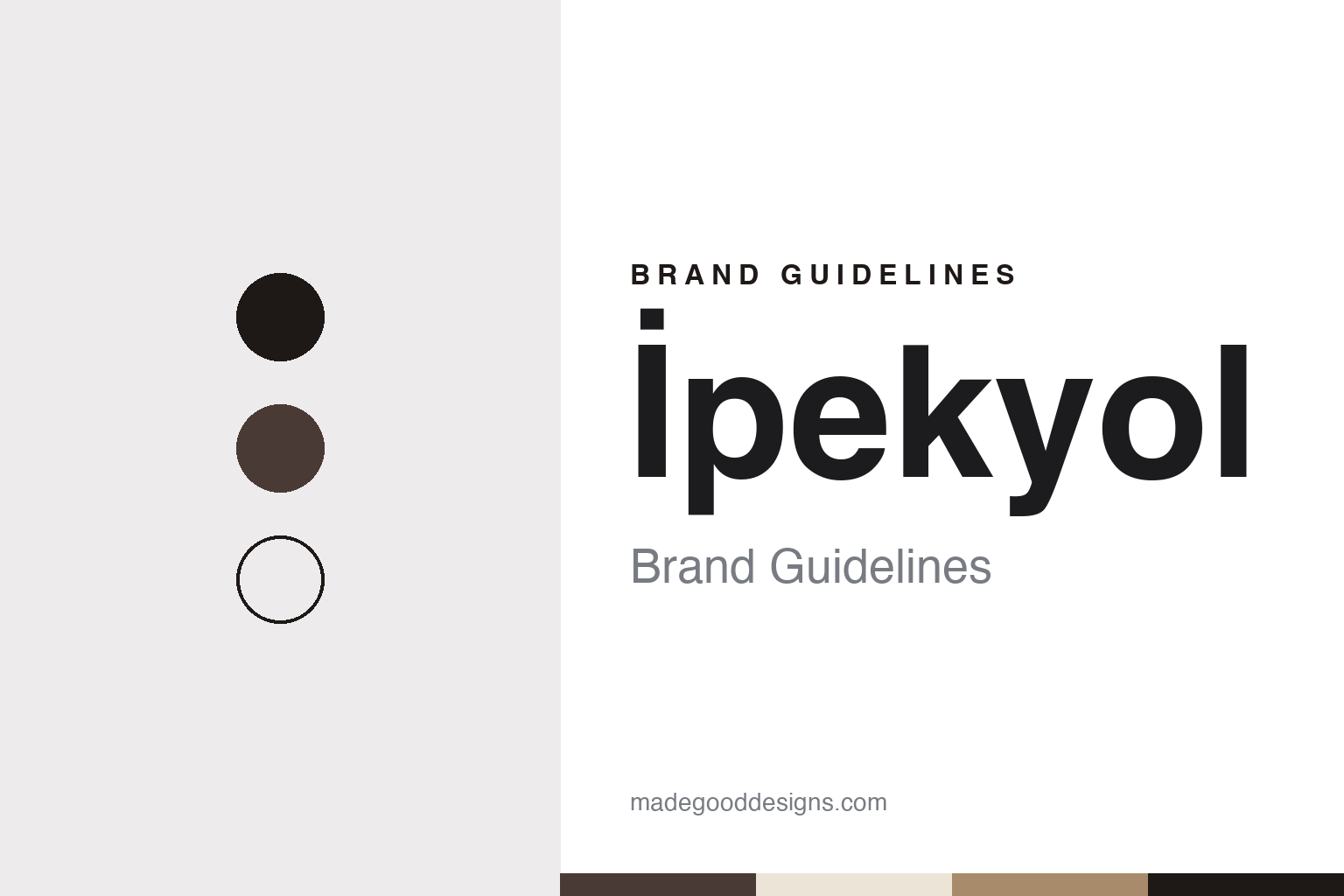
Two constants: an espresso, cocoa and raw silk palette and a silk-road serif register. Abstract homage — not an İpekyol product or mark; no garment, logo or monogram is reproduced.
Şişli
A womenswear label from Rumeli Caddesi.
İpekyol — the name means “Silk Road” in Turkish — is an Istanbul womenswear brand, and its company writes it in capitals as IPEKYOL and calls itself Ipekyol Group. The group says its foundations were laid in 1986 by Yalçın Ayaydın, who came to Istanbul from Mardin in south-eastern Türkiye and is still its chairman. Hürriyet, interviewing him in May 2006, also gave 1986 as the year he founded İpekyol.
The company dates its original shop to 1989, on Rumeli Caddesi in Şişli, which it describes as one of the busiest ready-to-wear streets of the time. It sells women’s clothing alongside bags, shoes and accessories, and describes the brand as day-to-evening dressing for the modern woman.
For two decades the brand did not make its own clothes. In the 2006 interview Ayaydın told Hürriyet that İpekyol had used contract manufacturers for all of its production for two decades, and that he was building his own factory because the pool of contract makers he relied on had shrunk sharply. At that point, the paper reported, İpekyol had about 50 shops in Türkiye and abroad, with stores in Kazakhstan, Azerbaijan, Latvia, Romania, Abu Dhabi and Athens, where its own Greek company, İpekyol Hellas, had opened its earliest shop at the start of 2006.
The group grew by adding labels. It says Twist, a younger street-inspired brand, followed in 1997, and that Machka joined in 2004 as an occasion-wear label created in collaboration with Dice Kayek, with collections designed by Ece Ege. The company also says its move abroad began in 2002 with a store in Abu Dhabi.
Colour
A factory that won an architecture award.
The most documented part of İpekyol’s story is a building. In 2006 the company opened its own clothing factory in Edirne, in Türkiye’s far north-west near the Greek and Bulgarian borders. Ayaydın told Hürriyet in May 2006 that the 17,000-square-metre plant would begin production that June with about 250 workers, and that he chose Edirne because it was close to both Istanbul and Europe and had a long textile tradition. He also told the paper that it would be the third clothing factory in the city, and that it had been built without a state investment incentive.
The factory was designed by Emre Arolat Architects. The Aga Khan Development Network’s project record lists the Ipekyol Textile Factory as a recipient of the Aga Khan Award for Architecture in the 2008–2010 award cycle, with Deyko and Twist Giyim as clients, design in 2004–2005, completion in 2006 and a size of 20,000 square metres. The record describes a single U-shaped building that puts administration and production under one roof, with the U following the production line from cutting to packing and dispatch, a glazed southern façade, five internal courtyards, gardens and light wells that give staff daylight and views, and the use of local materials.
The group’s own website describes the Edirne site as an integrated ready-to-wear plant and gives the Aga Khan award as one of its milestones.
The brand’s visual identity was renewed more recently. The group says that in 2022 the IPEKYOL logo was redrawn after an eight-month design process led by the French art director Thomas Schwab, and that a Monogram Collection of bags, wallets, shoes, silk scarves, gloves and hats was built around an IPK symbol. The same year, it says, it introduced IPEKYOL Cosmetics, a line of personal-care and home-fragrance products and gift sets.
Typography
Design and documentation.
Turkish fashion, denim and footwear chains are mostly met in person, in shopping centres. Trade reports on these companies’ expansion abroad tend to describe the same kind of opening: a new unit in a regional mall, the brand name across the fascia, and a launch event at the door. For a design reader, the store front is where the identity is fixed, and the shopping bag is the version of it that leaves the building.
The names are short and usually written as plain lettering. Some of these chains use a word or an abbreviation rather than a symbol, and where a mascot or emblem once existed, published histories describe it being folded into a typographic logo. Campaign imagery, rather than the logo, carries most of the season-to-season change: model-led photography, designer collaborations and named collections are how the companies present each range.
Collection and store naming is generally descriptive. Sub-brands and formats tend to add a plain word to the parent name, such as Home, Outlet or Baby, so the parent name stays visible on every sign. In this guide we describe those ranges by the names the companies publish, without judging one against another.
The corporate side matters too. Some of these businesses began as small family shops or wholesale labels in Istanbul and later became large groups, some of them listed on Borsa Istanbul. Their corporate pages on founders, owners, board members and listings are part of the brand’s public face, and the guides in this series draw on those pages alongside dated independent reporting. The palettes shown are our own unofficial interpretations, not company colour standards.
Aa
A silk-road serif — capitals with a fine contrast. (Specimen set in Cormorant Garamond, a serif STAND-IN; NOT the İpekyol logo.)
İpekyol
An Istanbul group with an Italian partner.
İpekyol has had a foreign partner since 2008. In June 2008 Milliyet reported that the Italian textile and fashion group Miroglio, which its chief executive said had been in the textile business since 1947, had become a 50 per cent partner in the Ayaydın group companies that owned İpekyol, Twist and Machka. In August 2016 the retail trade magazine AVM Dergi described the resulting Ayaydın-Miroglio group as founded in 2008 through that partnership.
The same 2016 report gave a picture of the chain at that date. The group said it had taken İpekyol and Machka to Italy that year, and listed 200 stores in 42 Turkish cities — 136 İpekyol, 58 Twist and six Machka — with the 200th, an İpekyol shop, opening at the Akbatı shopping centre in Istanbul. Abroad, it listed 15 stores in Iran, Saudi Arabia, Kuwait, Qatar, Bahrain, Cyprus and Azerbaijan.
The company’s own timeline adds later steps: online stores in 2012, sales through Zalando from 2019, and in 2023 a Dubai store at The Mall that it says it runs directly from head office. As of its website in September 2026, Ipekyol Group said it had more than 300 stores in Türkiye and abroad, a head office in Şişli and the Edirne factory. In March 2026 ELLE Türkiye reported that the Italian label Trussardi was entering Türkiye with Ipekyol Group, and the group says that, under its partnership with Miroglio, a Trussardi store opened in Antalya in 2026. The group is led as chief executive by Uğur Ayaydın, according to ELLE Türkiye.
For a design guide, İpekyol shows how a fashion brand can carry its identity into a building as well as a logo, from an Edirne factory to a redrawn monogram. Compare Network, another Istanbul ready-to-wear label that changed hands at group level, and Koton, a Turkish fashion chain. For this guide we use espresso, cocoa, raw silk and a gilt sand with a serif, an unofficial interpretation; no product or logo is reproduced.
Explore & save
Keep İpekyol’s identity on hand — save it to a board in the Made Good inspiration library.
İpekyol identity set
Pin the İpekyol espresso, cocoa and raw silk palette and the silk-road serif register to your own board.
Source & notes
Frequently Asked Questions
What font can I use to match the İpekyol look?
This guide describes İpekyol’s type as “A silk-road serif — capitals with a fine contrast”. Its type specimen is set in Cormorant Garamond from Google Fonts as a stand-in; Cormorant Garamond is not İpekyol’s own lettering.
What colours are in the İpekyol palette?
This guide’s İpekyol palette is Espresso #1E1917, Cocoa #4A3A36, Raw silk #EDE4D8, Gilt sand #A88B6A and Paper #F8F5F0. The tones are the guide’s own unofficial interpretation, not official İpekyol hex codes.
When was İpekyol founded?
İpekyol was founded in 1986, in Istanbul, Türkiye. This guide gives Edirne, by Emre Arolat Architects (completed 2006) as where İpekyol is made.
Who founded İpekyol?
İpekyol was founded by Yalçın Ayaydın in 1986. This guide gives Edirne, by Emre Arolat Architects (completed 2006) as where İpekyol is made.
Where is İpekyol made?
İpekyol is made in Edirne, by Emre Arolat Architects (completed 2006).