RT-Mart Brand Guidelines
A 1996 Ruentex hypermarket, Sun Art, Alibaba and DCP Capital.
Aa
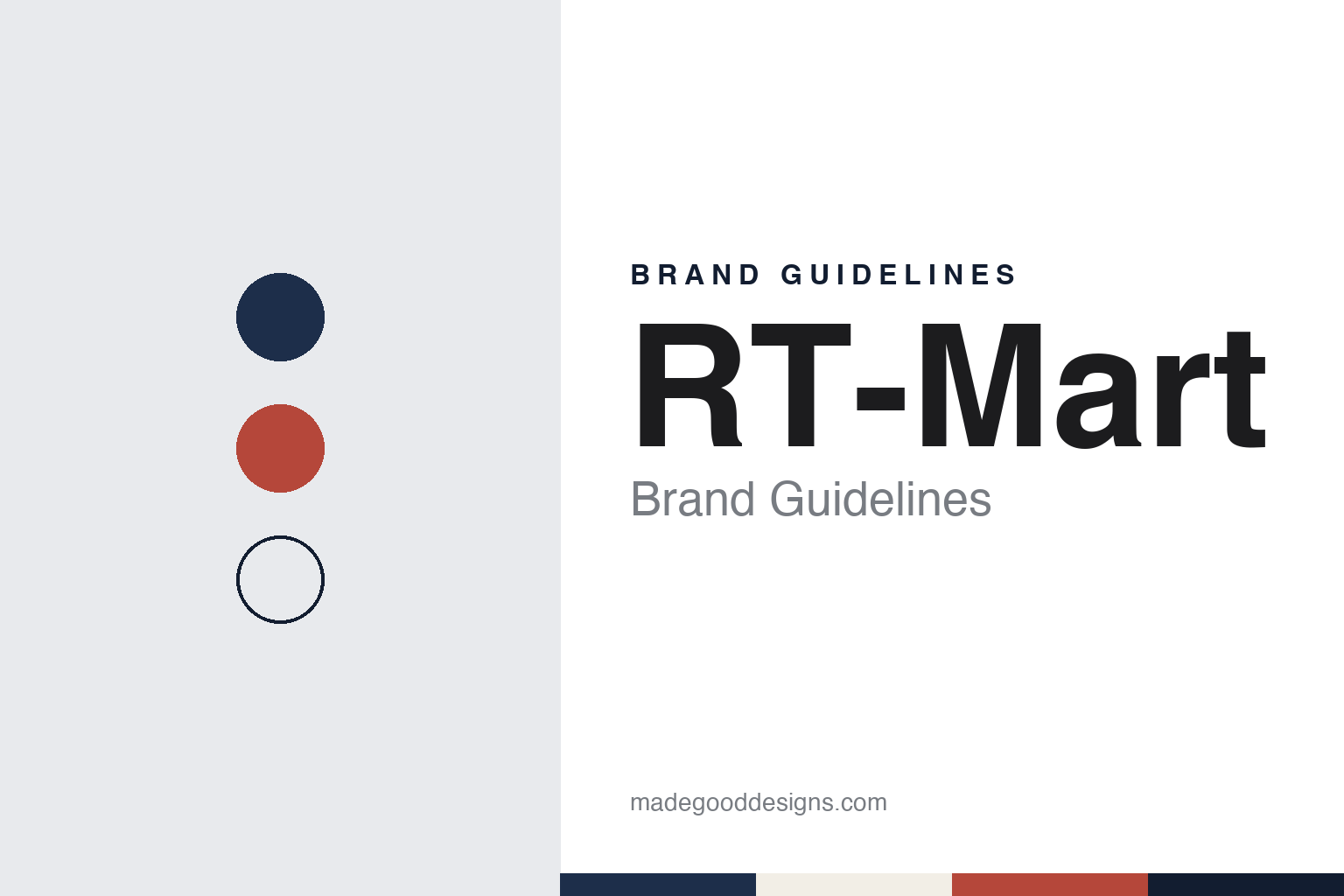
Two constants: an ink blue, cream and red palette and a sturdy hypermarket sans register. Abstract homage — not an RT-Mart product or mark; no logo, fascia or pack is reproduced.
Ruentex and Taoyuan
A Taiwanese conglomerate opens a hypermarket.
RT-Mart, written 大润发 in simplified Chinese, began as a hypermarket brand of Taiwan’s Ruentex Group. Chinese Wikipedia says Ruentex created the brand in 1996, setting up the RT-Mart operating company in August that year, and opened the first store in 1997 in Pingzhen, Taoyuan, on the site of a former Ruentex textile mill. In 1997 Ruentex also set up Shanghai RT-Mart Co., and the first mainland store opened in Shanghai in 1998, the same source says.
Two retail groups came together at the end of the decade. On 13 December 2000, Chinese Wikipedia says, Ruentex and the French retailer Auchan formed Sun Art Retail Group as a joint venture to run both the RT-Mart and Auchan hypermarket brands on the mainland, through a jointly owned holding company that held the controlling block. From 2001 the two groups also ran RT-Mart in Taiwan together, the same source says. Sun Art listed on the Hong Kong stock exchange on 27 July 2011.
The business was large by the time a third partner arrived. In November 2017 Sun Art ran 446 hypermarkets across 29 provinces and autonomous regions under the Auchan and RT-Mart names, Yicai Global reported; its holding company Jixin then held 51 per cent, with Auchan Retail and Ruentex holding smaller direct stakes. A Yicai Global report in December 2018 gave Auchan about 70 stores of its own on the mainland.
Colour
The Alibaba years.
On 20 November 2017 Alibaba, Auchan and Ruentex announced a “new retail” cooperation under which Alibaba took a 36.16 per cent stake in Sun Art, Yicai Global reported, with the work aimed at data, digitising the stores and joining online and offline sales. In October 2020 Alibaba’s Taobao China agreed to buy nearly 71 per cent of A-RT Retail Holdings, the vehicle that owned 51 per cent of Sun Art, from Auchan, lifting Alibaba’s effective stake to about 72 per cent, Yicai reported on 19 October 2020. Chinese Wikipedia gives the economic interests after the 2017 deal as about 36.18 per cent for Auchan, 36.16 per cent for Alibaba and 4.67 per cent for Ruentex; Yicai described the 2020 purchase as Alibaba taking control. In the same 2017 report, Yicai noted that Alibaba had recently formed similar partnerships with the department-store chain Yintai, the retailer Suning, the supermarket chain Sanjiang Shopping and the mall operator Bailian.
Under Alibaba the stores were tied into its apps. Yicai wrote in 2020 that more than 480 RT-Mart and Auchan stores in over 230 cities had been connected to delivery services including Taoxianda, Ele.me and Tmall Supermarket, offering one-hour grocery delivery within five kilometres. KrASIA, reporting for 36Kr in January 2025, listed Taobao, Tmall, Freshippo and Ele.me among the Alibaba platforms the chain was linked to. On the mainland, Chinese Wikipedia says, Sun Art handed the running of Auchan’s stores to RT-Mart at the end of 2018 and from 2021 gradually replaced the Auchan name with RT-Mart.
The range of store types widened too. Yicai Global listed three chains in January 2025: RT-Mart hypermarkets, the smaller RT-Mart Super and the members-only M-Club. At the end of September 2024 Sun Art operated 502 stores, of which 466 were hypermarkets, 30 medium-sized supermarkets and six M-Club stores, and KrASIA wrote that 34 per cent of its hypermarket and supermarket space was self-owned, with the rest leased, across about 14 million square metres of retail space.
Typography
How Chinese retailers present themselves.
Chinese retailers and e-commerce platforms present themselves across a wide range of surfaces at once. A single group may run hypermarkets, appliance showrooms, shopping malls, small franchised shops and a shopping app, and each has to carry the same name at very different sizes, from a rooftop sign on a city-centre store to a small icon on a phone. Many of these companies grew from one shop or one website into groups with several store formats, so their names often began with one product category and later had to stretch to cover many.
Naming is often plain and descriptive. Store and company names commonly pair a short brand word with a description of what is sold, such as electrical appliances, and later drop that description as the business widens. Platform names and company names can swap places: a group may rename itself after its own website or app, or give an app a new name and later return to the original one. Chinese characters and an English or pinyin form usually appear side by side, and the two do not always translate each other.
Shopping festivals shape much of the visual calendar. Dates such as 11 November, known as Double Eleven, bring campaign artwork across store windows, app home screens and delivery packaging, usually set around the date itself and the company’s own name. For a designer, the useful material is how the companies publish these campaigns and how the core name holds steady while the seasonal graphics change around it.
Corporate pages fill in the rest. Listed retailers publish their founders, owners and exchange listings in annual results and announcements, and these records also show renamings, store closures and changes of control as dated facts. Read together with independent press, they give a fuller picture of how each name has been used over time.
Aa
A sturdy hypermarket sans. (Specimen set in Archivo, a sans STAND-IN; NOT the RT-Mart logo.)
RT-Mart
DCP Capital, and a new name in Taiwan.
Alibaba then sold. On 1 January 2025 it announced through the Hong Kong exchange the sale of its entire stake in Sun Art, about 78.7 per cent, to the private-equity firm DCP Capital, KrASIA reported; Yicai Global described the sale as part of Alibaba’s move away from non-core assets. Sun Art’s announcement list records completion of the share purchase on 28 February 2025, which triggered mandatory unconditional cash offers for the remaining shares; a joint announcement on 27 March 2025 recorded the close of those offers. Sun Art kept its Hong Kong listing, and its announcement list still showed regular monthly returns in November 2026.
The Taiwan business took a separate route. In December 2021 the supermarket chain PX Mart bought 95.97 per cent of RT-Mart International, the Taiwan operator, from Auchan and Ruentex, and Taiwan’s Fair Trade Commission conditionally approved the deal in July 2022, the Taipei Times reported; PX Mart said then that RT-Mart would continue as a separate brand. The commission’s conditions included limiting retail price rises to increases in wholesale costs, and giving suppliers shelf space without charge for at least three years, the paper reported. Focus Taiwan reported in June 2026 that PX Mart had completed the integration of RT-Mart under the Mega PX Mart name in 2025. Chinese Wikipedia dates that renaming to 1 August 2025 and says that, since then, the RT-Mart hypermarket name has been used only on the mainland, where Sun Art runs it.
For a design guide, RT-Mart shows a hypermarket name that began in Taiwan, grew inside a joint venture with a French retailer, passed through Alibaba’s hands and by 2025 traded only on the mainland. Compare Alibaba, its controlling shareholder from 2020 until the 2025 sale, and Freshippo, the Alibaba grocery chain named among its online links. For this guide we use an ink blue, a night ink, a receipt cream and an aisle red with a sturdy sans, an unofficial interpretation; no product or logo is reproduced.
Explore & save
Keep RT-Mart’s identity on hand — save it to a board in the Made Good inspiration library.
RT-Mart identity set
Pin the RT-Mart ink blue, cream and red palette and the sturdy hypermarket sans register to your own board.