Canadian Tire Brand Guidelines
A 1922 Toronto garage, paper money and the Bay stripes.
Aa
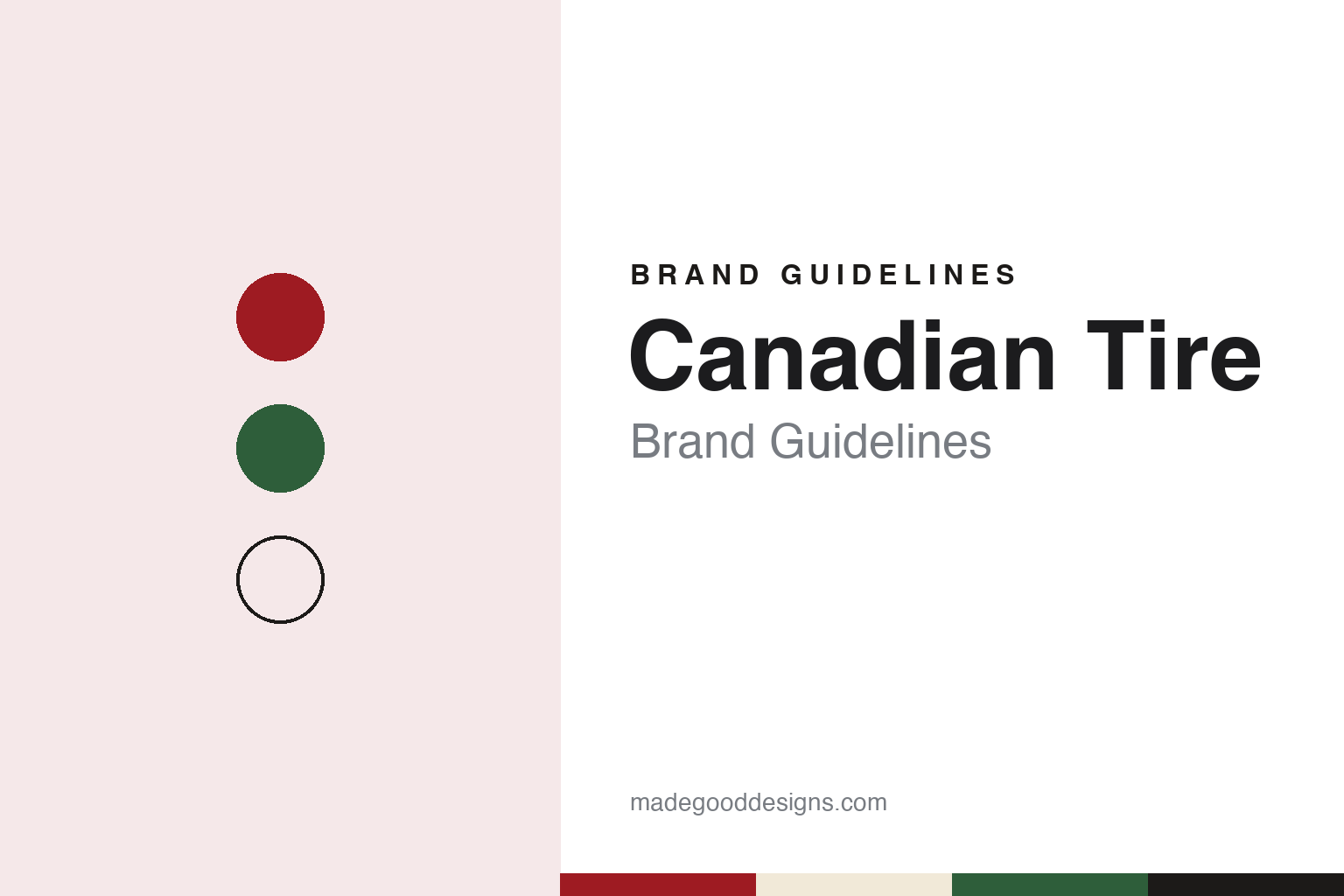
Two constants: a Canadian Tire red, green and coupon cream palette and a Workshop sans register. Abstract homage — not a Canadian Tire product or mark; no logo, coupon or store sign is reproduced.
Hamilton Tire and Garage
Two brothers, a tyre shop and a name that “sounded big.”
Canadian Tire began in Toronto in 1922. English Wikipedia dates the start to 24 October 1922, when the brothers John William Billes and Alfred Jackson Billes put their combined savings into Hamilton Tire and Garage Ltd., a business set up in 1909 as the Hamilton Garage and Rubber Company. Its trade, the same source says, was buying tyres at a discount from manufacturers in winter and reselling them in the busy summer season, from a shop at Yonge and Gould Streets. CBC News gave the same founding year, 1922, in May 2025.
The name came five years later. In 1927 the business was incorporated as Canadian Tire Corporation Limited, English Wikipedia says, because, in A. J. Billes’s words, it “sounded big.” The first Canadian Tire catalogues followed in 1928, made up of price lists along with road maps.
Growth came through Associate Stores. The first official Associate Store opened in Hamilton, Ontario, in 1934. In 1944 the company became a public company to fund its growth, and by 1945 there were 110 Canadian Tire stores, according to English Wikipedia. The first gas bar opened in 1958 at Yonge and Church Streets in Toronto, and the petroleum business, now trading as Canadian Tire Gas+, was set up the same year to bring more customers to the stores.
Not every move worked. Canadian Tire twice tried to expand into the United States: in 1982 it bought White Stores, an automotive chain based in Wichita Falls, Texas, and sold the remaining stores in 1986; and from 1991 to 1995 it ran Auto Source, an auto-parts chain in the American Midwest. A scaled-down version of that format became PartSource in Canada, English Wikipedia says.
Colour
Canadian Tire money.
The company’s most distinctive piece of branding is printed on paper. Canadian Tire money began in 1958 as a reward for customers at the gas bars, English Wikipedia says, first under the name “Gas Bonus Coupons,” giving a discount to spend in the stores. Global News reported in August 2018, when the programme turned 60, that the idea was inspired by Muriel Billes, the wife of the co-founder A. J. Billes, at a time when gas stations handed out small gifts such as cutlery to thank customers. The same report described a coupon collectors’ club whose members showed hundreds of the notes at a store in Halifax, comparing errors and variants under a magnifying glass.
The notes moved online over time. In April 2018 Canadian Tire launched Triangle Rewards to replace its digital loyalty scheme, English Wikipedia says, and traditional paper Canadian Tire money continued at some stores until 2020 for customers without a rewards card. The Global News report of 2018 noted that customers could by then collect e-money on points cards.
Its own brands carry much of the store. English Wikipedia names Mastercraft for tools and MotoMaster for automotive goods among its house brands, together with NOMA and Simoniz, two names for which Canadian Tire acquired the Canadian trademark rights. In 2013 it launched Frank, a budget range for household goods and groceries, whose packaging carries jokey product-specific lines about its namesake mascot. It also owns the hockey names Sherwood, Hespeler and Victoriaville.
The group grew by buying other retailers. It bought Mark’s Work Wearhouse, now Mark’s, in 2001; the Forzani Group, owner of SportChek and Sports Experts, in 2011; the Canadian business of Party City in 2019; and, in 2017, Padinox, the maker of Paderno kitchen equipment, according to English Wikipedia. It bought the Norwegian clothing company Helly Hansen in 2018 and, the same source says, sold it to Kontoor Brands in 2025.
Its advertising has a history of its own. English Wikipedia recalls Christmas spots in which Santa Claus and Ebenezer Scrooge argued about why to shop there, under the line “Give like Santa, save like Scrooge,” and a Canada Post stamp for the company’s 75th anniversary based on an advertisement showing a boy receiving his first bicycle. Its name is also on the home arena of the Ottawa Senators, the Canadian Tire Centre, since 2013, and on Canadian Tire Motorsport Park, the former Mosport, since 2012.
Typography
Banners, own labels and loyalty.
Canadian retail identities are often built in layers: a parent group, a set of store banners, and the own-label ranges that sit on their shelves. Loblaw Companies is a clear example. English Wikipedia describes it as running corporate and franchise supermarkets under 22 regional and market-segment banners, from the full-service Loblaws to the discount No Frills and Maxi, each with its own sign, store format and tone of voice.
Own labels carry much of the visual identity. Loblaw’s No Name range arrived in 1978 in plain yellow packaging, and its President’s Choice line followed in the mid-1980s with photography-led packs, according to the International Directory of Company Histories. Loblaw’s apparel label, Joe Fresh, began in 2006, English Wikipedia says. Loyalty schemes and flyers do similar work: Loblaw’s PC Optimum points programme runs across its grocery and pharmacy banners, and when No Frills built a 2020 campaign around shopper types, Canadian Grocer reported, one of them was a deal hunter who searches the weekly digital flyer before she shops.
Quebec adds a language layer. Some national chains trade under French names there: Shoppers Drug Mart has used the Pharmaprix banner in the province since its first Quebec store in 1972, Loblaw’s own history says, and Loblaw entered the Quebec grocery market in 1998 by buying the Quebec-based chain Provigo, whose name it kept.
Corporate pages tell the rest of the story. Groups such as Loblaw publish timelines of founders and acquisitions, investor pages and lists of banners, and these are useful for dates and ownership; this guide presents them as the company’s own account, alongside encyclopaedias, trade press and regulators. The brands that follow range from century-old grocers to fashion chains, and each is described by what the sources show about its names, formats and labels.
Aa
A workshop sans — a name chosen because it “sounded big.” (Specimen set in Archivo, a sans STAND-IN; NOT the Canadian Tire logo.)
Canadian Tire
A general store that bought the Bay’s stripes.
In 2025 Canadian Tire took on part of another Canadian retailer’s identity. On 15 May 2025 it announced a deal to take over the intellectual property of the Hudson’s Bay Company, CBC News reported, including its four-stripe motif, company names, logos and coat of arms. Hudson’s Bay had been granted creditor protection in March 2025, and on 1 June 2025 it closed its remaining 96 Bay and Saks-branded stores to the public. A court approved the sale on 3 June 2025, CBC reported, with Canadian Tire set to take ownership of the trademarks in July; the deal also covered domain names and customer data, but not the company’s art, artifacts and archives or its staff. English Wikipedia says Canadian Tire owns the former Hudson’s Bay Company’s intellectual property as of 2025; the Zellers name was not part of the deal.
Its petroleum arm is changing too. In May 2023 Canadian Tire agreed with Suncor Energy that its Gas+ sites would be converted to Petro-Canada franchises, English Wikipedia says, and the first converted site opened in Kitchener, Ontario, in July 2024.
Canadian Tire Corporation is a public company with its corporate home office in Toronto, CBC News reported in July 2025, selling automotive parts, sporting goods, hardware, building supplies and small kitchen appliances, with stores in every province as well as Yukon and the Northwest Territories. In May 2025 CBC put its retail locations across the country at more than 1,700. Its president and chief executive since 2020 has been Greg Hicks, English Wikipedia says. In September 2022 it marked its centennial with a flagship store at Carlingwood Mall in Ottawa, introducing a large-format store concept it calls “Remarkable Retail.”
For a design guide, Canadian Tire shows how a retailer’s loyalty scheme can become part of its identity, from a paper note at a gas bar in 1958 to a digital rewards card in 2018. Compare SportChek, the sporting-goods chain it bought with Forzani in 2011, and Hudson’s Bay, whose stripes it now owns. For this guide we use a garage red, a forest green and a coupon cream with a sans, an unofficial interpretation; no product or logo is reproduced.
Explore & save
Keep Canadian Tire’s identity on hand — save it to a board in the Made Good inspiration library.
Canadian Tire identity set
Pin the Canadian Tire red, green and coupon cream palette and the Workshop sans register to your own board.
Source & notes
Frequently Asked Questions
What font can I use to match the Canadian Tire look?
This guide describes Canadian Tire’s type as “A workshop sans — a name chosen because it “sounded big.””. Its type specimen is set in Archivo from Google Fonts as a stand-in; Archivo is not Canadian Tire’s own lettering.
What colours are in the Canadian Tire palette?
This guide’s Canadian Tire palette is Garage red #9E1B22, Ink #1C1A18, Forest green #2E5E3A, Coupon cream #F1E9D8 and Paper #F8F6F2. The tones are the guide’s own unofficial interpretation, not official Canadian Tire hex codes.
When was Canadian Tire founded?
Canadian Tire was founded in 1922, in Toronto, Ontario. Canadian Tire is known for Canadian Tire money (from 1958), Associate Stores.
Who founded Canadian Tire?
Canadian Tire was founded by John William Billes and Alfred Jackson Billes in 1922.