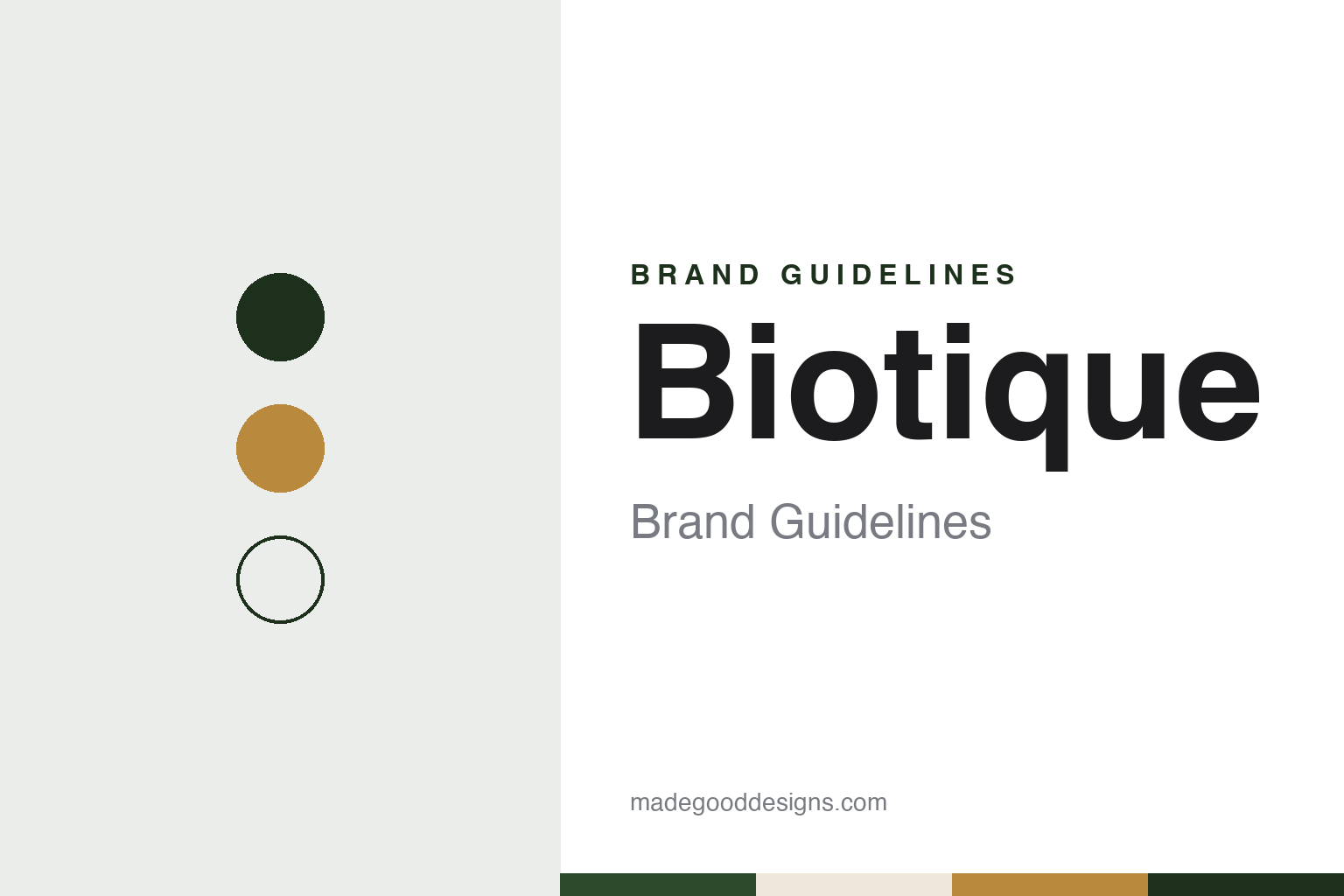
Biotique Brand Guidelines
An Indian beauty brand built for three decades by its founder, without television advertising.
Aa
Two constants: a deep green, gold and rice-paper palette and a soft botanical serif register. Abstract homage — not a Biotique product or mark; no pack, logo or label is reproduced.
Bio Veda
A founder, a company name and a 1992 start.
Biotique was founded in 1992 by Vinita Jain. The Economic Times gave that year in October 2025, as did Entrepreneur India in September 2019, and the brand’s own history page agrees. The company behind the brand is Bio Veda Action Research; the copyright line on the Biotique website describes it as the brand owner, and The Economic Times named it as the parent company in 2025.
The company tells its story through its founder. Its website says Vinita Jain grew up on her family’s tea estates in Assam and Darjeeling, studied biotechnology in Switzerland and business management in the United States, and then returned to India to start the company. It says that in 1992 Bio Veda Action Research began producing and selling Biotique products, and it describes those products as made in the foothills of the Himalayas with Swiss biotechnology.
The brand’s name joins two ideas that the company keeps returning to. Its website describes Biotique as a combination of Ayurveda, the traditional system it traces back thousands of years, and “21st-century biotechnology.” Entrepreneur India wrote in 2019 that biotechnology was “a little known word in India” when Jain set up the business, and that the company had been built with a mix of old techniques and modern science in mind.
Biotique has stayed a family business. Entrepreneur India reported in 2019 that the founder’s son, Ishaan Jain, was running the brand’s digital and e-commerce push, and described the company as internally funded and free of debt. In June 2016 The Economic Times called Vinita Jain a “reticent founder” giving her first extensive media interview in at least a decade, and reported that the privately held company had been approached by private equity investors but was not looking for outside money.
Colour
Ranges, packs and a children’s line.
Biotique sells a broad range across skin, hair, body and baby care. The Economic Times described it in October 2025 as making products for skin and hair, make-up and babies, and the brand’s own website in 2026 groups its shop into skin, hair and body sections, with further sections for men, babies, make-up and fragrance. Named collections on the website include BXL, Advanced Organics and Advanced Ayurveda, and the site also has separate pages for a professional line and for hotel and spa supplies.
Some of those ranges have a documented launch. In June 2016 ET BrandEquity reported that the brand had recently launched Biotique Advanced, a range of 21 products, and that it had agreed a collaboration with Disney India for its children’s and baby products. That report said the girls’ baby and kids’ ranges took their themes from Disney princesses such as Rapunzel and Snow White, the boys’ baby range featured Mickey and Friends, and the boys’ kids’ range carried Pixar Cars designs.
The more unusual part of the story is how little Biotique advertised for most of its life. Entrepreneur India reported in 2019 that the company had kept away from traditional advertising and grown through word of mouth, quoting Ishaan Jain as saying the brand had never spent on television commercials. In 2016 Vinita Jain told The Economic Times that the company had “stayed away from marketing buzz,” but that it was time to change and to make the brand more approachable.
That change can be followed in later coverage. By 2019 Entrepreneur India was describing digital campaigns aimed at younger buyers, alongside sales through the brand’s own website and the main e-commerce marketplaces, and noted that more of its online sales came through third-party platforms. In October 2025 The Economic Times reported that the company still leaned on word of mouth and on the Biotique name itself rather than heavy marketing, using what it called tactical advertising, and that the actor Sara Ali Khan had been signed as the face of the brand the previous year.
Shops are part of the picture too. Entrepreneur India wrote in 2019 that, alongside general trade distribution, the brand sold through its own retail stores.
Typography
How the category presents itself.
India’s beauty and personal-care brands range from names that began inside old industrial groups to labels that started on their own websites. Lakmé was incorporated in December 1952 as a Tata company, according to Trent, the retailer that the original company became, and its brands passed to Hindustan Lever, now Hindustan Unilever, in 1998, Business Today reported. Dabur says on its corporate site that it started operations in Calcutta in 1884.
Some newer brands describe themselves as digital-first. Honasa Consumer, the owner of Mamaearth, calls itself a “digital-first house of brands” on its corporate website, and says Mamaearth began in 2016. Sugar Cosmetics sold only through its own website and a marketplace partner until 2017, Inc42 reported in 2020, before moving into general trade, large-format stores in malls and its own shops.
Shops and counters remain part of the picture. Sugar’s chief executive told the trade magazine Retail4Growth in 2023 that the brand used exclusive outlets, shop-in-shop counters and multi-brand stores, and that it changes its visual merchandising every year. Lakmé has tied its name to a runway since 2000, when the Fashion Design Council of India and IMG brought it in as title sponsor of a new fashion week, The Tribune reported in 2025.
This guide sets out what can be checked about each brand: when and where it began, who founded and owns it, which named product lines and campaigns it publishes, and how it presents itself in packs, logos and stores. Where a fact rests only on a company’s own pages, the text says so, and the palettes and typefaces shown are an unofficial interpretation rather than any brand’s own.
Aa
A soft botanical serif for a founder-led brand. (Specimen set in Fraunces, a serif STAND-IN; NOT the Biotique logo.)
Biotique
Still owned by its founder, as of 2025.
The ownership question has had a steady answer for many years. In June 2016 The Economic Times reported that Biotique was privately held and internally funded, and that Vinita Jain had cited IKEA and Giorgio Armani as companies that had grown internationally while staying private. In October 2025 the same newspaper reported that Biotique was owned almost entirely by Jain, that private equity firms had repeatedly sought stakes, and that so far it had resisted any stake sale.
Biotique is also notable for how much of its brand rests on a single founding story. The company’s website gives Vinita Jain the title of founder chairperson and builds its history page around her upbringing, her studies and the company she set up in 1992. Press coverage over the following decades, from The Economic Times in 2016 to Entrepreneur India in 2019 and The Economic Times again in 2025, has kept returning to the same figure, and to the next generation of the family working in the business.
For a design guide, Biotique shows how a founder-owned brand can hold one botanical look across three decades, a wide product range and a move from shop shelves to e-commerce, without leaning on television advertising. Compare Himalaya, a family-owned Indian personal-care company with a much longer history, and Kama Ayurveda, another Indian brand built around traditional recipes. For this guide we use a deep leaf green, a turmeric gold and rice-paper neutrals with a serif, an unofficial interpretation; no product or logo is reproduced.
Explore & save
Keep Biotique’s identity on hand — save it to a board in the Made Good inspiration library.
Biotique identity set
Pin the Biotique deep green, turmeric gold and rice-paper palette and the soft botanical serif register to your own board.
Source & notes
Frequently Asked Questions
What font can I use to match the Biotique look?
This guide describes Biotique’s type as “A soft botanical serif for a founder-led brand”. Its type specimen is set in Fraunces from Google Fonts as a stand-in; Fraunces is not Biotique’s own lettering.
What colours are in the Biotique palette?
This guide’s Biotique palette is Deep leaf green #2E4A2C, Forest ink #1D301C, Turmeric gold #B98A3E, Rice paper #EFE8DA and Clay white #F8F5EF. The tones are the guide’s own unofficial interpretation, not official Biotique hex codes.
When was Biotique founded?
Biotique was founded in 1992, in India. Biotique is known for Skin, hair, baby and make-up ranges.
Who founded Biotique?
Biotique was founded by Vinita Jain in 1992. Biotique is known for Skin, hair, baby and make-up ranges.