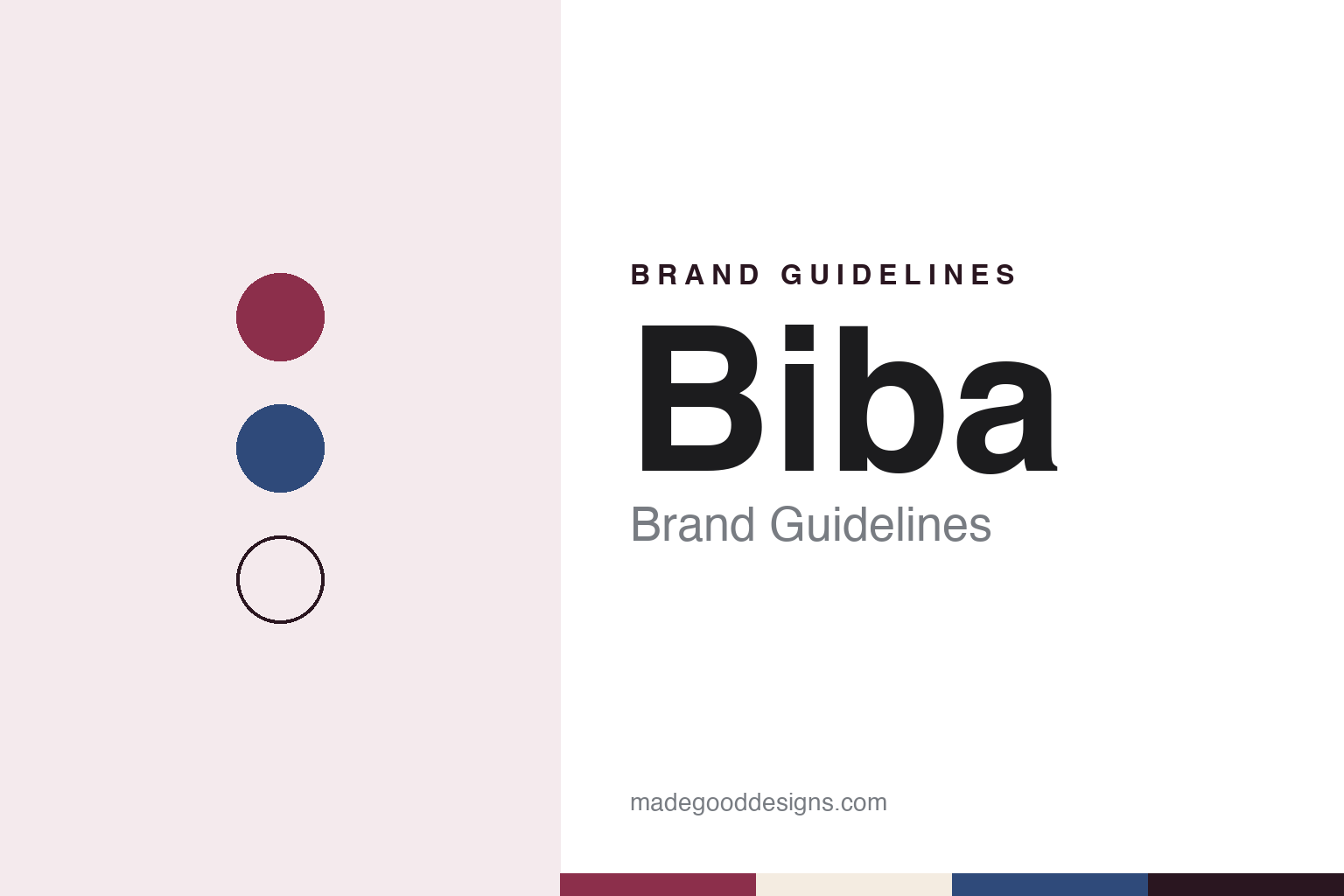
Biba Brand Guidelines
Meena Bindra’s home-made salwar suits, grown into a mall-based ethnic-wear chain.
Aa
Two constants: a madder rose, indigo and cream palette and an elegant serif register. Abstract homage — not a Biba product or mark; no garment, print, logo or label is reproduced.
Mrs Bindra’s suits
A home business, a block printer and forty cotton suits.
Biba began as a home business in Mumbai. Outlook Business, profiling the founder Meena Bindra in November 2015, reported that she started selling Indian salwar suits from home in 1985, with a small loan to pay for the first fabric; the company’s own website dates the brand to 1988, “when Mrs. Meena Bindra founded our brand.” By the magazine’s account she had no formal design training. She found fabric and a young block printer, with whom she went on to work for more than a decade, and her first batch of 40 cotton suits sold out.
Orders came by word of mouth. Outlook Business reported that the Mumbai retailer Benzer became a major client, followed by Sheetal and smaller boutiques, and that once she began supplying shops she needed a name to put on her bills. She chose Biba, which she described to the magazine as a Punjabi word meaning nice or elegant; the company’s website now glosses it as the Punjabi word for “pretty woman.” The business became Biba Apparels. When Benzer later asked her to supply it alone, she refused and lost its orders, the magazine reported, and kept selling to other retailers instead.
The clothes reached organised retail before Biba had shops of its own. By the mid-1990s, according to Outlook Business, Biba was supplying chains such as Shoppers Stop, and by the late 1990s the business had moved to Delhi. FashionUnited, reporting in December 2013, described the brand as created from Meena Bindra’s line of salwar, kameez and dupattas at affordable price points.
Colour
Mall stores, new investors and a second generation.
Biba opened its own first store in 2004, in the Inorbit mall at Malad in Mumbai, followed by one at Nariman Point, Meena Bindra told Outlook Business. The magazine counted 180 stores opened since then by November 2015. In April 2026 the trade publication DFU Publications put the count at more than 430 stores across 70 cities, and reported new openings that month at Inorbit Mall in Visakhapatnam and at Felix Plaza in Gurgaon.
Ownership changed in the 2000s and 2010s. Outlook Business reported that Future Lifestyle Fashion, part of Kishore Biyani’s Future Group, took a stake in the family business and exited in 2013, nearly seven years after buying in. In December 2013 the private equity firms Warburg Pincus and Faering Capital took a minority stake in Biba Apparels, FashionUnited and Outlook Business reported.
Management passed to the next generation. The founder’s younger son, Siddharth Bindra, took over the running of the business in 2010, the magazine said, while she continued to oversee the designs; DFU Publications, spelling his name Siddharath, named him as managing director in April 2026.
Biba has also worked with designers from outside the family. FashionUnited reported in December 2013 that, the year before, Biba had formed a joint venture with the fashion designer Manish Arora to sell his premium ethnic-wear brand, Indian, with Biba holding the majority share of the venture.
A FashionUnited profile in August 2017 filled in the picture. It dated the business to 1988 and described Meena Bindra’s start as an exhibition of nearly 40 suits in hand block prints, with Benzer Departmental Stores in Mumbai as the first store to stock them. It named the designer Rohit Bal, alongside Manish Arora, among Biba’s collaborators, and said the spring–summer 2017 collection drew on Indian textile and craft traditions, citing chanderi, chikankari and shibori. At that point, the publication reported, Biba was sold in 230 stores across 105 cities, and through department stores including Shoppers Stop, Lifestyle, Pantaloons and Central, as well as online through marketplaces such as Myntra, Flipkart and Amazon.
The same report described two offshoots. Biba had opened three standalone stores for girls aged two to fifteen, in Mumbai and Bangalore, and a second brand, Rangriti, was then sold in 22 stores, FashionUnited said in August 2017.
Typography
Indian fashion and lifestyle brands.
Indian fashion and lifestyle brands tend to present themselves through what they make for particular moments. Ethnic-wear labels sort their ranges by garment, from kurtas, suit sets and sarees to sherwanis and lehengas, and by occasion, from festivals and office days to the separate ceremonies of a wedding. Western-wear and suiting labels lean instead on fabric, fit and the working week, and many companies now sell both kinds of clothing side by side.
Ownership is part of the story. Several names sit inside larger listed or private groups, such as Aditya Birla Fashion and Retail, Vedant Fashions, TCNS Clothing and Raymond, while others remain founder-run or family-run companies that have taken outside investors. Corporate and investor pages are usually the plainest record of this: they set out founders, subsidiaries, stock-exchange listings and the dates on which a label was launched, bought or merged, and those pages are a sensible place to start when tracing who owns a brand today.
Visual identity is mostly carried by the stores and the campaigns rather than by published brand manuals. Exclusive brand outlets in malls and high streets, shop-in-shops in department stores, cricket sponsorships, cinema spots and celebrity ambassadors do much of the work, and a company’s logo is often seen first on a shopping bag, a jersey or a billboard. Colour palettes and typefaces are seldom documented in public.
This guide follows that record. It sets out founding dates, owners and listings as the companies and dated press reports give them, names collections and campaigns only where a source names them, and treats the colours and type shown here as an unofficial interpretation rather than a brand standard.
Aa
An elegant serif for a brand that writes its name in capitals. (Specimen set in Cormorant Garamond, a serif STAND-IN; NOT the Biba logo.)
Biba today
Suit sets, sub-labels and a name in capitals.
Today Biba’s website names the manufacturer as BIBA Fashion Limited, with India as the country of manufacture, and its investor pages list subsidiaries including IMA Clothing and Kashida Apparels alongside a trading company, BIBA Apparels Trading LLC. The range is built around women’s and girls’ ethnic wear. The site sorts it into suit sets, among them straight, Anarkali, flared and A-line cuts, then kurtas and tops, lehengas, dresses and dress materials, with handbags, jewellery and fragrances alongside. The company says its autumn–winter 2024 collection featured the actor Kriti Sanon as brand ambassador.
The brand has added sub-labels for different shoppers. DFU Publications reported in April 2026 that Biba NXT is aimed at Gen Z and early-millennial customers, with silhouettes such as halter-neck kurtas and corset-style tops; the website also carries a Biba Luxe line and collections grouped by season and occasion, from workwear and everyday wear to wedding wear, plus a plus-size collection. The company writes its own name in capitals, BIBA, across its website.
For a design guide, Biba shows how a label that began with block-printed cotton suits sold from home became a mall-based retail chain while keeping ethnic wear at its centre. Compare Manyavar, another Indian ethnic-wear brand built by its founder, in Kolkata, and W, another Indian women’s-wear label. For this guide we use a madder rose, a block-print indigo and a cotton cream with a serif, an unofficial interpretation; no product or logo is reproduced.
Explore & save
Keep Biba’s identity on hand — save it to a board in the Made Good inspiration library.
Biba identity set
Pin the Biba madder rose, indigo and cream palette and the elegant serif register to your own board.
Source & notes
Frequently Asked Questions
What font can I use to match the Biba look?
This guide describes Biba’s type as “An elegant serif for a brand that writes its name in capitals”. Its type specimen is set in Cormorant Garamond from Google Fonts as a stand-in; Cormorant Garamond is not Biba’s own lettering.
What colours are in the Biba palette?
This guide’s Biba palette is Madder rose #8C2F4B, Block-print indigo #2F4A7A, Mulberry ink #2A1620, Cotton cream #F4ECE1 and Haldi gold #C99A3B. The tones are the guide’s own unofficial interpretation, not official Biba hex codes.
When was Biba founded?
Biba was founded in 1985 (home business; the company dates the brand to 1988), in Mumbai, India.
Who founded Biba?
Biba was founded by Meena Bindra in 1985 (home business; the company dates the brand to 1988).