Chinawok Brand Guidelines
A 1999 Lima food-court chifa that spread across Latin America.
Aa
Two constants: a black, white and lacquer red palette and a Condensed sans register. Abstract homage — not a Chinawok product or mark; no logo, menu or signage is reproduced.
Jockey Plaza, 1999
Chifa for the shopping-centre food court.
Chinawok is a Peruvian fast-food chain built around chifa, the Peruvian-Chinese food that Peruvians eat in thousands of restaurants of that name. Its first restaurant opened in January 1999 at the Jockey Plaza shopping centre in Lima, Spanish Wikipedia says; the Lima newspaper El Comercio gave the same birthplace and year in May 2012, describing a chain that sold Peruvian-Chinese food in a fast-food format, and the business daily Gestión again dated its growth in Peru to its arrival at Jockey Plaza in 1999 in a December 2024 report.
The brand is written as one word, Chinawok, in Peru, while Spanish Wikipedia notes that some franchises use the two-word form China Wok.
The chain grew through shopping centres. Spanish Wikipedia says it had three restaurants in Lima by the end of its first year, adding sites at a Saga Falabella department store in San Isidro and at the Primavera Park Plaza, a centre now called Real Plaza Primavera. In 2002 it moved into the fast-growing districts on the edges of the capital, with outlets at Mega Plaza Norte and at several supermarket sites, and into the port city of Callao, at the Minka shopping centre; in 2009 it opened at Plaza Norte and at the Real Plaza Centro Cívico. The same article lists restaurants across the regions, in cities including Arequipa, Chiclayo, Piura, Trujillo, Huancayo, Puno and Tacna.
Colour
A franchise abroad, a new owner at home.
Chinawok went abroad early. Spanish Wikipedia says it began franchising in Ecuador in 2003 and in Central America the following year, listing Panama (2004), El Salvador and Costa Rica (2005), Chile (2007), Colombia and Argentina (2012) and Honduras (2024). By May 2012, El Comercio reported, the brand belonged to Corporación China Wok and had 32 restaurants in Peru and another 48 in Chile, Costa Rica, Ecuador, El Salvador, Guatemala and Panama.
That month the Peruvian business changed hands. On 1 May 2012 El Comercio reported that the Interbank group, through NG Restaurants, the restaurant holding of its investment arm Nexus Group, had bought all the shares of Alert del Perú, the company that held the franchise for Chinawok in Peru and operated its restaurants there. The price was not officially disclosed. Gestión reported the same deal on 2 May 2012, describing Chinawok as the group’s fourth restaurant brand and the holding as a new national competitor to Delosi, the Peruvian operator of KFC, Burger King and Pizza Hut restaurants. NG Restaurants already ran the burger chain Bembos, which El Comercio said had 82 restaurants, had created the rotisserie-chicken brand Don Belisario and had taken the Popeyes franchise, all as part of a push into restaurants that El Comercio dated to the previous year; the group, the newspaper said, saw shared food-court sites as one source of savings across its brands.
Both newspapers stressed the limits of the deal. NG Restaurants bought the Peruvian operation, covering the existing restaurants, about 32 of them according to Gestión, and the plan for developing the brand further in Peru, while the restaurants abroad stayed with Corporación Chinawok, which remained the franchisor of the Peruvian company rather than its owner. El Comercio added that the corporation also kept Montao, a newer fast-food brand for Peruvian creole cooking.
Typography
Design and documentation.
Latin American restaurant chains tend to present themselves through a small set of public surfaces: the shopfront, the menu, the delivery box and the corporate page. The shopfront carries the name and colours to the street, often on a corner unit or inside a shopping centre. Many chains refresh it on a cycle, and anniversaries are a common moment for a new look across dining rooms and signs.
Menus do much of the brand work. A chain is often remembered for one or two named dishes, such as a taco, a pizza or a breakfast plate, and the company repeats those names in its signs, its menus and its own telling of its history. Where a chain says it created a dish, the claim belongs to the company, and independent food writers do not always agree; a careful guide keeps the two apart. Mascots, packaging and delivery boxes extend the same vocabulary to takeaway and app orders.
Ownership is often a group matter. Several chains in Mexico, Brazil, Peru and Colombia sit inside larger restaurant or retail groups that run national brands next to international franchises, and some, like Toks within Grupo Gigante, began as a sideline of a supermarket business. Groups buy, convert and rename chains, so the same dining room can carry two names in a decade. Dated reports and stock-exchange filings are the plain record of who owns what, and when.
Franchising is the other common thread. Corporate pages describe founders, owners and franchise networks, and the business press counts units at a stated date, at home and abroad. Those counts change quickly, and openings in new countries do not always last, so each figure in these guides is tied to the report and the date that gave it.
Aa
A condensed sans — a chifa name for food courts. (Specimen set in Oswald, a sans STAND-IN; NOT the Chinawok logo.)
Chinawok
Black and white, with oriental motifs.
Twelve years after the sale, the chain was still adding restaurants. In December 2024 Gestión described Chinawok as part of NG Restaurants, the restaurant holding of the Intercorp group, with 48 restaurants in Peru and 180 across the region. The same report set the brand in a crowded market: it put the number of chifas in Peru at around ten thousand and noted newer chains in the category, such as Wanta from the Delosi group. Its own website shows the current offer to customers. In November 2026 the Chinawok website in Peru was taking delivery and pick-up orders, with a menu arranged around combos, single-person meals and larger meals for groups, and a store finder for its restaurants across the country.
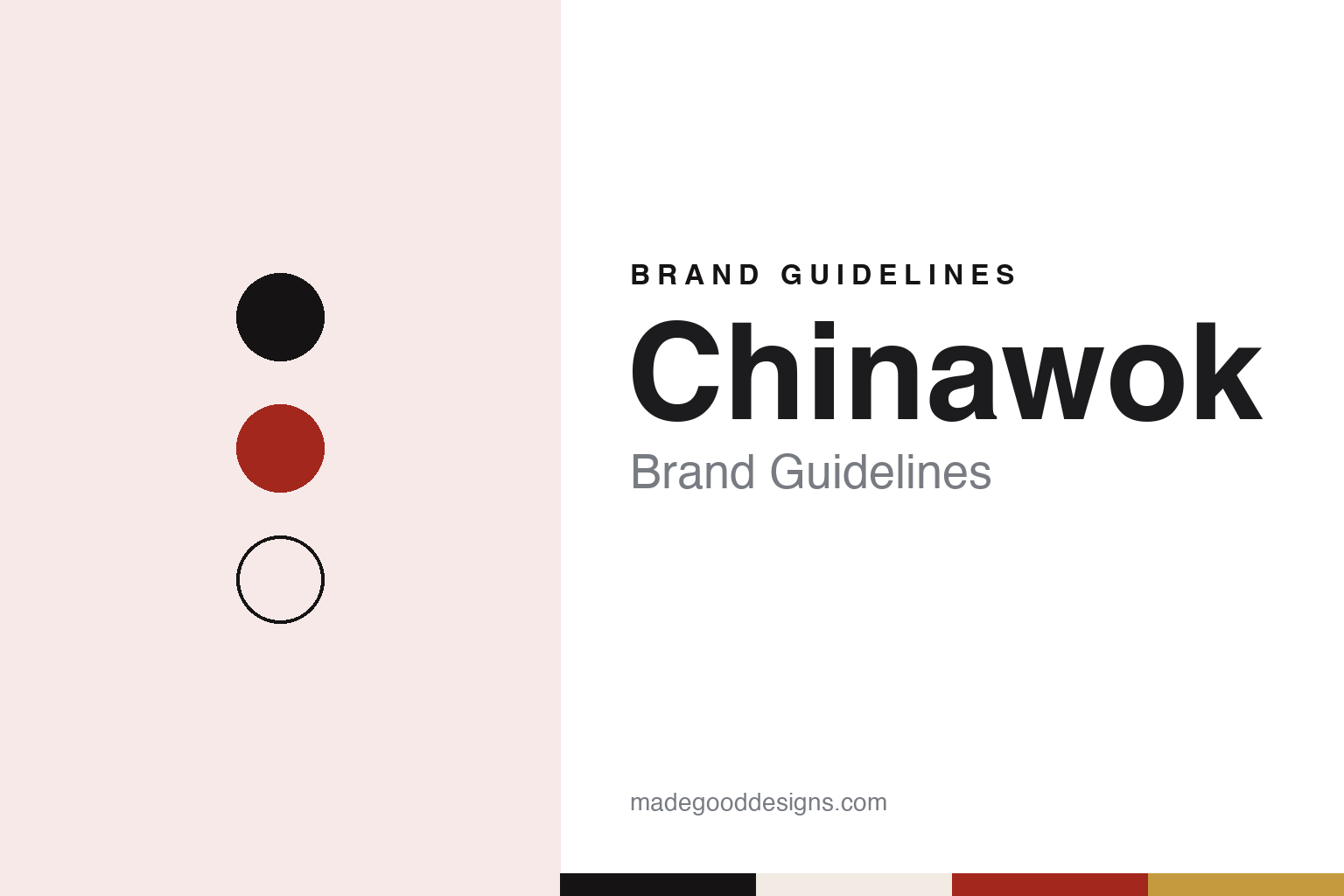
Spanish Wikipedia describes the brand’s main colours as black and white, with oriental designs. Beyond that short description, no published brand manual, typeface or official colour reference appears in the sources used for this guide, so the palette on this page is our own interpretation: a near-black and a rice white for the core pair, with a lacquer red and a ginger gold as accents.
Ownership of the name now differs by country. In Peru the restaurants have belonged since 2012 to the company bought by NG Restaurants, which Gestión in 2024 placed in the Intercorp group alongside Bembos; outside Peru, the 2012 reports in El Comercio and Gestión described a separate franchisor, Corporación Chinawok, running the brand’s restaurants abroad through franchise partners. Spanish Wikipedia’s country list shows that franchise network still adding markets after the sale, with Colombia and Argentina in 2012 and Honduras in 2024.
For a design guide, Chinawok shows how a single cuisine can carry a fast-food brand across borders while ownership differs from country to country. Compare Bembos, its sister brand at NG Restaurants, and China in Box, a Brazilian Chinese-food chain. For this guide we use black, a rice white and a lacquer red with a condensed sans, an unofficial interpretation; no product or logo is reproduced.
Explore & save
Keep Chinawok’s identity on hand — save it to a board in the Made Good inspiration library.
Chinawok identity set
Pin the Chinawok black, white and lacquer red palette and the Condensed sans register to your own board.
Source & notes
Frequently Asked Questions
What font can I use to match the Chinawok look?
This guide describes Chinawok’s type as “A condensed sans — a chifa name for food courts”. Its type specimen is set in Oswald from Google Fonts as a stand-in; Oswald is not Chinawok’s own lettering.
What colours are in the Chinawok palette?
This guide shows Chinawok’s palette as Wok black #151313, Rice white #F1EBE3, Lacquer red #A3271C, Ginger gold #C59A3E and Paper #FAF8F5. It notes the values are approximate rather than official Chinawok codes.