Yellow Cab Pizza Brand Guidelines
A 2001 Makati Avenue pizzeria in taxi black and yellow.
Aa
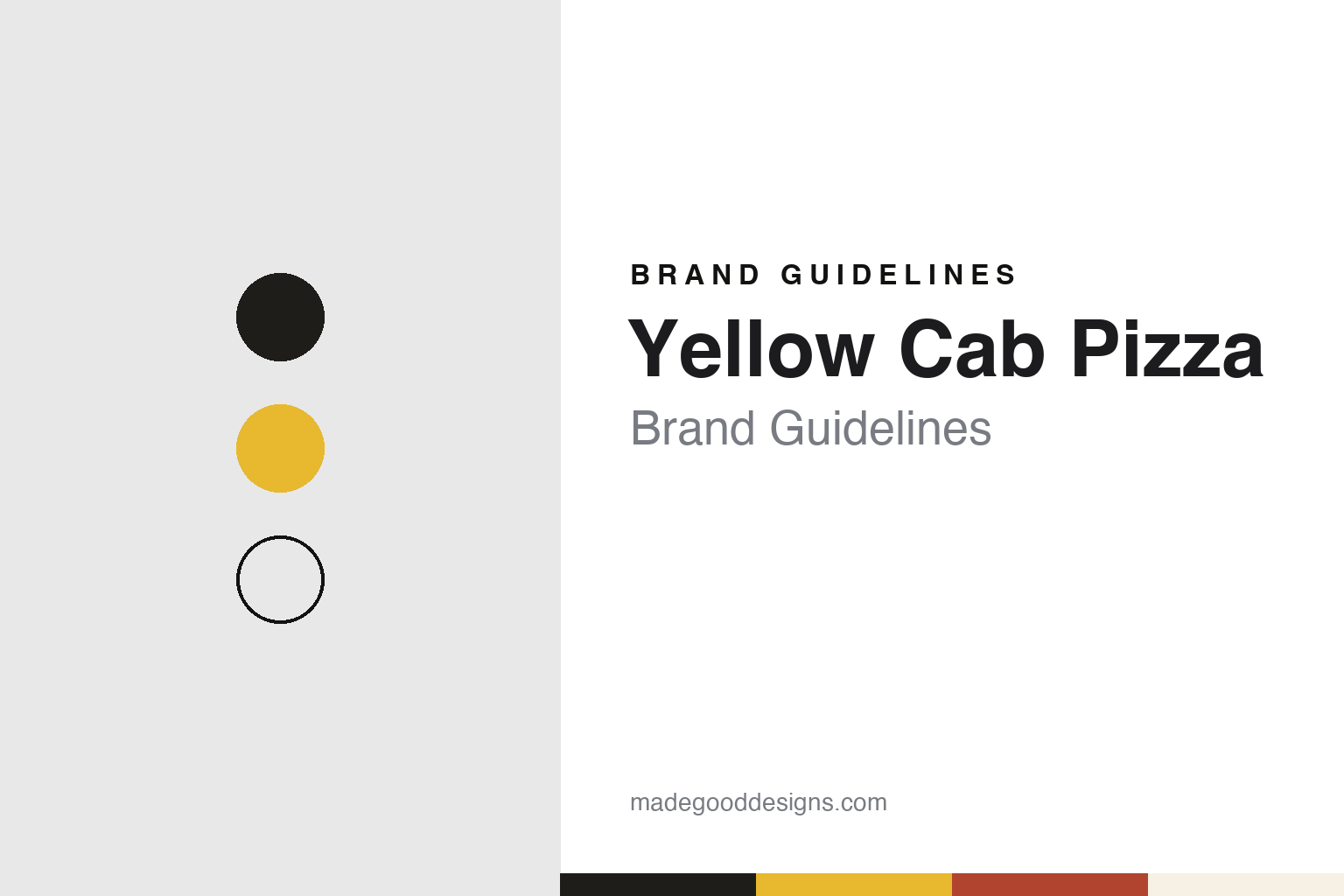
Two constants: a taxi black and yellow palette and a condensed sans register. Abstract homage — not a Yellow Cab Pizza product or mark; no logo, box or sign is reproduced.
Makati Avenue
A slice of New York on a Makati street.
Yellow Cab Pizza Co. opened its first branch on Makati Avenue, in the business district of Makati, Metro Manila, in April 2001, according to its owner, Max’s Group. Tatler Asia, in a 2021 piece on Filipino-owned restaurant chains, names the founders as the entrepreneurs Eric Puno, Henry Lee and Albert Tan, and English Wikipedia gives the same three names. In a 2013 profile of the chain’s chief operating officer, The Philippine Star also described Eric Puno and Albert Tan as the founders and original owners.
The name has nothing to do with taxis. Tatler Asia says the theme was inspired by the black and yellow of New York taxicabs, and English Wikipedia makes the same point: the colours, not a cab service, are the reference. The reference is a single colour pair borrowed from another city’s streets.
In its early years the chain was run by its founders. Tatler Asia notes that in its first years it operated a sister restaurant serving burgers and burritos, which was later spun off as a separate group; English Wikipedia adds that the sister brand was not part of the later sale of Yellow Cab. By early 2013 The Philippine Star was describing Yellow Cab as a fast casual restaurant with almost a hundred branches in the Philippines and abroad.
Colour
Big pies and a New York theme.
The menu is built around large New York-style pizzas. Max’s Group says the brand is known for its 18-inch pies; Tatler Asia lists giant pizzas, chicken wings and Charlie Chan noodles as the dishes people come for; and the 2013 Philippine Star profile mentions a pizza called New York’s Finest. When the chain reached Hawaii, the Honolulu Star-Advertiser described the offer as New York-style pizzas, pasta dishes and appetizers.
Delivery is part of how the brand is seen on the street. The Honolulu Star-Advertiser noted in January 2017 that in the Philippines meals are delivered on Yellow Cab-branded scooters, while the Honolulu branch would use a third-party delivery service instead. The Hawaii restaurant took over space formerly used by a sandwich chain and a wallpaper shop, seated 90, added coffee and espresso drinks, beer and wine to the menu, and put big-screen televisions in the dining room, the paper reported.
One 2013 campaign centred on shared occasions. That year the chain was preparing a campaign called “Great Times, Great Pizza,” which its operations chief described to The Philippine Star as being about celebrating promotions, birthdays, anniversaries and reunions with friends. Max’s Group now describes the brand as drawing on the energy and drive of New York.
Typography
Filipino chains and their owners.
The Philippines’ restaurant, bakeshop and snack chains tend to present themselves through a small set of recurring elements: a shop name and sign that customers can spot in a mall or on a busy road, menus organised around named dishes and named cakes, and packaging that travels home with the order. Some brands take their names from a place or a founder; Red Ribbon, by its own account, takes its name from the ribbon once tied around its cake boxes.
Many of these chains now sit inside a few restaurant groups. Jollibee Foods Corporation, which adopted “Jollibee Group” as its corporate brand in July 2025 according to BusinessWorld, owns brands including Jollibee, Chowking, Greenwich, Red Ribbon and Mang Inasal. Max’s Group, which traces itself to the Max’s Restaurant fried-chicken café of 1945, runs another portfolio of casual-dining brands, according to its own website.
Franchising is the usual route to growth, at home and abroad. Group and brand websites publish franchising pages for the Philippines and, in several cases, for international partners, and some chains have opened abroad. Red Ribbon is one example: it opened in California in 1984, according to English Wikipedia, and had 39 stores in the United States by October 2022, The Philippine Star reported.
This guide sets out what can be checked about each brand: who founded it, when and where, who owns it now, and how its own pages and the Philippine press describe its menu, stores and franchise network. Counts of stores are given with the date of the source, and claims that rest only on a company’s own word are marked as such.
Aa
A tall, condensed sans with a street-sign feel. (Specimen set in Oswald, a condensed sans STAND-IN; NOT the Yellow Cab Pizza logo.)
Yellow Cab Pizza
From founders to a listed restaurant group.
The founders did not keep the chain for long. In August 2011 Yellow Cab was bought by Pancake House Inc., the listed owner of the Pancake House chain, The Philippine Star reported that November; the paper’s 2013 profile named the Pancake House Group chairman, Martin Lorenzo, as the new owner. Fast Casual reported in February 2014 that the investment firm Abraaj, a shareholder in Pancake House, had supported that purchase.
Ownership changed again in 2014. In February the Max’s Group, led by the Fuentebella family and the company behind the Max’s Restaurant fried-chicken chain, completed its purchase of a controlling stake of nearly 90 percent in Pancake House Inc., The Philippine Star reported. In July the listed company’s board approved taking in the Max’s Group of Companies through a share issue, and by the end of that month Marketing-Interactive reported that Pancake House Inc. would change its name to Max’s Group, Inc., with the stock ticker MAXS. At the end of March 2014 the group counted 109 Yellow Cab branches among its stores, according to The Philippine Star.
Franchising took the brand into the Gulf before the merger. In September 2013 the Dubai trade title Images RetailME reported that the UAE-based Hospitality Consultancy & Investment Group had signed a ten-year master franchise agreement with Pancake House Inc. for Yellow Cab Pizza in the United Arab Emirates, with Dubai and Abu Dhabi as the focus. The same report described Yellow Cab, established in 2001, as having more than 110 outlets worldwide at the time, with pastas, appetizers and desserts alongside the pizzas.
Yellow Cab has since followed its owner abroad. In January 2017 the Honolulu Star-Advertiser reported the opening of a 90-seat Yellow Cab in the Iwilei district of Honolulu, in the same shopping complex as a Max’s restaurant; the paper described the two as sister restaurants. In January 2026 The Philippine Star listed Yellow Cab Pizza in Max’s Group’s portfolio, alongside Max’s Restaurant, Pancake House and Teriyaki Boy, and reported that the group ran 573 stores, 60 of them outside the Philippines, as of the end of 2025.
For a design guide, Yellow Cab Pizza shows how far a borrowed colour pair can carry a restaurant brand: two colours, a city theme and branded delivery scooters. Compare Max’s Restaurant, the group’s flagship chain, and Pancake House, the company that bought Yellow Cab in 2011. For this guide we use a taxi yellow, an asphalt black and a brick red with a condensed sans, an unofficial interpretation; no product or logo is reproduced.
Explore & save
Keep Yellow Cab Pizza’s identity on hand — save it to a board in the Made Good inspiration library.
Yellow Cab Pizza identity set
Pin the taxi black and yellow palette and the condensed sans register to your own board.
Source & notes
Frequently Asked Questions
What font can I use to match the Yellow Cab Pizza look?
This guide describes Yellow Cab Pizza’s type as “A tall, condensed sans with a street-sign feel”. Its type specimen is set in Oswald from Google Fonts as a stand-in; Oswald is not Yellow Cab Pizza’s own lettering.
What colours are in the Yellow Cab Pizza palette?
This guide’s Yellow Cab Pizza palette is Cab yellow #E8B92E, Asphalt black #1E1D1A, Crust tan #C79B5E, Sauce brick #B0442F and Box paper #F6F1E4. The tones are the guide’s own unofficial interpretation, not official Yellow Cab Pizza hex codes.
When was Yellow Cab Pizza founded?
Yellow Cab Pizza was founded in April 2001, in Makati, Metro Manila.
Who founded Yellow Cab Pizza?
Yellow Cab Pizza was founded by Eric Puno, Henry Lee and Albert Tan in April 2001.