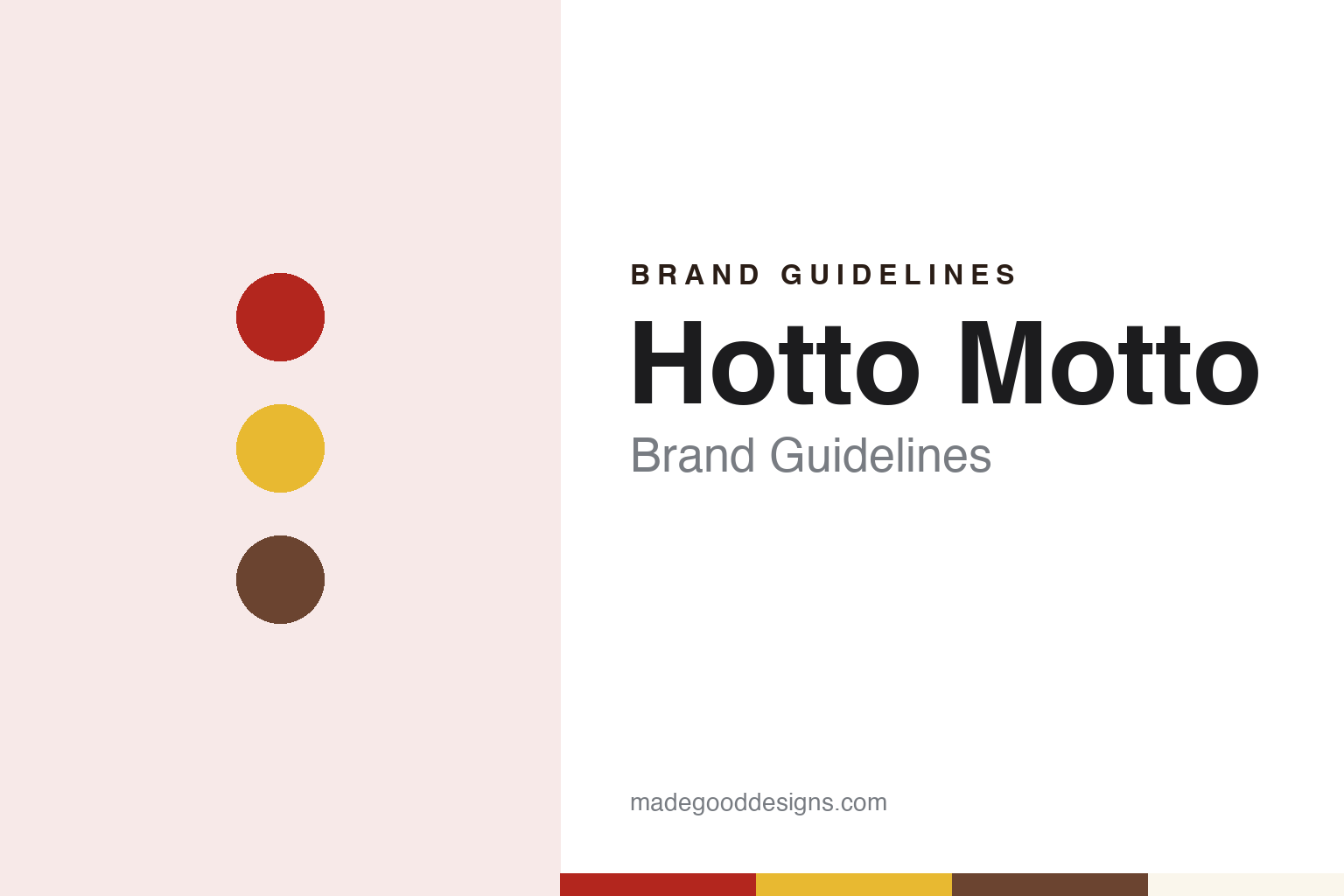
Hotto Motto Brand Guidelines
The takeaway bento chain that began as a franchise split in 2008.
Aa
Two constants: a red, yellow and brick-brown palette and a rounded sans register. Abstract homage — not a Hotto Motto product or mark; no logo, sign or packaging is reproduced.
From office equipment to bento
A Sasebo company that became a Hokka Hokka Tei regional head office.
Hotto Motto is a young name on old foundations. The chain is run by Plenus, a company whose own published history starts in March 1960, when its predecessor, Taiyo Jimuki, began as an office-equipment business; Plenus names Shioi Sueyuki as its founder. Taiyo Jimuki became a joint-stock company in Sasebo, Nagasaki Prefecture, in November 1976. English Wikipedia also says the company sold office equipment before it changed industries and moved into food in 1980.
That move came through a franchise. In April 1980 the company set up the Hokka Hokka Tei Kyushu regional head office, and in July 1980 it opened the first Hokka Hokka Tei in the Kyushu region, in Fukuoka, Plenus says. Gigazine, setting out the chain’s structure in February 2008, described Hokka Hokka Tei as a brand split between regional companies from the start: the original Hokka Hokka Tei company was founded in 1978, an Osaka regional body (later renamed Hurxley) in March 1980, the Kyushu body in April 1980, and the brand-owning head office, Hokka Hokka Tei Sohonbu, in 1981.
The Kyushu company was renamed Taiyo in 1985 and Plenus in December 1990, and moved its head office to Hakata in Fukuoka the same year. It also tried its own restaurant format: the first Meshiya Don set-meal restaurant opened in Fukuoka in December 1989, and the name was changed to Yayoi Ken in July 2006. In April 1999 Plenus made the eastern Hokka Hokka Tei company in Tokyo a subsidiary, and in March 2004 it absorbed it. Plenus’s history records the Hokka Hokka Tei chain it ran passing 1,000 stores in July 2002 and 2,000 in March 2004, and a listing on the first section of the Tokyo Stock Exchange in December 2002. By 2008 the company ran the brand across Kyushu, Yamaguchi and eastern Japan, while Hurxley ran it in the Kinki region and Shikoku, Gigazine reported.
Colour
Leaving Hokka Hokka Tei, May 2008.
The split came in 2008. Japanese Wikipedia says relations between Plenus and the franchisor, Hokka Hokka Tei Sohonbu, had worsened over rights to the trademark. On 6 February 2008 Plenus announced that it would leave Hokka Hokka Tei, and on 12 February it gave the new name: Hotto Motto. Gigazine reported on 13 February 2008 that the contract with the franchisor ran out on 14 May and that Hotto Motto would begin trading the next day. Of about 2,200 stores in eastern Japan and Kyushu, about 1,000 run directly by Plenus would change name, and about 1,200 franchisees supplied by Plenus would choose whether to follow; the menu itself would stay the same. Stores in the Kinki region and Shikoku, run by Hurxley, kept the Hokka Hokka Tei name.
The name is a play on words: Plenus describes Hotto Motto as bento that bring a sense of “hotto” relief to “motto”, or more, customers. The renamed stores opened in mid-May 2008, and on 20 May 2008 Plenus opened its first store in the Kansai region, by Isogami Park in Kobe. Gigazine visited on opening day and described a counter with two tills, numbered tickets for orders cooked after payment, chairs for waiting and shelves set aside for ready-made bento. A year later, in May 2009, Fukuoka Now reported that Plenus had given up about a fifth of its original outlets as part of going independent, and had opened enough new shops to run nearly 1,000 in Kyushu and Yamaguchi Prefecture alone.
The network kept growing. Japanese Wikipedia gives 2,758 stores at the end of February 2012, and says Hotto Motto reached all 47 prefectures with a store in Tottori in October 2016. In 2011 Plenus took the naming rights to the baseball stadium at Kobe Sports Park, which became Hotto Motto Field Kobe, English Wikipedia says. Abroad, Plenus’s history lists a joint venture in China in July 2010 and one in South Korea in January 2012; Fukuoka Now reported in June 2012 that the first Korean shop had opened in Seoul, with seats for eating in and 30 bento identical to those sold in Japan. In Australia, English Wikipedia says, a Hotto Motto opened in The Galeries in Sydney in December 2016 and closed in September 2019.
Typography
Category context.
Japan’s restaurant and food chains cover a wide spread of formats: takeaway bento shops, tempura and set-meal counters, family restaurants, ramen and champon chains, takoyaki stands, burger shops and yakiniku grills. Most present themselves first through the shopfront. A sign over the door, a colour that can be read from across the street and a short name, often written in both Latin letters and Japanese script, do much of the work of telling passers-by what is sold inside.
Menus carry the rest. Chains tend to describe themselves by named dishes rather than by abstract promises: a standard bowl, a set meal, a takeaway box, a seasonal special that changes through the year. Menu boards, printed menus, ordering screens and ticket machines repeat those names, and many chains publish their menus online as well, so the dish names themselves become part of the identity.
Store networks are another way these companies describe themselves. Corporate pages and annual histories list store counts, prefectures and the year a chain opened in a new region or country, and many chains mix company-run stores with franchised ones. Some brands operate abroad directly, others through joint ventures or local franchise partners, and the overseas store design and menu can differ from those at home.
Ownership is often layered. A single chain may sit inside a larger restaurant group, alongside sister brands with their own names and looks, and some brand names have changed when a franchise arrangement ended or a parent company reorganised. Corporate pages usually set out the founders, the operating company, the owner and the franchise network, and those pages, read alongside dated press reports, are a useful record of how each chain came to look the way it does today.
Aa
A rounded, friendly sans for a takeaway counter. (Specimen set in M PLUS Rounded 1c, a sans STAND-IN; NOT the Hotto Motto logo.)
Brown brick, then red
A round rice mark and a 2024 store redesign.
Hotto Motto inherited many of its buildings. Japanese Wikipedia describes the usual shopfront as brown, built around wood and brick, a look that had replaced older stores from the early 2000s, while Hokka Hokka Tei was still the name over the door; in 2008 many of those stores changed only the logo and lettering, and older ones swapped their yellow-based signs for brown Hotto Motto signs. The same source describes the mark as round, in red and yellow, with a symbol of glossy cooked rice at its centre, the letters “HM” over it, “Hotto Motto” above and the name in hiragana below. The service model has shifted too: a heated showcase of ready-made bento for busy hours, ticket machines in new and refitted stores from 2015, and, from October 2020, Hotto Motto Grill, which adds oven-cooked dishes and a casual range to the core bento.
The newest look began on 3 September 2024, when the Togoshi Ekimae store in Tokyo opened as the first in a new design. The company’s announcement says the new logo leans on red, which it calls the brand’s key colour, so that people think of Hotto Motto when they see red in the street, and keeps a mark based on shining rice. The red-based exterior adds cube-shaped digital signage, and the store sells items only it carries, including bento turned into burgers, such as a nori bento burger and a chicken nanban burger, and Japanese sweets. Japanese Wikipedia notes that pole signs and similar fittings still use the earlier mark alongside the new one.
The owner has changed shape as well. Plenus moved its head office to Ginza, in Tokyo, in January 2023, and its shares were taken private in February 2023 following a management buyout, its company history says. Its company outline, viewed in November 2026, gives 2,819 stores across the group, a figure that also covers the Yayoi Ken restaurants, of which 754 are run directly and 2,065 by franchisees. The company says every bento is made by hand in the shop.
For a design guide, Hotto Motto shows how a renamed chain can keep its buildings and its menu and change only the mark over the door, then move to a single key colour. Compare Sukiya, which also traces its start to a lunchbox shop, and Matsuya. For this guide we use a red, a warm yellow and a brick brown with a rounded sans, an unofficial interpretation; no product or logo is reproduced.
Explore & save
Keep Hotto Motto’s identity on hand — save it to a board in the Made Good inspiration library.
Hotto Motto identity set
Pin the Hotto Motto red, yellow and brick-brown palette and the rounded sans register to your own board.
Source & notes
Frequently Asked Questions
What font can I use to match the Hotto Motto look?
This guide describes Hotto Motto’s type as “A rounded, friendly sans for a takeaway counter”. Its type specimen is set in M PLUS Rounded 1c from Google Fonts as a stand-in; M PLUS Rounded 1c is not Hotto Motto’s own lettering.
What colours are in the Hotto Motto palette?
This guide’s Hotto Motto palette is Bento red #B3261E, Lid yellow #E8B931, Brick brown #6B4430, Steamed rice #FAF6EC and Soy ink #2A1D16. The tones are the guide’s own unofficial interpretation, not official Hotto Motto hex codes.
Who owns Hotto Motto?
Hotto Motto is owned by Plenus Co., Ltd. (Tokyo). Hotto Motto is known for Takeaway bento made to order in each shop.