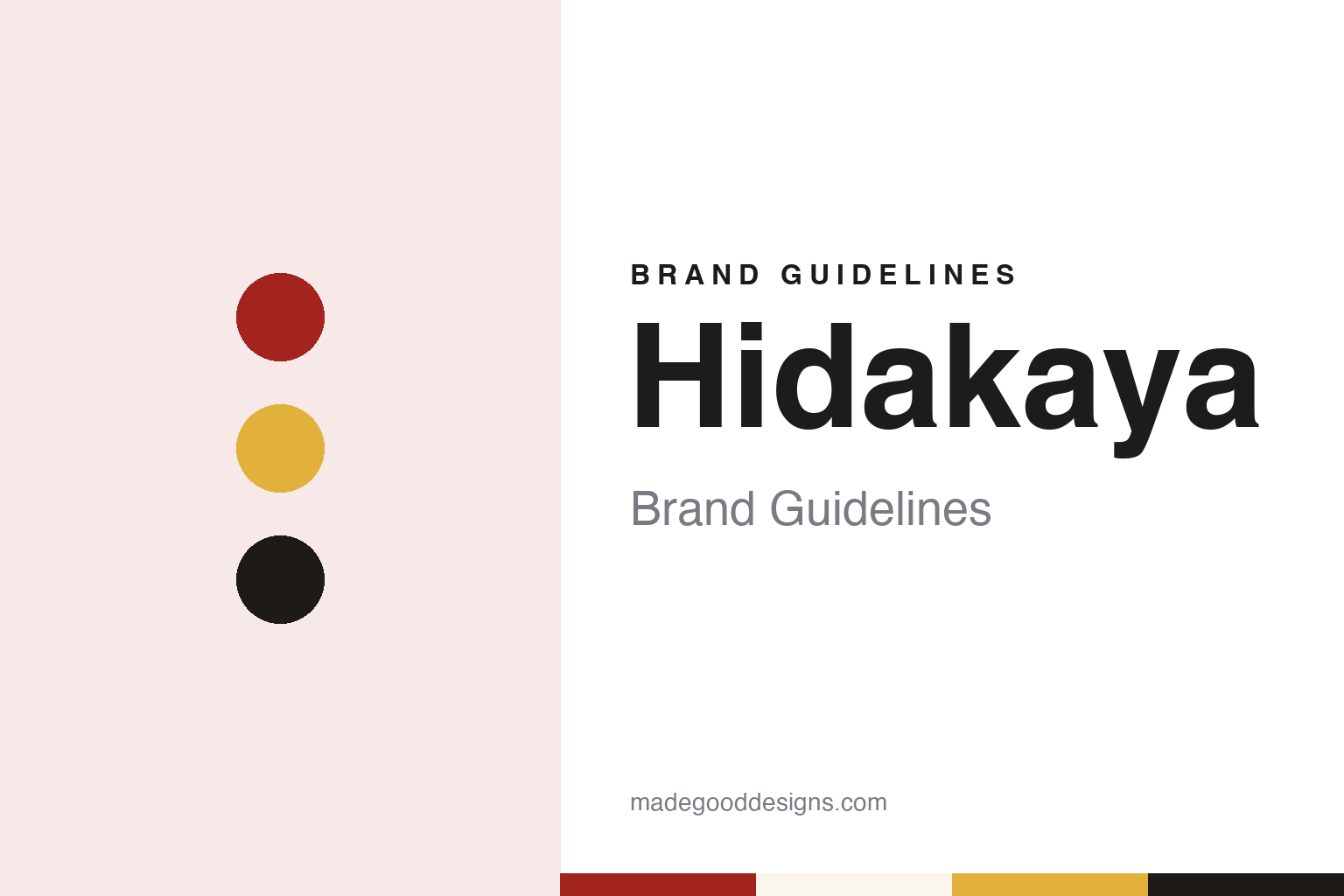
Hidakaya Brand Guidelines
Hiday Hidaka’s station-front chuka chain from a 1973 Omiya shop.
Aa
Two constants: a Hidakaya wok red and mustard palette and a Shopfront grotesque register. Abstract homage — not a Hidakaya product or mark; no dish, logo or signboard is reproduced.
Rairaiken
A Chinese restaurant in Omiya.
Hidakaya is younger than its company. The chain’s first restaurant opened in June 2002, but its operator, Hiday Hidaka, dates its own beginning to February 1973, when Tadashi Kanda, now its chairman, opened a Chinese restaurant called Rairaiken in Miyamachi, in Omiya, a district of today’s Saitama City. The company marked fifty years in February 2023.
Kanda came to ramen by chance. Mynavi News, reporting in February 2023, said he was born in the town of Hidaka in Saitama and that a friend in Omiya suggested he try a ramen shop. At a press event that January, reported by ASCII, he described a stint on a factory line at Honda, his first ramen job in Urawa, work at a street stall, and helping out at a ramen shop in Iwatsuki. When that shop closed, the landlord offered him premises and lent him the money to open; that restaurant was Rairaiken. It took menus to the nearby city office and delivered to staff there, ASCII reported.
The chain itself grew from a second, very small shop. Kanda rented a narrow unit near Omiya’s Kita-Ginza district, ASCII reported, and it was busy enough that he brought in his younger brother and his sister’s husband, Hitoshi Takahashi, who later served as the company’s president. Each ran a shop — the others in Minami-Ginza and in Warabi — and when the two might have gone independent, as was usual for trained cooks at the time, Kanda persuaded them to stay together and build a chain. The company’s timeline records the Rairaiken Omiya Minami-Ginza restaurant opening in March 1975.
Colour
From Ramen-kan to Hidakaya.
The company was incorporated on 22 March 1978, it says, and moved its head office around Omiya several times. In 1986 it set up a food subsidiary, Hidaka Foods, to make noodles and gyoza; it absorbed that business in 1995. It opened its first Tokyo restaurant, Ramen Hidaka in Akabane, in 1993, the year its count passed twenty, and started the Bunrakuza izakaya format. In 1994 came Ramen-kan and the Tainan Ichiba format, and in December that year a Ramen-kan in Kabukicho, Shinjuku, after which, the company says, its openings in central Tokyo nightlife districts accelerated.
In June 1998 the company took the name Hiday Hidaka and adopted a symbol mark and a brand mark, its timeline says. Its shares were registered for over-the-counter trading in September 1999, listed on the second section of the Tokyo Stock Exchange in April 2005, and moved to the first section in August 2006.
Hidakaya arrived in June 2002, with a first restaurant at Shinjuku’s east exit, and by December of that year the company counted 100 restaurants across its formats. At the 2023 anniversary event, ASCII reported, the company explained Hidakaya as a mix of two earlier formats: the wok-cooked menu of Rairaiken and the ramen-centred Ramen-kan. Its full name, Mynavi News noted, is Netsuretsu Chuka Shokudo Hidakaya — roughly “passionate Chinese diner Hidakaya.” On its English pages the chain appears simply as “Ramen Hidakaya.”
Expansion was steady. The company’s timeline records 200 restaurants in July 2008, 300 including three franchised ones in February 2012, and 400 including franchises in May 2017; Mynavi News put the count at more than 400 in February 2023. It entered Chiba in 2004, Tochigi in 2012, Ibaraki in 2014 and Gunma in December 2022, which, the company says, put it in all seven prefectures of the Kanto region. In April 2026 a Hidakaya opened at the Bandai exit of Niigata Station under a franchise agreement with Ocean System, according to the company.
Typography
Design and documentation.
Japan’s restaurant and food chains cover a wide spread of formats: takeaway bento shops, tempura and set-meal counters, family restaurants, ramen and champon chains, takoyaki stands, burger shops and yakiniku grills. Most present themselves first through the shopfront. A sign over the door, a colour that can be read from across the street and a short name, often written in both Latin letters and Japanese script, do much of the work of telling passers-by what is sold inside.
Menus carry the rest. Chains tend to describe themselves by named dishes rather than by abstract promises: a standard bowl, a set meal, a takeaway box, a seasonal special that changes through the year. Menu boards, printed menus, ordering screens and ticket machines repeat those names, and many chains publish their menus online as well, so the dish names themselves become part of the identity.
Store networks are another way these companies describe themselves. Corporate pages and annual histories list store counts, prefectures and the year a chain opened in a new region or country, and many chains mix company-run stores with franchised ones. Some brands operate abroad directly, others through joint ventures or local franchise partners, and the overseas store design and menu can differ from those at home.
Ownership is often layered. A single chain may sit inside a larger restaurant group, alongside sister brands with their own names and looks, and some brand names have changed when a franchise arrangement ended or a parent company reorganised. Corporate pages usually set out the founders, the operating company, the owner and the franchise network, and those pages, read alongside dated press reports, are a useful record of how each chain came to look the way it does today.
Aa
A shopfront grotesque — a station-front signboard. (Specimen set in Archivo, a sans STAND-IN; NOT the Hidakaya logo.)
Hidakaya
Ramen, wok dishes and a central kitchen.
Hiday Hidaka describes a deliberately narrow model. It says it runs its restaurants directly as a rule, so that every one serves the same food and service; that it looks for sites in front of busy stations and in shopping districts, with long opening hours; and that its menus pair ramen with set meals and wok-fried dishes. Its signature bowl, it says, is a chuka soba with a soup built on pork-bone and chicken-bone stock, served beside dishes such as stir-fried garlic chives and liver cooked in a wok. The original Rairaiken format still trades under that name, which the company calls its starting point, alongside Yakitori Hidaka, launched in September 2006.
Its production is concentrated in one place. The company’s central kitchen at Gyoda, in northern Saitama, began full operation in February 2005 and was enlarged in November 2013, to more than twice its earlier site area. The company says the plant buys, makes and delivers for every restaurant — noodles, soup, gyoza, chashu and cut vegetables — and has capacity for 600 restaurants. Its head office moved in February 2022 to the Omiya Kadomachi SQUARE building in Saitama City.
Anniversaries are marked on the menu. For its fiftieth year, the chain sold a limited Hidaka champon from March 2023, a pork-bone and seafood soup with thick, Kitakata-style noodles; the company explained at the launch event, ASCII reported, that the name also played on the idea of a mixture, since champon means a blend and Hidakaya itself had grown from two formats.
For a design guide, Hidakaya shows how a chain can build an identity on position — the station exit, the lit signboard — as much as on any single dish. Compare Ringer Hut, the Nagasaki champon chain, and Matsuya, the gyumeshi chain that began in Ekoda, Tokyo. For this guide we use a wok red, a mustard gold and charcoal with a sans, an unofficial interpretation; no product or logo is reproduced.
Explore & save
Keep Hidakaya’s identity on hand — save it to a board in the Made Good inspiration library.
Hidakaya identity set
Pin the Hidakaya wok red and mustard palette and the Shopfront grotesque register to your own board.
Source & notes
Frequently Asked Questions
What font can I use to match the Hidakaya look?
This guide describes Hidakaya’s type as “A shopfront grotesque — a station-front signboard”. Its type specimen is set in Archivo from Google Fonts as a stand-in; Archivo is not Hidakaya’s own lettering.
What colours are in the Hidakaya palette?
This guide’s Hidakaya palette is Wok red #A3241E, Charcoal #1E1A18, Noodle white #FAF6EE, Mustard gold #E2B13C and Soy brown #5B3A24. The tones are the guide’s own unofficial interpretation, not official Hidakaya hex codes.
When was Hidakaya founded?
Hidakaya was founded in February 1973 (Rairaiken), in Omiya, Saitama.
Who founded Hidakaya?
Hidakaya was founded by Tadashi Kanda in February 1973 (Rairaiken).


