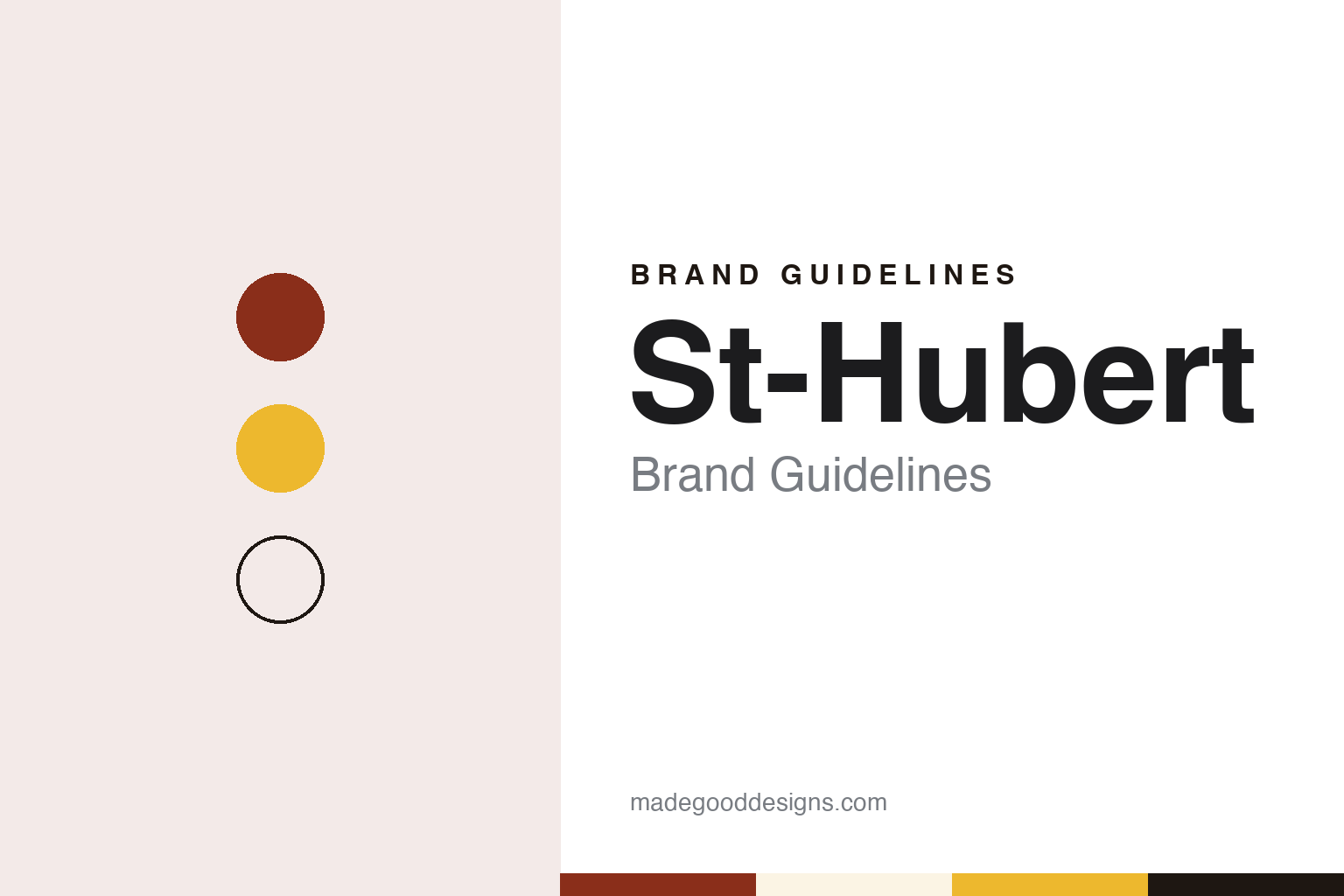
St-Hubert Brand Guidelines
Montreal’s 1951 rotisserie, yellow delivery cars and Recipe.
Aa
Two constants: a St-Hubert red, yellow and cream palette and a warm slab serif register. Abstract homage — not a St-Hubert product or mark; no logo, mascot or vehicle is reproduced.
Rue Saint-Hubert
A family rotisserie on a Montreal street.
St-Hubert takes its name from a street. English Wikipedia says the first restaurant opened in September 1951 on Saint-Hubert Street in Montreal, just south of Beaubien Street, and names its founders as Hélène and René Léger. CBC News, in a 2016 history of the chain, wrote that the family had been inspired by similar barbecue restaurants in the city and decided to take a chance. The original address still trades, English Wikipedia says, now as a St-Hubert Express take-out restaurant.
The menu that built the business was simple. CBC News described the chicken, coleslaw and fries combination as the core of the offer and said the family business had grown to five locations by the time Montreal hosted Expo 67; a photo caption in the same report dates the first Quebec City restaurant to the 1960s. The company’s full legal name, according to English Wikipedia, is St-Hubert BBQ Ltd., and the chain writes its name with a hyphen and the short “St” form.
Growth beyond Quebec followed. CBC News reported that the chain expanded outside the province during the 1970s and that the owners quadrupled the number of rotisseries in ten years. English Wikipedia adds an episode in Florida: a St-Hubert restaurant opened in Fort Lauderdale on 12 June 1979, operated by a U.S. company, St. Hubert of Florida, and served mainly French-Canadian winter visitors, with advertising in French. By mid-1988 another restaurant chain occupied the site. In 1983 the company also tried an Italian restaurant concept, Pastelli, which English Wikipedia says ended in the late 1980s.
Colour
Yellow cars, a rooster and a sauce on the shelf.
Much of St-Hubert’s identity sits outside the dining room. CBC News wrote in 2016 that the chain’s jingle and its yellow fleet of Beetle delivery cars became a cornerstone of the brand and of its free delivery service, and English Wikipedia says the bright yellow cars have carried a sound-based slogan on their sides.
The chain’s mascot is a rooster. English Wikipedia says the original St-Hubert chicken character was created and designed by the former Disney animator Jack Dunham, who also produced the company’s first television commercials, and that the rooster in use since the early 1970s is a later design that was not his.
The brand also reached supermarket shelves. Both CBC News and English Wikipedia date the move of St-Hubert’s gravy sauce into supermarkets across Quebec to 1965. English Wikipedia lists barbecue sauce in a ready-to-serve format, desserts, seasonings and frozen chicken among the products sold in grocery stores.
The restaurants come in several formats. English Wikipedia describes full-service restaurants, resto-bars and St-Hubert Express outlets, which are closer to fast food and offer take-out, drive-through and delivery. CBC News noted in 2016 that most restaurants were in Quebec, with others in Ontario and New Brunswick. English Wikipedia says its overlap with Swiss Chalet, another rotisserie chain that left the Quebec market in the early 2000s, is limited to the Ottawa area and to Moncton and Fredericton.
The map has moved over time. English Wikipedia records that restaurants in Halifax and in St. John’s, Newfoundland, closed around the late 1980s and early 1990s, and that those in the Saint John, New Brunswick, area closed in 2013. In January 2011 the company announced three St-Hubert Express locations for the Toronto area and briefly returned to Kingston, Ontario, with an Express that closed about a year after opening; the remaining Toronto-area restaurants later closed or became independent, the same account says.
Typography
Design and documentation.
Canada’s home-grown restaurant chains grew up alongside the American franchises that crossed the border, and many still introduce themselves by where they began. Harvey’s dates its first restaurant to Richmond Hill, Ontario, in 1959; Mary Brown’s traces its first to St. John’s, Newfoundland and Labrador, in 1969. Their corporate and franchising pages tell those founding stories, name founders and owners, and describe their franchise networks in their own words.
The chains in this group cover burgers, fried and rotisserie chicken, subs, pizza, juice, salads, Thai dishes and burritos. On their own websites they present themselves through shopfronts, signage, packaging and a handful of named dishes, such as a lead burger or a chicken sandwich, repeated across their restaurants. In Quebec, names and menus appear in French, written as the companies write them.
Ownership is often grouped. Several of these brands belong to larger restaurant companies that run many chains at once: Recipe Unlimited, taken private by Fairfax Financial in October 2022, lists Harvey’s, Swiss Chalet and St-Hubert among its brands, according to the law firm Torys, and Mary Brown’s parent, MBI Brands, bought a Toronto burrito chain in 2022, The Telegram reported. Some restaurants share a building with a sibling brand, as some Harvey’s and Swiss Chalet locations do.
Some of these chains also trade abroad, at times under a shorter name, as Mary Brown’s does with MB Chicken. This guide sets out what can be checked about each brand: who founded it, who owns it and how many restaurants a dated source gives it. It marks clearly what rests only on the company’s own word, and its palettes and typefaces are our own interpretation, not the brands’ official ones.
Aa
A warm slab serif — a register for a family rotisserie. (Specimen set in Bitter, a serif STAND-IN; NOT the St-Hubert logo.)
St-Hubert
From the Léger family to Recipe Unlimited.
The family sold the business in 2016. CBC News reported on 1 April 2016 that St-Hubert was changing hands for the first time in 65 years, with 120 restaurants and take-out counters, almost all of them in Quebec. English Wikipedia says the buyer, Cara Operations, owner of Swiss Chalet, announced the purchase on 31 March 2016 and completed it on 2 September 2016. It adds that the Quebec pension fund manager Caisse de dépôt et placement du Québec had offered to take a minority stake, an offer that was declined, and that Jean-Pierre Léger, the founders’ son, had looked for buyers within Quebec before agreeing to the sale to Cara.
Cara changed its name to Recipe Unlimited in May 2018, and English Wikipedia records that Fairfax Financial completed a deal taking Recipe private on 31 October 2022, after which its shares left the Toronto Stock Exchange. Recipe, based in Vaughan, Ontario, also owns Harvey’s and Swiss Chalet. English Wikipedia gives St-Hubert’s own head office as Boisbriand, Quebec.
The chain marked its 75th anniversary in 2026. L’Express Franchise reported on 28 September 2026 that St-Hubert held a special day on 29 September across more than 120 rotisseries in Quebec, Ontario and New Brunswick, and that it has belonged to Recipe Unlimited since 2016, with Richard Scofield as president and chief executive of Groupe St-Hubert.
For a design guide, St-Hubert shows how a colour can travel: one colour, the yellow of its delivery cars, can carry a brand as far as its name does. Compare its sister rotisserie chain in the Swiss Chalet brand guidelines and its stablemate in the Harvey’s brand guidelines. For this guide we use rotisserie red, roast brown, delivery yellow and cream with a serif, an unofficial interpretation; no product or logo is reproduced.
Explore & save
Keep St-Hubert’s identity on hand — save it to a board in the Made Good inspiration library.
St-Hubert identity set
Pin the St-Hubert red, yellow and cream palette and the warm slab serif register to your own board.
Source & notes
Frequently Asked Questions
What font can I use to match the St-Hubert look?
This guide describes St-Hubert’s type as “A warm slab serif — a register for a family rotisserie”. Its type specimen is set in Bitter from Google Fonts as a stand-in; Bitter is not St-Hubert’s own lettering.
What colours are in the St-Hubert palette?
This guide’s St-Hubert palette is Rotisserie red #8A2E1A, Roast brown #5E3A22, Delivery yellow #EDB82E, Cream #FBF4E4 and Ink #1E1712. The tones are the guide’s own unofficial interpretation, not official St-Hubert hex codes.
When was St-Hubert founded?
St-Hubert was founded in 1951, in Montreal, Quebec. St-Hubert is known for Rotisserie chicken, sauces, yellow delivery cars.
Who founded St-Hubert?
St-Hubert was founded by Hélène and René Léger in 1951.