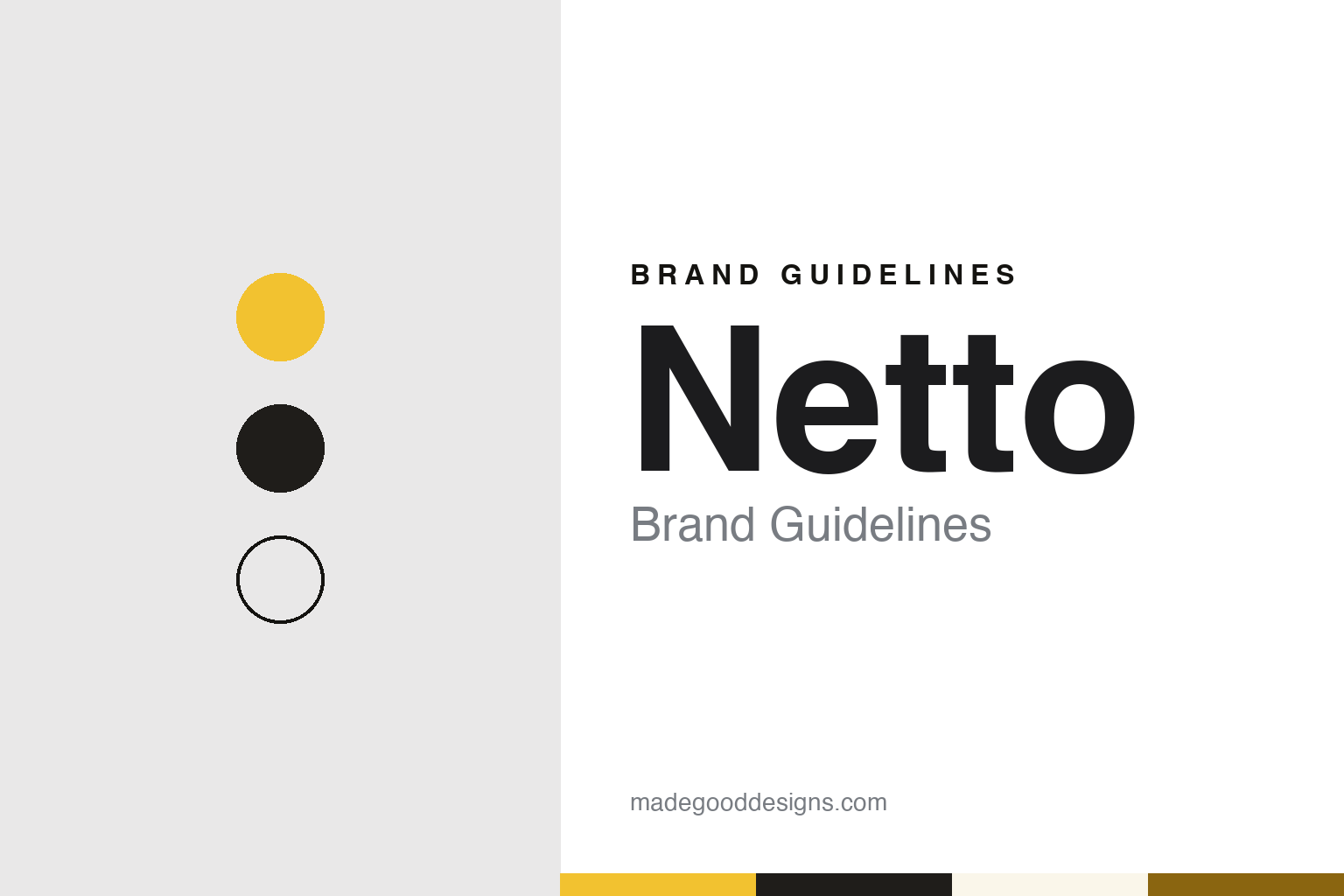
Netto Brand Guidelines
A 1981 Copenhagen discounter, a Scottish terrier and three countries.
Aa
Two constants: a yellow, near-black and warm white palette and a condensed sans register. Abstract homage — not a Netto product or mark; no logo, dog emblem or pack is reproduced.
Vanløse, 1981
A plain neighbourhood shop from an Aarhus retail group.
Netto opened its first store on 1 April 1981 in Vanløse, a district of Copenhagen, Danish Wikipedia says. The chain belonged to Dansk Supermarked, the Aarhus retail group behind the føtex supermarkets and the Bilka hypermarkets. The idea, Danish Wikipedia explains, was a neighbourhood shop: simply fitted stores of 500 to 1,000 square metres, limited service and a fixed range of the most common everyday groceries, placed mainly in larger towns close to housing. English Wikipedia adds that the earliest stores sold goods straight from boxes and pallets, and that the service level rose as the chain expanded.
The group had been set up as Jysk Supermarked by the Aarhus retailer Herman Salling in 1960, the year he opened the first føtex, according to the company’s own history. It was renamed Dansk Supermarked in 1964, when A.P. Møller-Maersk joined as a 50 per cent partner; Maersk raised its stake to 68 per cent in 1982. The Salling Foundations took majority control in January 2014 and bought the remaining shares in November 2017, and in June 2018 Dansk Supermarked was renamed Salling Group. The company says it is wholly owned by the Salling Foundations.
At home, Netto grew by opening stores and by buying them. In 2001 it took over 26 stores of the rival Suma on Zealand, Danish Wikipedia says. From 5 December 1996, when the first opened in Gentofte, it also ran DøgnNetto, a set of smaller late-opening shops, mainly in Greater Copenhagen, with a narrower range and fresh bread every day; Dansk Supermarked wound the format up in 2016 and turned the remaining stores into ordinary Netto shops or føtex Food.
Colour
A Scottish terrier, own labels and a confusing name.
The chain’s emblem is a dog. Danish Wikipedia says the Scottie, a Scottish terrier, was “born” in October 1992, chosen after bees, flowers and many other symbols had been discussed, and that it then appeared in advertising, on carrier bags, on store signs and much more. Netto’s own labels include ØGO, which Salling Group names as its organic brand. Danish Wikipedia also describes Netto’s weekly “spot” items, limited batches of food and non-food goods that fill much of its leaflets, though not every store stocks them.
Netto went abroad in 1990. Its first German store opened that year in Mecklenburg-Vorpommern, then still part of East Germany, English Wikipedia says, and the chain spread across Brandenburg, Berlin, Saxony, Saxony-Anhalt and the north. In Britain it opened in Leeds on 13 December 1990, with a head office at South Elmsall in West Yorkshire. Poland followed in 1995, with a first store in Szczecin, and Sweden in 2002, through Netto Marknad, a joint venture with the Swedish group ICA; English Wikipedia says the first Swedish store opened in Trelleborg on 8 May 2002 and that ICA later reduced its stake and then left the business.
The name causes confusion. Germany’s Netto Marken-Discount, owned by the Edeka group and trading since 1984, is a separate company with no link to the Danish chain, English Wikipedia says; the Netto stores in France, part of Les Mousquetaires, and in Spain are independent of it too. This guide covers only the Danish Netto of Salling Group.
Typography
Signs, own labels and store networks.
Europe’s supermarket, hypermarket and discount chains present themselves first through the shopfront. A store sign has to read from across a car park or down a busy street, so most chains keep a short name, a strong colour and a simple mark, and repeat them on carrier bags, leaflets, delivery vans and receipts. Some add an emblem: the Danish discounter Netto has used a Scottish terrier, which it calls the Scottie, since 1992.
Own-label packaging is the second carrier of identity. Chains name these ranges themselves, from the plain store name on everyday goods to separate labels for organic, premium or value lines, and the guides in this group name them only as the companies do. A range of thousands of products can carry one look, which makes the own label as visible as the sign above the door.
Store formats multiply a brand. One group may run small neighbourhood shops, larger edge-of-town stores, convenience outlets at service stations and hypermarkets, each with its own banner or a variation of the main one; Spain’s Dia, for example, has used names such as Dia Market, Maxi Dia and La Plaza de Dia. Networks also change across borders, as chains enter new countries, sell stores to rivals or leave markets altogether, and the store counts in these guides are given with the date of the source.
Ownership is often less visible than the sign. Many chains sit inside larger retail groups, some listed on stock exchanges, some controlled by investment firms and some owned by foundations or cooperatives of independent retailers. The corporate pages of these groups, along with official competition decisions and trade press, set out who founded each chain, who owns it now and which banners belong together, and those are the records this guide relies on.
Aa
A condensed sans for a discount shop sign. (Specimen set in Barlow Condensed, a sans STAND-IN; NOT the Netto logo.)
Netto
Out of Britain and Sweden, deeper into Poland and Denmark.
Britain was the first market Netto left. Asda agreed to buy Netto Foodstores, the 193-store British business, from Dansk Supermarked, the trade title Eurofruit reported on 27 May 2010, with the stores to be converted to the Asda name; Danish Wikipedia says the Netto name had gone from England by September 2011. Netto came back in 2014 as a 50:50 joint venture with Sainsbury’s, and the partners ended it in 2016 and closed the stores, English Wikipedia says. In Sweden, Salling Group agreed in May 2019 to sell the 163 Netto stores to Coop, and the stores passed to Coop in July 2019 after approval by the Swedish competition authority, Danish Wikipedia says.
Poland and Denmark went the other way. Salling Group says it completed the purchase of Tesco’s Polish business in 2020, taking about 300 stores and two distribution centres and converting the stores to Netto. In Denmark, as Aldi left the market, the Danish Competition Council approved Salling Group’s purchase of 13 Aldi stores and 8 store projects on 29 November 2023, with commitments to sell one store and sublet another, the Danish Competition and Consumer Authority announced. In 2025 the authority cleared the purchase of 33 stores from Coop Danmark, most of them 365discount shops, to become Netto or føtex stores, NHH Food, the food-retail news service of the Norwegian School of Economics, reported on 3 April 2025.
The same NHH Food report, citing Salling Group, counted 553 Netto stores in Denmark, 676 in Poland and 341 in Germany as of April 2025. Salling Group says it runs Netto in Denmark, Germany and Poland, alongside føtex, Bilka and the Salling department stores in Denmark and, since 2025, the Rimi chain in the Baltic states.
For a design guide, Netto shows how a single animal emblem and a short, plain name can follow a discount format across borders, even when another chain abroad shares the name. Compare Aldi, whose Danish stores partly passed to Netto, and Rimi, now in the same group. For this guide we use a sunflower yellow, a deep ochre, a near-black and a warm white with a condensed sans, an unofficial interpretation; no product or logo is reproduced.
Explore & save
Keep Netto’s identity on hand — save it to a board in the Made Good inspiration library.
Netto identity set
Pin the Netto yellow, near-black and warm white palette and the condensed sans register to your own board.
Source & notes
Frequently Asked Questions
What font can I use to match the Netto look?
This guide describes Netto’s type as “A condensed sans for a discount shop sign”. Its type specimen is set in Barlow Condensed from Google Fonts as a stand-in; Barlow Condensed is not Netto’s own lettering.
What colours are in the Netto palette?
This guide’s Netto palette is Sunflower yellow #F2C230, Deep ochre #8A6510, Near-black #1F1D1A, Terrier grey #6B6A66 and Warm white #FAF6EA. The tones are the guide’s own unofficial interpretation, not official Netto hex codes.
When was Netto founded?
Netto was founded in 1981, in Vanløse, Copenhagen, Denmark.