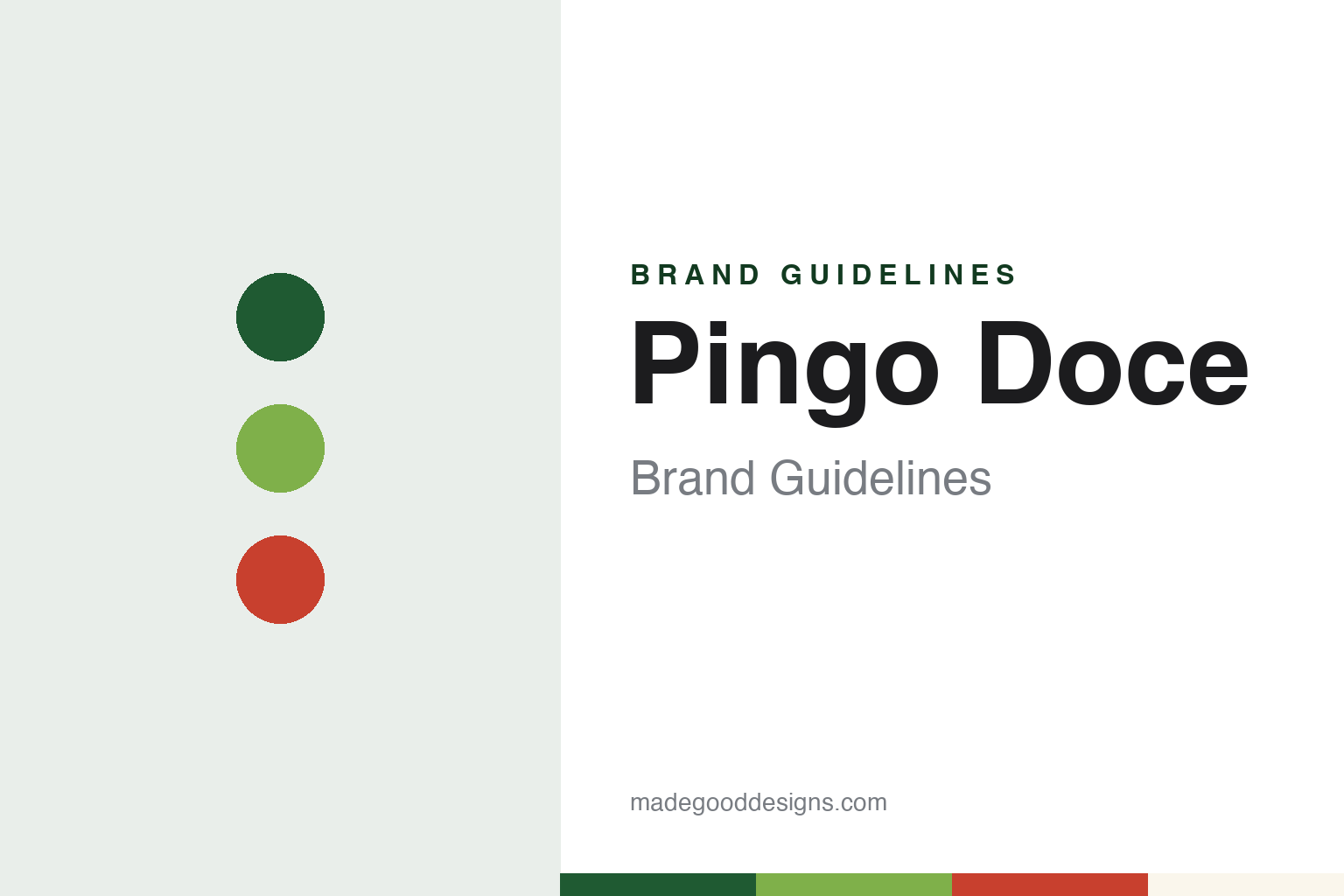
Pingo Doce Brand Guidelines
A Lisbon grocer’s name, a supermarket chain and a house label.
Aa
Two constants: a deep green, leaf green and tomato red palette and a rounded grocery sans register. Abstract homage — not a Pingo Doce sign, product or mark; no logo or packaging is reproduced.
A Chiado shop
A grocer’s name from 1792, a supermarket chain from 1980.
Pingo Doce is a Portuguese supermarket chain, and its parent is far older than the chain. Jerónimo Martins’ own history, published on its Feed magazine in July 2017, says a young Galician named Jerónimo Martins opened a small shop in Lisbon’s Chiado district in 1792, selling a little of everything. The group says that in 1921 the business was taken over by Francisco Manuel dos Santos and Elysio Pereira do Vale, who reopened it as Estabelecimento Jerónimo Martins & Filho. From 1938 it produced margarine in its own factory, and in 1949 it formed a joint venture with Unilever, which turned the family firm into a largely industrial company making edible oils, margarines, ice creams and detergents.
The move back into shops came later. According to the group, Alexandre Soares dos Santos took over the business in 1968 and wanted an alternative to the Unilever manufacturing work. A Jerónimo Martins article from November 2021 describes Pingo Doce as the retail chain he founded in 1978, and says it took two years to move from small superettes to full supermarkets. Pingo Doce’s own timeline dates the opening of its first store to 1980, and the group’s 2017 history calls that year a return to its original trade of distribution. The name translates as “Sweet Drop,” English Wikipedia says.
Growth was steady through the 1980s. The company timeline lists a modernisation of the supermarkets in 1983, the first themed in-store fairs in 1985 and the 100th store in 1987. In 1985, Jerónimo Martins says, it formed a partnership with the Belgian retailer Delhaize “Le Lion” to develop the chain, and in 1988 it bought the cash-and-carry business Recheio. In 1992, the group’s bicentenary year, it bought out the Delhaize stake and set up a joint venture with the Dutch company Royal Ahold, which held 49% of Jerónimo Martins Retail, the holding that controls Pingo Doce. English Wikipedia’s article on the chain gives the same split, with Ahold Delhaize as the minority partner.
Colour
Own label, Feira Nova and a single banner.
The chain’s house label is a large part of its identity. Pingo Doce’s timeline dates the launch of the Pingo Doce own brand to 1991, while the group’s 2017 history places the introduction of private brands in 1992. The November 2021 Feed article says the chain rolled out more than 50 own-label references between 1991 and 1993, among them olive oil, coffee, milk and yoghurt. It also records that the step caused tension with the Unilever side of the business, since retailer brands competed directly with branded goods made by the group’s own factories.
Portugal’s industrial-property institute, INPI, lists a PINGO DOCE logotype registration filed in December 1992 and held by Pingo Doce – Distribuição Alimentar, S.A.; the record classifies it as a mixed sign, meaning words combined with a graphic element. English Wikipedia says the chain has used its current logo since 2008, the year it repositioned itself and began folding the group’s Feira Nova supermarkets and hypermarkets into the Pingo Doce brand.
The merger reshaped the chain’s visual footprint. Pingo Doce’s timeline says the merger with Feira Nova and the acquisition of the Plus stores in 2007 tripled the number of its shops across the country. On 17 February 2010, just-food reported that Jerónimo Martins would rebrand its nine remaining Feira Nova hypermarkets under the Pingo Doce banner in a gradual process over that year, and quoted a spokesperson saying that Feira Nova as a brand would disappear by the end of 2010. The group chose to concentrate on two names in Portugal, Pingo Doce for supermarkets and Recheio for cash and carry.
Advertising has given the brand a recognisable sound as well as a look. The company timeline lists a 2009 campaign called “Pingo Doce, venha cá” and, from 1996, recipes presented under the line “No Sítio do Costume.” English Wikipedia says that in 2021 the chain popularised the line “Quem trouxe, quem trouxe? Foi o Pingo Doce!” with a Christmas jingle. ECO reported in November 2023 that the jingle returned for that year’s Christmas campaign, sung by Fernando Daniel, with creative work by BBDO Portugal and music by Joaquim Albergaria and Ivo Costa.
Typography
Signs, own labels and group pages.
Europe’s supermarket, hypermarket and discount chains present themselves first through the shopfront. A store sign has to read from across a car park or down a busy street, so most chains keep a short name, a strong colour and a simple mark, and repeat them on carrier bags, leaflets, delivery vans and receipts. Some add an emblem: the Danish discounter Netto has used a Scottish terrier, which it calls the Scottie, since 1992.
Own-label packaging is the second carrier of identity. Chains name these ranges themselves, from the plain store name on everyday goods to separate labels for organic, premium or value lines, and the guides in this group name them only as the companies do. A range of thousands of products can carry one look, which makes the own label as visible as the sign above the door.
Store formats multiply a brand. One group may run small neighbourhood shops, larger edge-of-town stores, convenience outlets at service stations and hypermarkets, each with its own banner or a variation of the main one; Spain’s Dia, for example, has used names such as Dia Market, Maxi Dia and La Plaza de Dia. Networks also change across borders, as chains enter new countries, sell stores to rivals or leave markets altogether, and the store counts in these guides are given with the date of the source.
Ownership is often less visible than the sign. Many chains sit inside larger retail groups, some listed on stock exchanges, some controlled by investment firms and some owned by foundations or cooperatives of independent retailers. The corporate pages of these groups, along with official competition decisions and trade press, set out who founded each chain, who owns it now and which banners belong together, and those are the records this guide relies on.
Aa
A rounded, friendly grocery sans. (Specimen set in Nunito Sans, a sans STAND-IN; NOT the Pingo Doce logo.)
Pingo Doce
Supermarkets, kitchens and restaurants.
Since 2010 the chain has added food service to its stores. Portuguese Wikipedia says Pingo Doce introduced restaurant and take-away service in its supermarkets and hypermarkets in 2010, and the company timeline names a central kitchen at Odivelas in 2011, a fresh-pasta plant in 2009 and a programme of eco-design for Pingo Doce packaging from 2011. In 2015, Portuguese Wikipedia says, it opened the first Pingo Doce & Go, a 24-hour convenience format run with BP filling stations; five such shops were open by March 2019. The timeline then lists a new generation of stores with Comida Fresca restaurants from 2020, the GO Active own brand in 2021 and the app O Meu Pingo Doce in 2023.
The store network has grown in dated steps. Pingo Doce’s timeline records the 400th store in 2015. Portuguese Wikipedia counts 432 stores in 293 places in January 2019 and 470 stores in September 2022, spread across all seven Portuguese regions, with the Lisbon metropolitan area holding the most. Jerónimo Martins listed 497 Pingo Doce stores in December 2025, in mainland Portugal, the Azores and Madeira, and says almost half of them include a Comida Fresca restaurant, supplied by two central kitchens.
Pingo Doce sits inside a wider group. English Wikipedia says Jerónimo Martins is listed on Euronext Lisbon and also runs the Recheio cash-and-carry chain in Portugal, the Biedronka discount chain in Poland since 1997, the Hebe health-and-beauty chain and, since 2013, Ara stores in Colombia.
For a design guide, Pingo Doce shows how a retailer can turn its own label and a single shop banner into the identity, retiring a sister name to do it. Compare Continente, the Sonae chain in the same country, and Dia, a Spanish supermarket name. For this guide we use a deep green, a leaf green and a tomato red on cream with a rounded sans, an unofficial interpretation; no product or logo is reproduced.
Explore & save
Keep Pingo Doce’s identity on hand — save it to a board in the Made Good inspiration library.
Pingo Doce identity set
Pin the Pingo Doce deep green, leaf green and tomato red palette and the rounded grocery sans register to your own board.
Source & notes
Frequently Asked Questions
What font can I use to match the Pingo Doce look?
This guide describes Pingo Doce’s type as “A rounded, friendly grocery sans”. Its type specimen is set in Nunito Sans from Google Fonts as a stand-in; Nunito Sans is not Pingo Doce’s own lettering.
What colours are in the Pingo Doce palette?
This guide’s Pingo Doce palette is Deep market green #1F5A32, Pine ink #123A20, Leaf green #7FB04A, Tomato red #C8402E and Cream paper #FAF6EC. The tones are the guide’s own unofficial interpretation, not official Pingo Doce hex codes.
Who owns Pingo Doce?
Pingo Doce is owned by Jerónimo Martins with Ahold Delhaize.