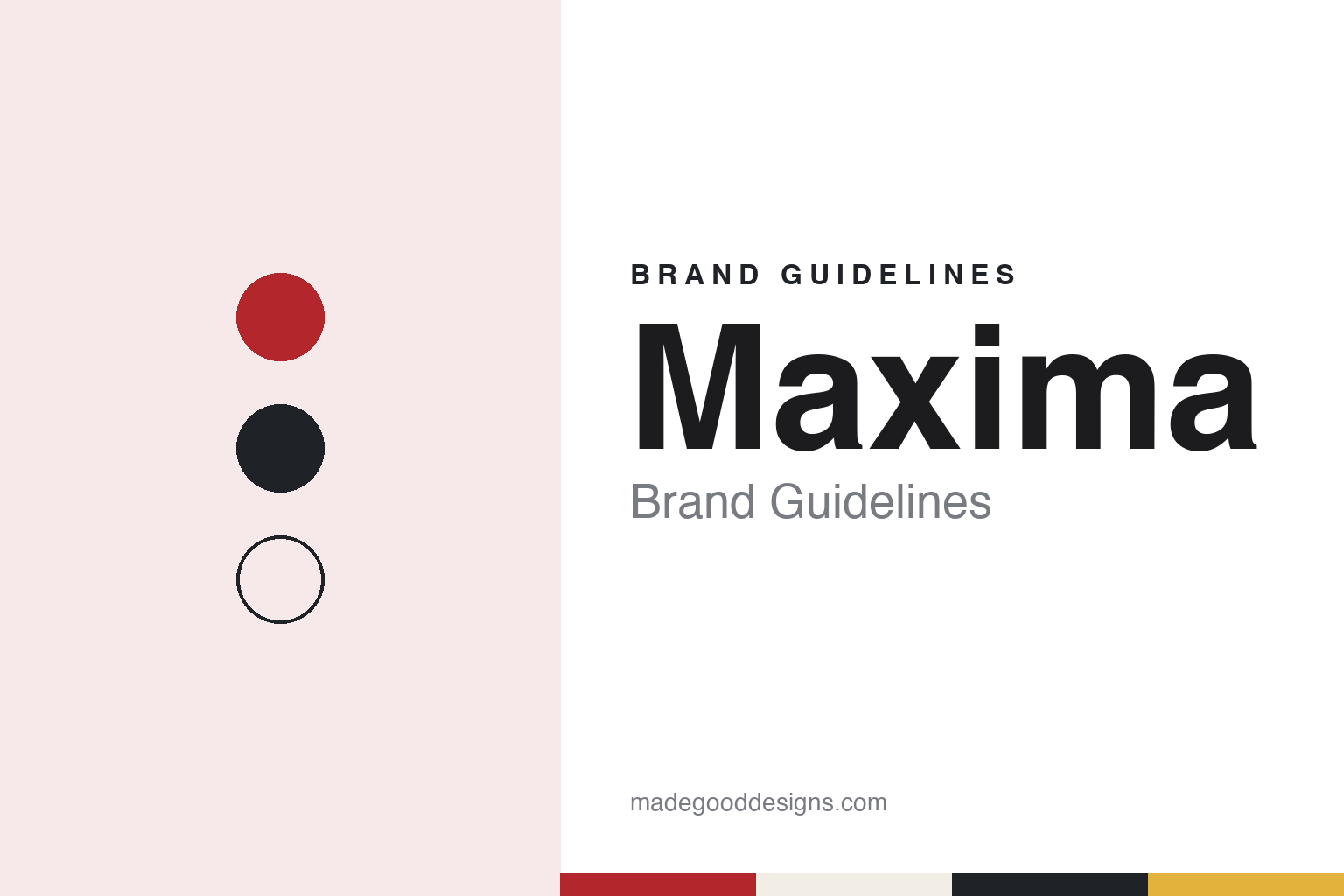
Maxima Brand Guidelines
A Vilnius grocer that turned a size scale into a name.
Aa
Two constants: a red, deep charcoal and warm white palette and a wide grotesque register. Abstract homage — not a Maxima product or mark; no logo, sign or pack is reproduced.
Minima, Media, Maxima
A Vilnius shop company that named its stores by size.
Maxima’s roots are in Vilnius in 1992. Lithuanian Wikipedia says the company Urdžia was registered that year, and that by 1994 three Urdžia shops were trading in the city, one on Naugarduko Street and two in the Antakalnis district. In 1995 the chain was renamed Vilniaus prekyba, by then with 18 stores in Lithuania, and it added new store names such as Taupa and Saulutė.
The Maxima name arrived in 1998. That year, Lithuanian Wikipedia says, the stores were renamed by size as Minima, Media and Maxima and the first Maxima opened in Vilnius; English Wikipedia also dates the first Maxima store to 1998. Between 1998 and 2005, the same source says, the business built a network of these differently sized stores.
One early store shows how the chain used existing buildings. Lithuanian Wikipedia says the Maxima on Mindaugo Street in Vilnius was designed in 1998 and opened at the end of June 1999 inside a former 8,600-square-metre furniture store. The reconstruction was designed by the building’s original architect, Elena Nijolė Bučiūtė, a professor in the architecture department of Vilnius Gediminas Technical University, and kept a distinctive part of the original structure.
The naming system was then tightened. In 2005 and 2006, Lithuanian Wikipedia says, the Minima, Mini Maxima, Media and Saulutė stores were all converted to Maxima, and the stores were graded by size and range as Maxima X, XX and XXX, with XXXX added later. The holding company MAXIMA GRUPĖ, UAB was established in 2007.
Colour
Latvia, Estonia, Bulgaria, Poland and Spain.
The chain went abroad early. It entered Latvia and Estonia in 2000, and in 2005 it started in Bulgaria under the T Market name, Lithuanian Wikipedia says. At the end of 2011 it was cleared to buy Aldik, a chain of 24 stores in Poland. In 2018 it bought a 93.7 percent stake in Emperia Holding, which ran the Polish supermarket chain Stokrotka; English Wikipedia says that transaction was completed in April 2018. In 2019 the Aldik and Stokrotka stores began trading under the single Stokrotka name.
Spain was a shorter chapter. English Wikipedia says Maxima ran a Spanish division from 2012 to 2020, acquired from the DinoSol group, under the names SuperSol for supermarkets and Cash Diplo for cash-and-carry, mainly in the Madrid area and Andalusia. In August 2020 the retail trade publication RetailDetail reported that Carrefour had agreed to buy the 172 SuperSol supermarkets and convenience stores, that Maxima had decided to leave the Spanish market, and that the stores would take Carrefour’s Express, Market and Supeco names. English Wikipedia says Cash Diplo was the subject of a separate takeover in 2021.
Online, Maxima began with an e-shop called e-Maxima, which started trading in Vilnius in 2011, according to Lithuanian Wikipedia. In 2017 Maxima Grupė bought UAB Radas, owner of the online grocer Barbora, and Barbora became the group’s online grocery name. The same source says Barbora stopped operating in Poland on 4 March 2024. In January 2019 the group set up Maxima International Sourcing, which Lithuanian Wikipedia describes as handling central supply, buying and negotiation for the group’s chains, wholesale trade, and the development of private labels.
Typography
How Europe’s grocers present themselves.
Europe’s supermarket, hypermarket and discount chains present themselves first through the shopfront. A store sign has to read from across a car park or down a busy street, so most chains keep a short name, a strong colour and a simple mark, and repeat them on carrier bags, leaflets, delivery vans and receipts. Some add an emblem: the Danish discounter Netto has used a Scottish terrier, which it calls the Scottie, since 1992.
Own-label packaging is the second carrier of identity. Chains name these ranges themselves, from the plain store name on everyday goods to separate labels for organic, premium or value lines, and the guides in this group name them only as the companies do. A range of thousands of products can carry one look, which makes the own label as visible as the sign above the door.
Store formats multiply a brand. One group may run small neighbourhood shops, larger edge-of-town stores, convenience outlets at service stations and hypermarkets, each with its own banner or a variation of the main one; Spain’s Dia, for example, has used names such as Dia Market, Maxi Dia and La Plaza de Dia. Networks also change across borders, as chains enter new countries, sell stores to rivals or leave markets altogether, and the store counts in these guides are given with the date of the source.
Ownership is often less visible than the sign. Many chains sit inside larger retail groups, some listed on stock exchanges, some controlled by investment firms and some owned by foundations or cooperatives of independent retailers. The corporate pages of these groups, along with official competition decisions and trade press, set out who founded each chain, who owns it now and which banners belong together, and those are the records this guide relies on.
XX
A wide, heavy grotesque for size grades and shelf signs. (Specimen set in Archivo, a sans STAND-IN; NOT the Maxima logo.)
Maxima Grupė
Back to the Baltic states in December 2025.
Maxima Grupė belongs to Vilniaus prekyba, the Lithuanian group that grew out of the 1990s Vilnius stores. Lithuanian Wikipedia lists the group’s other holdings as pharmacy, DIY and commercial property businesses, among them Euroapotheca, Ermi Group and Akropolis Group. The same source traces those sidelines to the grocery business itself: the group set up the Eurovaistinė pharmacy chain in 1998, the same year the Maxima name appeared, and the Ermitažas DIY chain in 2004, and in 2016 it joined a Maltese company in buying the Akropolis shopping-centre business. By 2022, Lithuanian Wikipedia says, the group’s companies ran shops, pharmacies and shopping centres in the Baltic states, Poland, Bulgaria and Sweden.
In December 2025 the group narrowed Maxima’s map. On 22 December 2025 Maxima Grupė announced that it had completed the sale of the companies running Stokrotka in Poland and T Market in Bulgaria to PARETAS B.V., another company in the Vilniaus prekyba group, as part of a restructuring of the wider group announced in October. The company says it continues to manage the Maxima chains in the Baltic states, the Barbora e-store and the companies Franmax and Maxima International Sourcing. Lithuanian Wikipedia likewise records that the group owned T Market and Stokrotka until the end of 2025.
The chain is now a Baltic business. English and Lithuanian Wikipedia put it at about 500 Maxima stores across Lithuania, Latvia and Estonia, all under the one Maxima name. In Estonia, Maxima operated 86 stores at the end of 2025 and employed an average of 2,852 people there during the year, ERR News reported in June 2026, drawing on the company’s annual report.
For a design guide, Maxima shows how a retailer can turn a size scale into a naming system, first with three words, Minima, Media and Maxima, and then with a run of letters from X to XXXX. Compare Rimi, its Baltic neighbour with its own four size names, and Carrefour, which agreed in 2020 to buy Maxima’s Spanish SuperSol stores. For this guide we use a signal red, a deep charcoal and a warm white with a sans, an unofficial interpretation; no product or logo is reproduced.
Explore & save
Keep Maxima’s identity on hand — save it to a board in the Made Good inspiration library.
Maxima identity set
Pin the Maxima red, deep charcoal and warm white palette and the wide grotesque register to your own board.
Source & notes
Frequently Asked Questions
What font can I use to match the Maxima look?
This guide describes Maxima’s type as “A wide, heavy grotesque for size grades and shelf signs”. Its type specimen is set in Archivo from Google Fonts as a stand-in; Archivo is not Maxima’s own lettering.
What colours are in the Maxima palette?
This guide’s Maxima palette is Signal red #B3262B, Deep charcoal #1F2226, Warm white #F2EEE6, Amber #E3B23C and Paper #FAF8F3. The tones are the guide’s own unofficial interpretation, not official Maxima hex codes.
When was Maxima founded?
Maxima was founded in 1992, in Vilnius, Lithuania. This guide lists Vilniaus prekyba group as its owner.
Who owns Maxima?
Maxima is owned by Vilniaus prekyba group. This guide dates Maxima to 1992, in Vilnius, Lithuania.