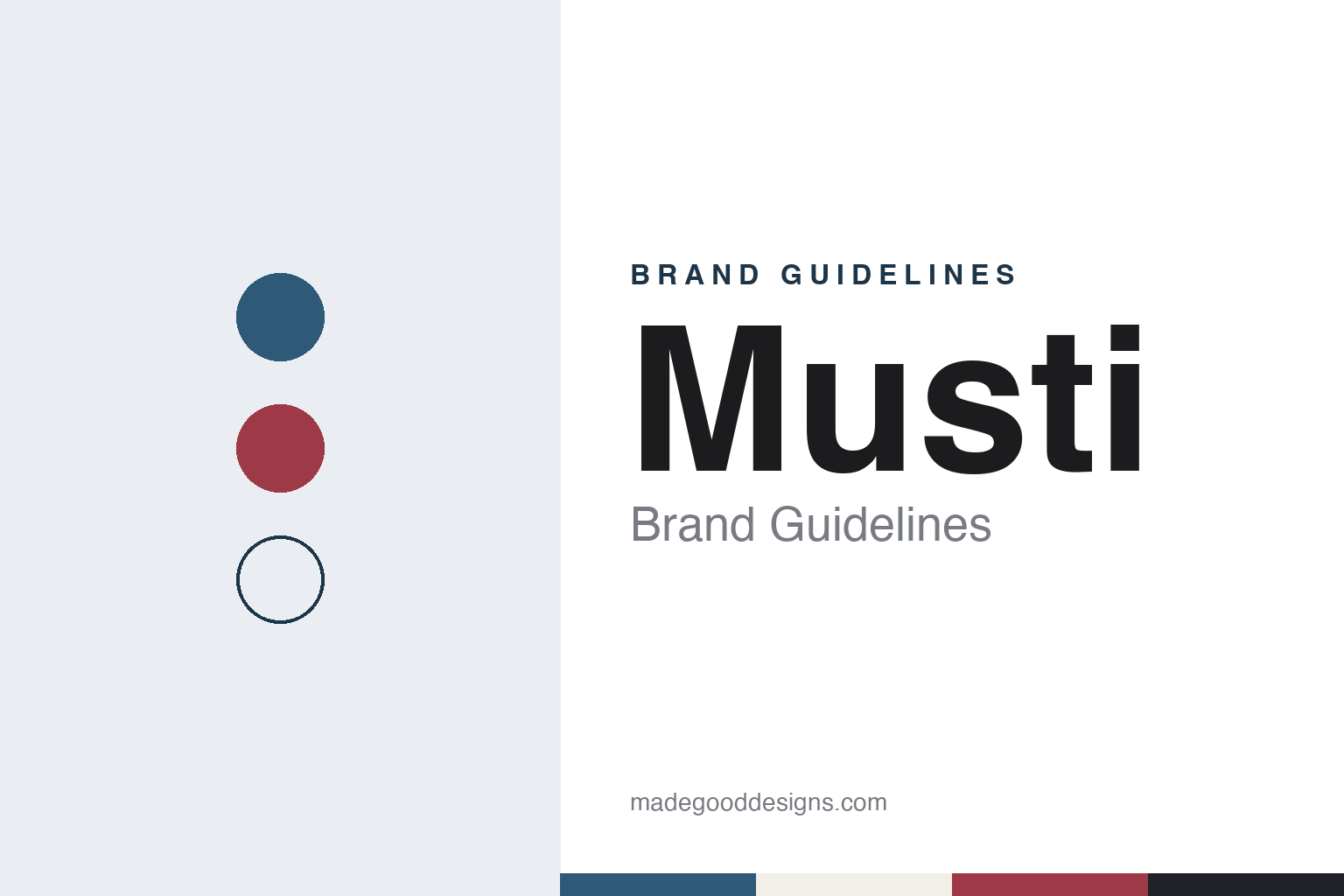
Musti Brand Guidelines
A Tampere pet shop of 1988 that became a seven-country pet care group.
Aa
Two constants: a lake blue, lingonberry and birch white palette and a rounded sans register. Abstract homage — not a Musti product or mark; no sign, logo or pack is reproduced.
Musti ja Mirri
One pet shop in Tampere, then a chain.
Musti began in Tampere, Finland, in 1988. Musti Group’s own history says that year the dog enthusiast and breeder Matti Varpula opened the first Musti ja Mirri store, and that the idea was to bring good products together with staff who knew animals. Finnish Wikipedia describes the start a little differently: Varpula bought an existing pet shop on Pyynikintori, a market square in Tampere, and began building a chain from it. Both accounts agree on the town, the year and the founder.
For its first two decades Musti ja Mirri was a Finnish business. The next owners were investors. Finnish Wikipedia says that in 2010 the chain was bought by Pohjola Capital Partners, the private equity firm now called Vaaka Partners, together with Mika Sutinen, who became chief executive. Under Sutinen, the same article says, the chain began buying stock directly from manufacturers rather than through Finnish wholesalers, and put more weight on its own labels.
Expansion abroad followed. In 2012 the group bought Grizzly Zoo, a Swedish pet food and accessories retailer founded in 2006, its first step into Sweden. When the private equity group EQT announced on 1 December 2014 that its EQT Mid Market fund had agreed to buy Musti ja Mirri Group from funds managed by Vaaka Partners, it put the chain at 127 stores, 106 of them in Finland and 21 in Sweden; the value was not disclosed. The trade magazine pet worldwide reported the purchase the same day.
Finnish Wikipedia records further Swedish purchases: Zoo Support Scandinavia, owner of the Arken Zoo and Djurmagazinet chains, in 2015, and the 12-store Djurkompaniet chain in 2017. The first Norwegian stores opened in the autumn of 2016, the year, the company says, its operations came together under the name Musti Group.
Colour
Five store names and a factory.
Musti Group is a family of shop names rather than one sign. On its corporate site the group lists its store chains as Musti ja Mirri in Finland, Arken Zoo in Sweden, Musti in Norway, Pet City in Estonia, Latvia and Lithuania, and ZU in Portugal, alongside the online shops Peten Koiratarvike in Finland and VetZoo in Sweden and Norway. Each local name keeps its own storefront, while the group name sits behind them.
The range covers food, treats, toys, grooming products and everyday supplies for dogs, cats and small animals. The company describes a mix of its own and exclusive labels with third-party brands, and Finnish Wikipedia names Purenatural, SMAAK and Nutrima among the house labels, sold only through the group’s own channels. In selected locations the company also offers grooming, training and veterinary services, and says that several of its markets have clinics run as part of the business.
Part of the food is now made in-house. Finnish Wikipedia, citing the company, says that in April 2023 Musti acquired the Premium Pet Food Suomi factory at Lieto, in south-west Finland, which makes dry, wet and frozen food for several brands. In its interim report of 5 November 2026 the company said its own factory now produces about 70 per cent of Musti-branded food; that figure is the company’s own.
The store network has been described in different ways at different dates. In that November 2026 report, Musti Group put its network at 542 locations, counting stores and veterinary clinics, at the end of September 2026. The same report mentions a new partnership with the Swedish grocer ICA, under which some Musti stores share a location with ICA. Store and clinic figures from earlier years are given below with their dates.
Typography
Pet-store chains and their signs.
Pet-store chains present themselves above all through the shopfront: a sign that has to read from a retail park, a high street or a shopping-centre corridor, and a logo repeated on loyalty cards, carrier bags, delivery apps and, increasingly, shop-in-shops inside other retailers. For chains that began online, the website and the app do the work of the sign. Tiendanimal, for example, started as an online shop in Málaga in 2006 and opened its first physical store there in 2012, according to Spanish trade press.
Ownership shapes these brands as much as design does. Many chains have passed from their founders to private-equity investors, family offices or larger retail groups, and some now sit beside former rivals under one parent. Arcaplanet, founded in Liguria in 1995, passed through several investors before the German Fressnapf group completed its takeover in December 2024, RetailDetail reported; in Spain, Tiendanimal and Kiwoko have shared an owner, the Peruvian Mulder family’s Emefin, since 2020, and trade under the IskayPet group name. Corporate pages on founders and owners are often the plainest record of these changes, and this guide states each owner with a date.
Store formats vary widely: large out-of-town units, small city shops, grooming salons, clinics run under separate names, and corners inside DIY or farm-supply stores. Networks change quickly, so every store or country count in these guides is given with its date and its source. Own-label ranges, mascots and loyalty schemes are named only as the companies name them.
The chains and online retailers in this group come from Europe, Asia, Latin America and Australia. Each guide sets out what can be checked — who founded the business, who owns it now and how its network is published — and marks plainly what rests only on the company’s own word. The colours and type in each guide are our unofficial interpretation, not the companies’ own.
Aa
A rounded sans for a friendly shop sign. (Specimen set in Nunito Sans, a sans STAND-IN; NOT the Musti logo.)
Musti Group
From private equity to a Sonae-led consortium.
Musti Group listed its shares on Nasdaq Helsinki in February 2020, according to the company and Finnish Wikipedia.
A change of control followed four years later. On 29 November 2023 a consortium led by the Portuguese group Sonae announced a public tender offer for all Musti shares, and Musti’s board unanimously recommended that shareholders accept it, the trade publication GlobalPETS reported in December 2023. The bid was made through Flybird Holding, a company owned by Sonae Holdings together with three Musti figures: the chairman Jeffrey David, the board member Johan Dettel and the chief executive David Rönnberg, GlobalPETS reported in February 2024. After the subsequent offer period closed on 6 March 2024, shares representing about 80.65 per cent of Musti had been tendered, the same publication reported on 14 March 2024. Musti Group plc has continued to publish stock exchange releases since then, and Sonae is now its majority owner.
Under the new owner the group has moved beyond the Nordic countries. It entered the Baltic states at the end of 2024 through Pet City, according to the company. In December 2025 it bought all the shares of ZU, the Portuguese pet retailer and services business, from MC, a Sonae retail company, as GlobalPETS and the Finnish broadcaster MTV Uutiset both reported on 5 and 8 December 2025. ZU then had 65 stores, 24 of them with veterinary clinics. With ZU, Musti said its network reached 474 stores, 54 clinics and 196 grooming and wellbeing points across seven countries. ZU’s stores kept their own name.
For a design guide, Musti shows how a retail group can keep several local shop names under one owner while its corporate identity stays in the background. Compare Fressnapf, the German pet chain that trades as Maxi Zoo abroad, and Zooplus, a European online pet retailer. For this guide we use a lake blue and a lingonberry red on birch white with a rounded sans, an unofficial interpretation; no product or logo is reproduced.
Explore & save
Keep Musti’s identity on hand — save it to a board in the Made Good inspiration library.
Musti identity set
Pin the Musti lake blue, lingonberry and birch white palette and the rounded sans register to your own board.
Source & notes
Frequently Asked Questions
What font can I use to match the Musti look?
This guide describes Musti’s type as “A rounded sans for a friendly shop sign”. Its type specimen is set in Nunito Sans from Google Fonts as a stand-in; Nunito Sans is not Musti’s own lettering.
What colours are in the Musti palette?
This guide’s Musti palette is Lake blue #2E5A78, Lingonberry #9E3A47, Birch white #F2EFE8, Ink #1F2328 and Paper #FAF8F4. The tones are the guide’s own unofficial interpretation, not official Musti hex codes.
When was Musti founded?
Musti was founded in 1988 (as Musti ja Mirri), in Tampere, Finland.
Who founded Musti?
Musti was founded by Matti Varpula in 1988 (as Musti ja Mirri).
Who owns Musti?
Musti today: Musti Group plc, majority-owned by a Sonae-led consortium.


