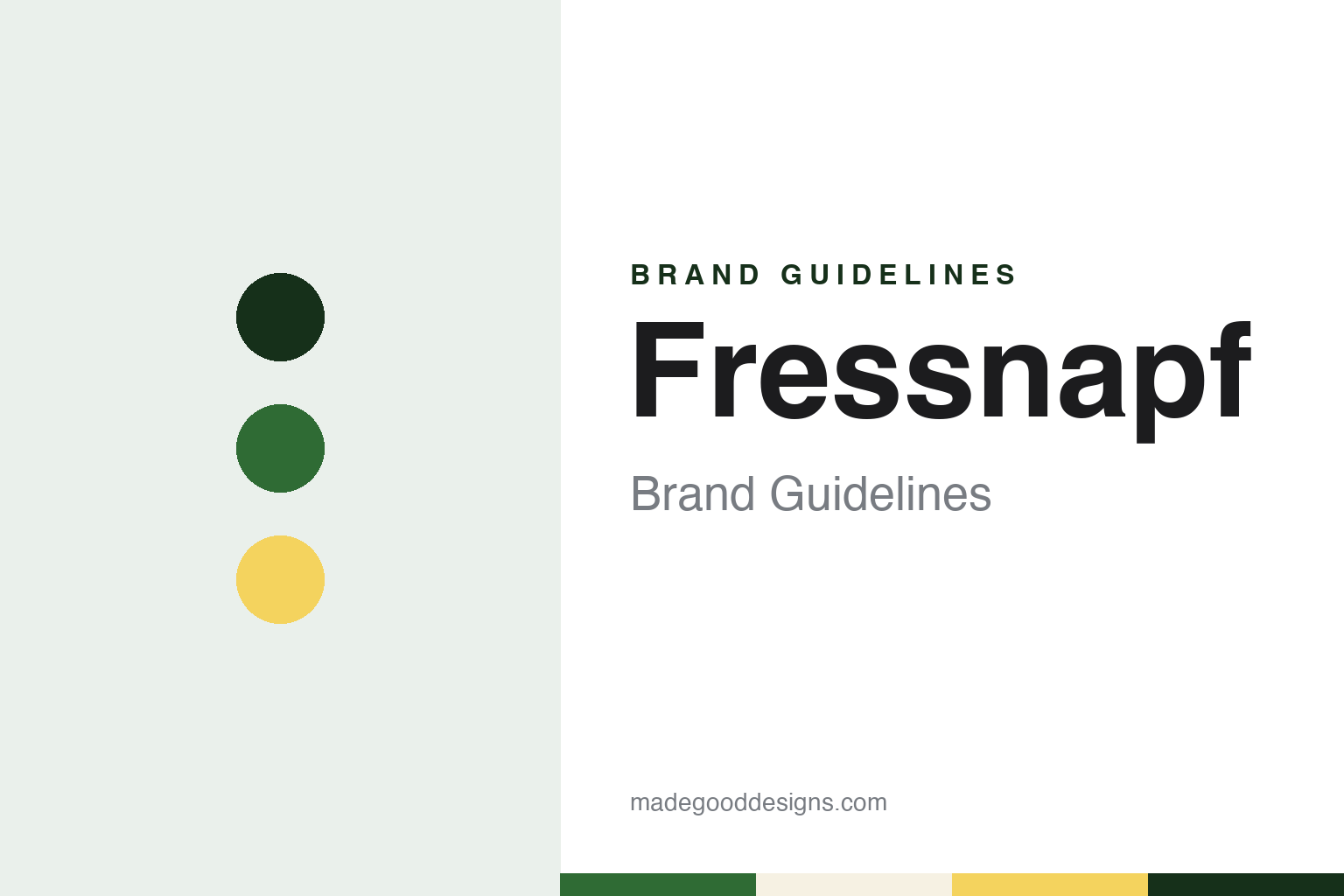
Fressnapf Brand Guidelines
The Krefeld pet chain, Maxi Zoo abroad and the 2024 petmoji.
Aa
Two constants: a Fressnapf green and warm yellow palette and a Rounded sans register. Abstract homage — not a Fressnapf product or mark; no logo, petmoji or store sign is reproduced.
Freßnapf
One store in Erkelenz, then a franchise.
Fressnapf began with a single shop. In 1990 Torsten Toeller opened his first specialist store for pet food and pet supplies in Erkelenz, a town in North Rhine-Westphalia, and German Wikipedia gives the company’s founding date as 18 January 1990. The company’s own history page spells that first shop the old German way, as a “Freßnapf” store, with the sharp s; the name itself is the everyday German word for a pet’s feeding bowl. The headquarters are not in Erkelenz but in Krefeld, on the Lower Rhine, and the top company is today Fressnapf Holding SE.
Both the English and German Wikipedia articles say Toeller took his idea from the pet superstores he had seen in the United States and adapted it for Europe. The growth model came early: from 1992, both say, new stores opened as franchises, and in 1997 the first stores outside Germany followed. That split still shapes the business. Design Tagebuch, the German corporate-design blog, reported in May 2024 that in Germany most stores are run by independent franchise partners, while in other European countries they are run as the company’s own branches. The German website lists 125 franchise partners running 780 stores.
Ownership has stayed with the founder. The company says Toeller has owned the business since that first store and is today its majority shareholder; German Wikipedia says the holding company is majority-owned by Allegro Invest SE, his family office. In July 2024 the finance magazine FINANCE reported that the private-equity firm Cinven was taking a minority stake in Fressnapf, describing Toeller as founder and majority owner; the size of the stake was not disclosed.
Colour
Fressnapf at home, Maxi Zoo abroad.
The brand changes its name at the border. In most countries where German is not spoken, the stores trade as Maxi Zoo; German Wikipedia lists Luxembourg, Romania and Hungary as exceptions, where the Fressnapf name is used. The company signs itself “Fressnapf | Maxi Zoo” and its German site says the group is active in 15 European countries.
Italy shows how that network has been rearranged. In June 2021 the trade magazine pet reported that Cinven had bought a majority of the Italian chain Arcaplanet from Permira, and that Arcaplanet would take over Maxi Zoo Italia, then about 120 stores; Fressnapf would become a minority shareholder in the enlarged Arcaplanet group, subject to competition approval. Three years later the roles turned around. In July 2024 FINANCE reported that Fressnapf was taking over Cinven’s Arcaplanet shares as Cinven bought into Fressnapf, and on 6 December 2024 pet reported that the European Commission had approved the takeover, making Fressnapf the sole owner of Arcaplanet. The deal added more than 560 locations, bringing the network to around 2,600, the magazine said. English Wikipedia says Arcaplanet is the name that survived in Italy.
The Netherlands followed a similar path. In November 2023 the trade title GlobalPETS reported that Fressnapf had signed the acquisition of Jumper, a Dutch pet retailer with 47 stores, three franchise locations and 19 shop-in-shops; in May 2024 the same title described the Dutch expansion through Jumper as recent. German Wikipedia also lists formats by size, from the large “Megazoo” to the “Fressnapf XXL.”
The shops are only part of the offer. W&V, the German marketing weekly, wrote in May 2024 that Fressnapf runs an online shop with more than 22,000 items, arranges holidays with dogs and runs cat and dog grooming salons. GlobalPETS reported the same month that its app-based loyalty programme, called Friends, was running in Germany, France, Poland, Austria, Belgium and Switzerland.
Typography
Shops, clubs and own labels.
Pet-supply retailers present themselves first through the store. Many trade from large out-of-town units described as superstores, where food, bedding, toys and aquarium or small-animal supplies run down long aisles under plain category signs. Several chains have added services under the same roof: grooming salons, vet clinics and training, each often with its own name that sits beside the main shop name on the fascia and in the aisles.
Naming follows the same pattern. Chains tend to keep one short shop name and add own-label ranges with names of their own, so a single store can carry the retailer’s brand, its food and accessory ranges and many outside makers side by side. In the UK, for example, Pets at Home dates its Wainwright’s food range to 2007, and trade reports of Jollyes have named its K9, Lifestage and Raw and Simple ranges. When a chain unifies these names, as Pets at Home did in 2023, the change is usually reported in the design and retail press.
Loyalty clubs and online shops are the other public face. Retailers publish membership schemes for regular buyers, such as Pets at Home’s VIP club, launched in 2012 according to the company, alongside websites with click-and-collect, delivery and repeat-order options. Shelf prices, promotions and member offers are presented in the stores and online, and change often, so a design guide describes how they are shown rather than what they are.
Behind the shop fronts sit corporate and investor pages. These usually give a founding story, the current owner and any stock-market listing, and many chains in this category have passed between private-equity owners before or after a listing. This guide sets out what dated sources say about each company’s founders, owners and listings, and treats the companies’ own descriptions as their claims.
Aa
A friendly rounded sans in lowercase — the register of the 2024 wordmark. (Specimen set in Nunito, a sans STAND-IN; NOT the Fressnapf logo.)
From bowl to petmoji
A logo the founder drew, replaced after 34 years.
For most of its life Fressnapf used one logo. Design Tagebuch reported in May 2024 that the mark had been in use in almost unchanged form for 34 years and had been drawn by Torsten Toeller himself: an illustration of a dog and a cat with a red feeding bowl, the Fressnapf lettering set into the bowl. W&V described the same old mark as showing a cat and a dog.
In May 2024 the company replaced it. The new logo is a word-and-image mark: a simplified, smiling animal face, which the company calls a “petmoji”, set in front of a wordmark now written entirely in lowercase. Design Tagebuch said the rollout had already been under way for about a year before the official launch, and that the new identity and its campaign, “Glücklich, wenn ihr es seid” (roughly, “happy when you are”), were made with Serviceplan, the group’s lead agency since 2016. GlobalPETS reported that the redesign began in 2022 with a new font, friendlier colours and more emotional photography online and in stores, and that the new logo was the next step; a company spokesperson told the title the whole change had taken three years. The Lebensmittel Zeitung reported that a Europe-wide campaign went with the new face.
Both trade reports tie the change to strategy. The company described a move from a product-focused supplier to an omnichannel business that looks after the life people share with their pets, and W&V listed the services beyond the shelves. Design Tagebuch, in its own comment, called the petmoji simple and memorable and noted that, together with the colour green, it carries the identity; it added that the old mark had been too detailed for today’s many screens and formats, and that the new one drops the doubling of a bowl drawn under a name that already means “bowl.” Four months later the same blog observed that the websites of Fressnapf and the online retailer Zooplus had grown alike, down to a shared warm yellow accent.
For a design guide, Fressnapf shows how a founder-drawn picture logo can be reduced to a face and a lowercase name, while the stores keep two names across Europe. Compare Zooplus, its online rival from Munich, and PetSmart, the American pet-superstore chain. For this guide we use meadow green, forest ink and straw yellow with a bowl red and oat paper, set in a rounded sans, an unofficial interpretation; no product or logo is reproduced.
Explore & save
Keep Fressnapf’s identity on hand — save it to a board in the Made Good inspiration library.
Fressnapf identity set
Pin the Fressnapf green and warm yellow palette and the Rounded sans register to your own board.