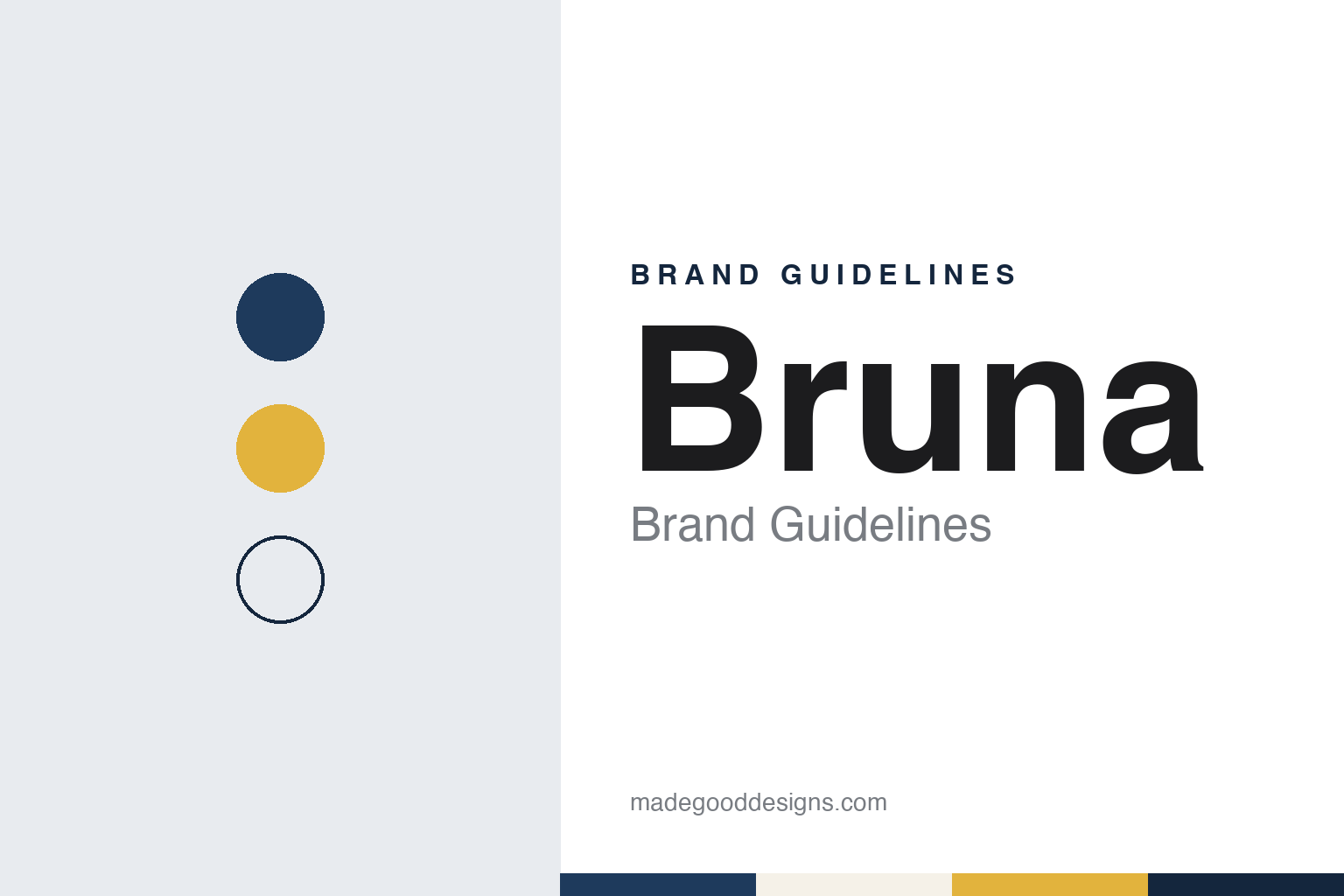
Bruna Brand Guidelines
A Haarlem shop of 1868, station kiosks and a franchise network.
Aa
Two constants: an ink blue, warm yellow and paper white palette and a plain retail sans register. Abstract homage — not a Bruna product or mark; no shop sign, logo or packaging is reproduced.
From Haarlem
A shop, a family and the railway.
Bruna’s story starts in 1868, when Albert Willem Bruna, then 24, took over a small shop selling books, paper and music in Haarlem, according to Dutch Wikipedia. The business moved to Utrecht in 1890, the city that became its long-term home, and from 1891 it added bookstalls at railway stations, Dutch Wikipedia says. Those station kiosks shaped the shop side of the family firm for generations: a counter of books, newspapers and paper goods placed where travellers pass every day.
In 1909 the business was divided. The publishing house, A.W. Bruna & Zoon, went to the founder’s eldest son, and the station bookselling business, De Spoorwegboekhandel, to his youngest son, Hendrik, Dutch Wikipedia says. Since that split, the same source says, the publisher and the shop chain have had no link and have operated as two separate organisations; the publisher, now A.W. Bruna Uitgevers, is part of the publishing group WPG Uitgevers. For anyone reading the shop sign this matters: the Bruna name over a Dutch high-street shop refers to the retail business, not to the publisher of the same name.
From 1935 to 1982 the chain was run by Henk Bruna, a grandson of the founder, whom Dutch Wikipedia describes as the director of his own chain of stationery and bookshops. He was also president of the booksellers’ society Boekverkooperscollegie Eendragt from 1947 to 1980, according to the same source. The sources used for this guide do not say how Bruna operated during the occupation of 1940–1945. Dutch Wikipedia says the company has been a franchisor since 1949, the model that still describes most of its shops today.
Colour
Books, papers, pens and cards under one sign.
Dutch Wikipedia describes Bruna as a retailer of books, magazines, newspapers, stationery and greeting cards, along with gift and multimedia products, with most shops run as franchises and books also sold through its website. On its own site the company lists children’s books, gift and school items and state lottery tickets alongside those ranges, and says its online shop plays a part in what it calls an omnichannel approach. The mix is the identity: books, papers, pens and cards sold under one sign, a range that echoes the station bookstalls of 1891.
The network has been counted at close to 300 shops in recent years. When the publisher VBK bought the chain in December 2017, NRC put it at nearly 300 shops. In January 2020 De Nationale Franchisegids reported 273 branches in the Netherlands, mainly franchise shops, with about 85 people working at head office. Those counts are dated to the reports that gave them. Dutch Wikipedia also notes a trade-in scheme under which a second-hand book can be exchanged for store credit, subject to a minimum value.
Bruna also tried digital formats. NU.nl reported in February 2017 that the chain had invested in online sales, automation and IT, and in Bliyoo, a digital magazine subscription service, and that a spokesperson said those investments were taking longer than hoped to pay off. When VBK took over later that year, NRC noted that the publisher gained Bliyoo with the chain, fitting a plan to sell books directly, in shops and online, as well as publish them.
Typography
Design and documentation.
Europe’s bookshop chains introduce themselves first through the sign over the door. Many carry a founder’s or family surname. Bruna takes its name from Albert Willem Bruna, who took over a book, paper and music shop in Haarlem in 1868 before the business moved to Utrecht in 1890, according to Dutch Wikipedia. Decitre carries the surname of Henri Decitre, who founded the Lyon bookseller with Marius Bassereau in 1907. Orell Füssli keeps the name of a Zurich printing house far older than its bookshops. Logos and shop signs change over time, and each guide in this series describes the current sign only as the company shows it.
Store formats in Switzerland, the Netherlands, Belgium, France and Finland are described here as each company publishes them: city-centre houses on several floors, branches in shopping centres and stations, franchise shops, and online shops and apps. Branch and country counts in these guides are given only with their source and date, because networks grow and shrink through takeovers and closures, and a chain that has closed is described as closed.
Ownership takes several forms. Some chains belong to larger groups: Finnish Wikipedia says Suomalainen Kirjakauppa was owned by Rautakirja from 1924, and Finland’s competition authority described the chain in 2016 as part of the Otava group. Others are cross-border joint ventures, such as Orell Füssli Thalia in Switzerland, which began trading on 1 October 2013. Others again are networks of independent shops under one name: Libris is a co-operation of independent booksellers run within the retail service group EK, rather than a chain whose shops one company owns.
Chains also name their own formats and services, and these guides name them only as the companies do. Corporate pages and company histories describe founders and owners, and each guide sets out what can be checked against dated, independent sources, with any gap in the record stated plainly.
Aa
A plain retail sans for a high-street sign. (Specimen set in Work Sans, a sans STAND-IN; NOT the Bruna logo.)
Bruna
From PostNL and ING to Audax.
Ownership changed several times in recent decades. Before 2017 Bruna belonged to Postkantoren BV, whose shareholders were PostNL and ING; NU.nl reported in February 2017 that the two shareholders were putting in extra funds. In December 2017 the chain passed to the publishing group VBK, parent of houses including Atlas Contact, Ambo Anthos and Luitingh-Sijthoff, NRC reported. In 2019, Dutch Wikipedia says, Bruna moved its head office from Houten to Amsterdam-Zuidoost to cut costs.
In November 2019 Shared Stories Group, by then the sole owner of Bruna, agreed to combine the chain with Audax Groep, with Bruna keeping its own name, De Nationale Franchisegids reported; the deal was completed in January 2020, after the Dutch competition authority concluded that enough competition would remain. Together, the same report said, the two businesses had about 1,700 employees and a retail network of around 1,300 outlets. Audax, which English Wikipedia says began in 1947 as the publisher De Vrijbuiter, also runs franchise labels such as AKO and The Read Shop, and its own site describes three units: Audax Retail, Audax Publishing and the distributor Betapress. Dutch Wikipedia says Bruna’s head office moved again in 2024, to Utrecht.
For a design guide, Bruna shows how a retail name can outlast the family firm that founded it, carried from station kiosks to a franchise network through several owners. Compare Libris, a Dutch bookshop group, and Standaard Boekhandel, a Dutch-language bookshop chain in Belgium. For this guide we use an ink blue, a warm yellow and paper white with a sans, an unofficial interpretation; no product or logo is reproduced.
Explore & save
Keep Bruna’s identity on hand — save it to a board in the Made Good inspiration library.
Bruna identity set
Pin the Bruna ink blue, warm yellow and paper white palette and the plain retail sans register to your own board.
Source & notes
Frequently Asked Questions
What font can I use to match the Bruna look?
This guide describes Bruna’s type as “A plain retail sans for a high-street sign”. Its type specimen is set in Work Sans from Google Fonts as a stand-in; Work Sans is not Bruna’s own lettering.
What colours are in the Bruna palette?
This guide’s Bruna palette is Ink blue #1E3A5C, Deep ink #14263D, Kiosk yellow #E2B33D, Paper white #F5F1E8 and Platform grey #8B9096. The tones are the guide’s own unofficial interpretation, not official Bruna hex codes.
When was Bruna founded?
Bruna was founded in 1868, in Haarlem, Netherlands. Bruna is known for Books, magazines, stationery, cards.
Who founded Bruna?
Bruna was founded by Albert Willem Bruna in 1868. Bruna is known for Books, magazines, stationery, cards.
Who owns Bruna?
Bruna is owned by Audax Groep (since 2020). Bruna is known for Books, magazines, stationery, cards.