Gall & Gall Brand Guidelines
The Amsterdam slijterij of 1884 that grew into a national chain.
Aa
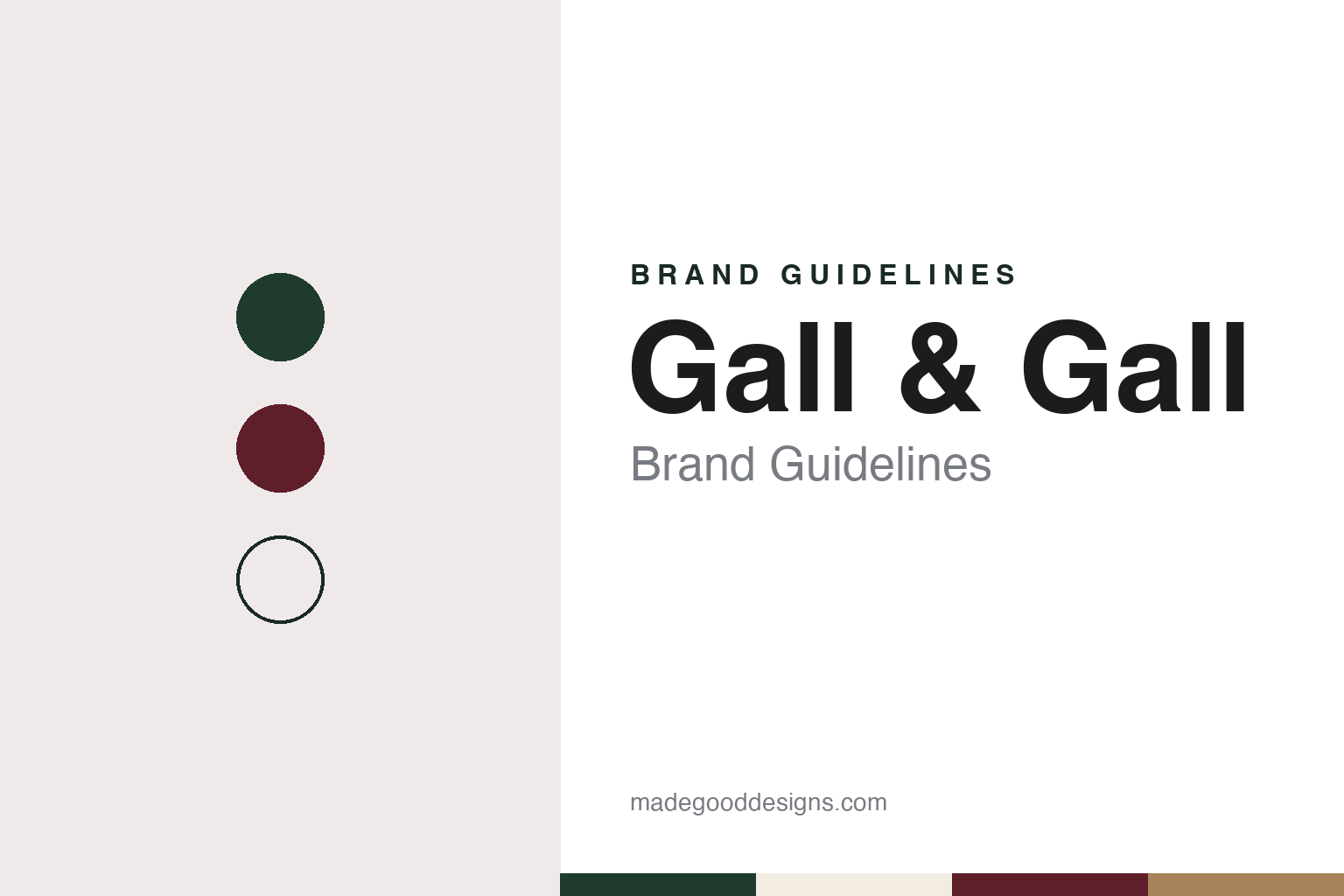
Two constants: a green, claret and cream palette and a shopfront serif register. Abstract homage — not a Gall & Gall product or mark; no shop sign, logo or label is reproduced.
Firma Wed. H.J.T. Gall
One shop on an Amsterdam street corner.
Gall & Gall dates its start to 5 August 1884. On that day, the company says, Maria Gall, then 33, opened a shop selling spirits and wine on the corner of the Ferdinand Bolstraat and the Eerste Jan Steenstraat in Amsterdam. The business traded as “Firma Wed. H.J.T. Gall”, and the company says its founder ran it seven days a week, from eight in the morning until eight at night, under a motto that no order was too large, too small or too far away. Dutch Wikipedia describes her as one of the first women entrepreneurs of her time.
The company says a second building was bought in 1900 and opened as a tapperij, a small café, run by her second son, Jan. By 1915 there were two shops, Dutch Wikipedia says, and they passed to her sons Herman and Jan Gall. Following an English example, the brothers added a second “Gall” to the name, a reference, the company says, to its two owners; the firm that had been called “wed. H.J.T. Gall” became Gall & Gall.
The company’s own account of those early decades describes customers who came mainly for jenever, the Dutch juniper spirit, for fine double liqueurs and for French cognac, and orders that could be placed ahead and were delivered by bakfiets, the Dutch cargo bicycle.
Dutch Wikipedia says the business grew quickly after Herman Gall withdrew from it in 1957, becoming the leading chain of slijterijen in the Netherlands, and that by 1984 it had about 100 shops and was owned by Bols Nederland, the drinks maker. The sources used for this guide do not say how the company operated during the occupation of 1940–1945.
Colour
From a family firm to a national chain inside Ahold.
In 1989 Gall & Gall became part of Ahold, the Dutch supermarket group now called Ahold Delhaize. Dutch Wikipedia says the chains Alberto, Impodra, Aguilar, Party Shop and Klerks then took the Gall & Gall name; the company says that step made Gall & Gall the market leader in the Netherlands at a stroke. It says it introduced an alcohol-free range and began selling New World wines in the same year, and that Gall & Gall was later the first Dutch slijterij chain to open a webshop, at gall.nl.
The shop network is the core of the brand. RetailTrends reported in March 2022 that Gall & Gall had 584 shops in the Netherlands, of which 128 were run as franchises, and named Ahold Delhaize as its parent; Dutch Wikipedia gives the same figure of 584 shops for 2020. In its own history page the company speaks of more than 550 shops, alongside its webshop and app. Dutch Wikipedia places the head office in Zaandam and the distribution centre in Delfgauw.
The chain remains a brand of its own within the group. In April 2026 ESM Magazine reported that Ahold Delhaize had appointed a new brand president for what it called the “Dutch off-licence chain,” with effect from 1 June 2026, moving an executive from Albert Heijn into the role.
Online, Dutch Wikipedia says Gall & Gall received the ABN AMRO Webshop of the Year 2019 award in the food and drink category on 17 September 2019. The website today is organised around wine, champagne and sparkling wine, whisky and jenever, with glassware and gift sets alongside, and offers home delivery or collection from a Gall & Gall shop. Its footer names a members’ programme, “Mijn Gall & Gall Premium,” and the site carries a digital wine adviser called Maira, which the company says is inspired by its founder, Maria Gall, and which it labels as a beta that uses AI.
Typography
Signs, ranges and owners.
Liquor, beer and wine store chains sell much the same goods, so they rely heavily on what sits around the bottles: the shop sign, the logo, the colours on the fascia and the bags, and the layout inside. The chains in this guide come from Australia, Finland, Canada, France and the Netherlands, and they show how differently that job can be done, from a founder’s portrait on the sign to a set of initials or a plain public-service name.
Store formats vary as much as the signs. At one end are large warehouse-style stores that draw shoppers from a wide area; in 2005 the wine writer Chris Shanahan described Dan Murphy’s stores in Australia as “prairie-like” spaces. At the other are neighbourhood shops beside supermarkets, smaller premium “cellar” stores and, in Australia, drive-through outlets, which BWS said in 2021 numbered 220 in its own fleet.
Ownership shapes the identity too. Some chains in this guide are state or provincial retailers owned by the public sector; others belong, or have belonged, to supermarket groups, as Dan Murphy’s and BWS did under Woolworths before the 2021 listing of Endeavour Group; others again trade as franchises under a shared name. Own-label ranges, tastings, delivery services and loyalty schemes, such as Dan Murphy’s My Dan’s, are part of the brand, and each company names them in its own way.
Most of these chains publish their own histories, on corporate or careers pages that name founders, first shops and owners. This guide uses those pages as the companies’ own accounts, sets them beside independent press and registers where it can, and describes colours and lettering in words; the palettes shown here are an unofficial interpretation, not the companies’ own.
Aa
A shopfront serif for a chain that dates itself to 1884. (Specimen set in DM Serif Display, a serif STAND-IN; NOT the Gall & Gall logo.)
Gall & Gall
A logo that keeps the founding year in view.
Gall & Gall’s identity leans on its age. The company says its logo refers to its “strong roots” with the words “sinds 1884”, the year Maria Gall opened her shop, and it repeats the date across its pages: “Al sinds 1884,” since 1884, and every day again. Dutch Wikipedia says the earlier logo was replaced by the current one around 2009. For the chain’s 140th anniversary the company published a timeline and a video telling its history with surviving photographs and documents.
The name itself is part of the design. The doubled surname, joined by an ampersand in the English manner, goes back to the brothers who took over the business, and the company still tells that story on its history page. It describes Gall & Gall today as a drankenspeciaalzaak, a specialist drinks shop, and calls itself the largest drinks specialist in the country; that is the company’s own description. Its staff, it says, help customers choose with product knowledge, and it presents the founder’s motto about orders of any size as a value it still keeps.
For a design guide, Gall & Gall shows how a national chain owned by a supermarket group can keep a family name and a founding date at the centre of its identity. Compare Nicolas, the French wine-shop chain, and Majestic Wine. For this guide we use a deep green, a claret and a warm cream with a serif, an unofficial interpretation; no product or logo is reproduced.
Explore & save
Keep Gall & Gall’s identity on hand — save it to a board in the Made Good inspiration library.
Gall & Gall identity set
Pin the Gall & Gall green, claret and cream palette and the shopfront serif register to your own board.
Source & notes
Frequently Asked Questions
What font can I use to match the Gall & Gall look?
This guide describes Gall & Gall’s type as “A shopfront serif for a chain that dates itself to 1884”. Its type specimen is set in DM Serif Display from Google Fonts as a stand-in; DM Serif Display is not Gall & Gall’s own lettering.
What colours are in the Gall & Gall palette?
This guide’s Gall & Gall palette is Jenever green #1F3B2D, Claret #5E1F2B, Cellar cream #F3EDE1, Cork #A9845A and Ink #161616. The tones are the guide’s own unofficial interpretation, not official Gall & Gall hex codes.
When was Gall & Gall founded?
Gall & Gall was founded in 1884, in Amsterdam, Netherlands.
Who founded Gall & Gall?
Gall & Gall was founded by Maria Gall in 1884.
Who owns Gall & Gall?
Gall & Gall is owned by Ahold Delhaize (since 1989).