The Social Hub Brand Guidelines
The Amsterdam hybrid hotel that grew out of The Student Hotel.
Aa
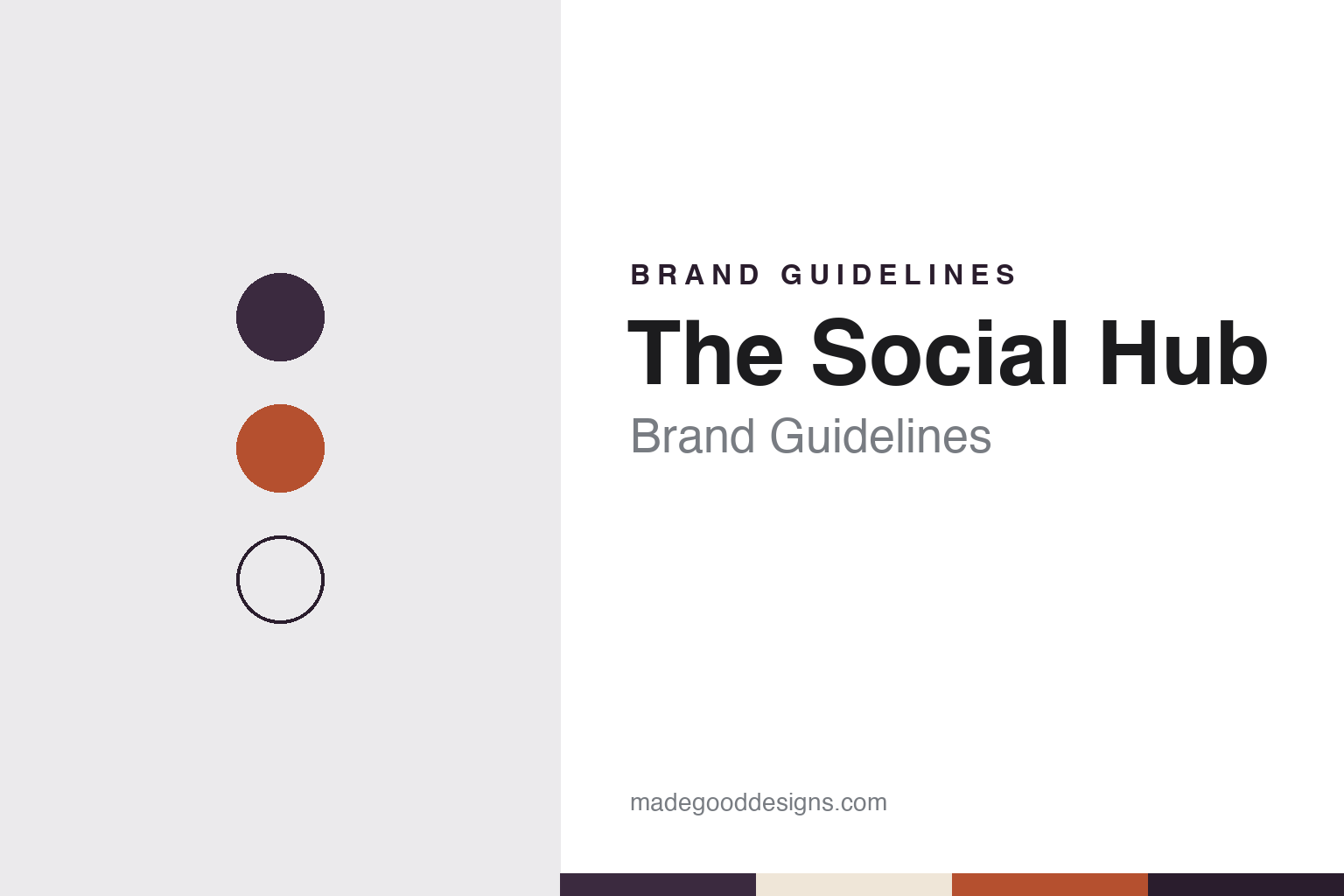
Two constants: a plum, terracotta and sand palette and a grotesque sans register. Abstract homage — not a The Social Hub product or mark; no building, logo or sign is reproduced.
The Student Hotel
Student rooms, hotel rooms, one building.
The Social Hub began as The Student Hotel, founded by Charlie MacGregor, an entrepreneur raised in Edinburgh who moved to Amsterdam. Its first property opened in Rotterdam in 2012, MacGregor told HOTELS magazine in December 2022, and English Wikipedia gives 2012 as the founding year. Dutch Wikipedia dates the business earlier, to 2006, and the Rotterdam opening to 2013. Citing a company brochure, it says MacGregor started out in partnership with the investment firm The Carlyle Group, and that a student-housing project in Liège in 2008, which someone described as a “sort of hotel”, gave him the idea of combining the two.
The concept mixed audiences under one roof. English Wikipedia describes the company as running hybrid hotels that combine short- and long-stay accommodation with student housing, coworking spaces and public amenities. In HOTELS, MacGregor said the properties had been open to more than students from the start — digital nomads, entrepreneurs and travellers among them — and the magazine listed coworking and event spaces, bars, lounges and gyms among their features.
The Netherlands came first. Dutch Wikipedia lists eight Dutch branches in 2020: two in Amsterdam, on Wibautstraat and Jan van Galenstraat, and one each in The Hague, Delft, Rotterdam, Eindhoven, Maastricht and Groningen, most of them in large buildings in university cities. A year after Rotterdam, it says, came a 707-room property in Amsterdam.
Colour
A new name in October 2022.
Dutch Wikipedia singles out several of its buildings: the Parooltoren in Amsterdam-Oost; the 76-metre Lichthoven beside Eindhoven station; and the Eiffelgebouw in Maastricht’s Sphinxkwartier. By 2020, the same article says, there were seven branches outside the Netherlands, in Berlin, Vienna, Paris, Barcelona (two), Florence and Bologna.
In October 2022 The Student Hotel became The Social Hub. HOTELS reported that the change coincided with the opening of properties in Madrid and Barcelona, when the portfolio included 13 properties, and MacGregor told the magazine that the rebrand covered everything from hotel signage to branded and digital assets. The old name, he said, “was still excluding” many members of its community; the company had planned the change earlier but postponed it until travel became more stable. He also said the concept itself was not changing, and that operations and teams would stay the same under the new name.
Ownership changed in the same year. In the HOTELS interview MacGregor named the company’s new equity partners as GIC and APG, announced a few months before the rename; English Wikipedia, citing the company’s newsroom, says GIC and APG Asset Management bought a substantial stake from Aermont Capital in 2022. English Wikipedia also says the company’s first property in the United Kingdom opened in Glasgow in April 2024. Hotel Designs described it in November 2024 as a B Corp-certified owner and operator, and English Wikipedia dates that certification to 2024.
Typography
Design and documentation.
Aparthotel and serviced-apartment operators sell a stay that sits between a hotel room and a rented flat: a studio or apartment with a kitchen, let by the night or the month. Their brands are seen on building signs, booking pages, key cards and apps, and in the lobbies and shared rooms that trade titles describe when a brand is launched or refreshed.
Many of these companies present themselves as brand families rather than single names. A listed group may run several brands at once, each with its own name on the door, while the group name appears on corporate pages and investor statements. Others run one core brand and add a second, more premium name for newer, purpose-built buildings. Property, unit and city counts appear in company statements and dated press reports, and they change often as buildings open, close or switch operator.
Ownership varies widely across the category. Some operators are arms of listed property groups; some are founder-led companies that began with a handful of flats; others are backed by investors or have changed hands through acquisitions. Many do not own their buildings at all, but lease them from developers, pension funds or other landlords, so the brand on the façade belongs to the operator while the building belongs to someone else.
When these operators describe a brand change, they often talk about spaces as much as graphics: a reception desk combined with a café, a lounge turned into a coffee bar, a shared kitchen that doubles as a meeting room, or studios fitted for longer stays. This guide sets out what can be checked about each brand, who founded it, who owns it and how it is organised, and marks plainly what rests on the company’s own word.
Aa
A grotesque sans for a brand that changed its name across a whole estate. (Specimen set in Space Grotesk, a sans STAND-IN; NOT The Social Hub logo.)
The Social Hub
Florence, Porto and a Roman customs house.
Three properties opened in early 2025. Hotel Designs reported in November 2024 that the second Florence property, Belfiore, in the San Jacopino neighbourhood, had 550 rooms and a 7,000-square-metre rooftop public park reached by an outdoor staircase; English Wikipedia dates its opening to February 2025. In March 2025 Serviced Apartment News reported the opening of The Social Hub Porto, in the Bonjardim area, the company’s first property in Portugal, with 271 hotel rooms and 39 apartments; Hotel Designs had called it the first of its properties to include long-stay apartments. The report gave the building an area of 11,200 square metres, with more than 580 square metres of coworking space, meeting and event areas, a gym, an interior courtyard garden, a rooftop pool with a cocktail bar and a café serving coffee from the local roaster Combi. In Florence, Hotel Designs described Belfiore as an 80,000-square-metre site with coworking for more than 600 people, restaurants, bars and a rooftop pool.
Later that month Hotel Designs covered the opening of The Social Hub Rome, in the San Lorenzo district, on the site of the city’s former railway customs house, the ex-Dogana. It described three buildings: a new 396-room four-star hotel, a restored indoor-outdoor event venue that was part of the original 1920s customs house, and a third historic building now home to the Accademia Italiana design school, all connected by a public park of about 10,000 square metres. Before the conversion, the magazine said, the complex had been used for concerts and outdoor cinemas until 2019 and had then stood empty. The new hotel includes extended-stay rooms and apartments of up to two bedrooms, a 24-hour gym and coworking for 160 people. The magazine called it the company’s fourth Italian hotel, after Bologna and the two in Florence.
Counts vary with the date. The company told Serviced Apartment News in March 2025 that Porto took it to 20 locations across 18 European cities; English Wikipedia, citing the company, gives 21 properties in 2026, in the Netherlands, Spain, Germany, Italy, the United Kingdom, France, Portugal and Austria. The company remains headquartered in Amsterdam, and its website is at thesocialhub.co rather than a .com address.
For a design guide, The Social Hub shows a rename carried out across a whole estate at once, with one name replacing another on signage and digital assets in October 2022, on buildings as different as an Amsterdam tower and a Roman customs house. Compare Zoku, another Amsterdam hybrid-stay brand, and citizenM. For this guide we use a dark plum, a brick terracotta and a warm sand with a sans, an unofficial interpretation; no product or logo is reproduced.
Explore & save
Keep The Social Hub’s identity on hand — save it to a board in the Made Good inspiration library.
The Social Hub identity set
Pin The Social Hub plum, terracotta and sand palette and the grotesque sans register to your own board.
Source & notes
Frequently Asked Questions
What font can I use to match the The Social Hub look?
This guide describes The Social Hub’s type as “A grotesque sans for a brand that changed its name across a whole estate”. Its type specimen is set in Space Grotesk from Google Fonts as a stand-in; Space Grotesk is not The Social Hub’s own lettering.
What colours are in the The Social Hub palette?
This guide’s The Social Hub palette is Dark plum #3B2A3F, Late night #2A1D2D, Brick terracotta #B5502F, Ochre #D9A441 and Sand #EFE6D8. The tones are the guide’s own unofficial interpretation, not official The Social Hub hex codes.
When was The Social Hub founded?
The Social Hub was founded in 2012 (as The Student Hotel), in Amsterdam, Netherlands.
Who founded The Social Hub?
The Social Hub was founded by Charlie MacGregor in 2012 (as The Student Hotel).