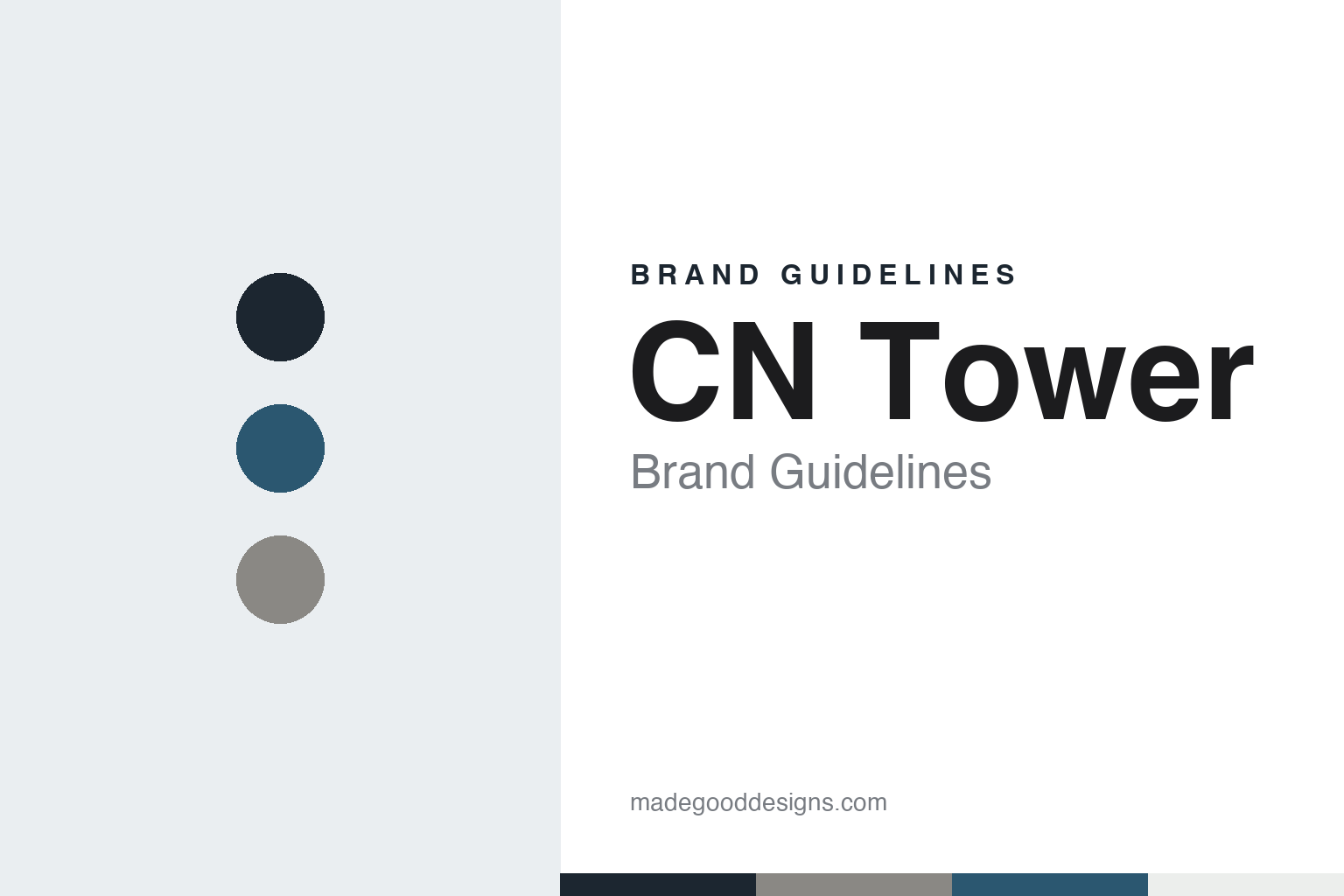
CN Tower Brand Guidelines
Toronto’s railway-built broadcast and observation tower.
Aa
Two constants: a concrete grey, lake blue and night slate palette and an engineered sans register. Abstract homage — not a CN Tower asset or mark; no logo, wordmark or photograph is reproduced.
Canadian National
A railway’s answer to a signal problem.
The CN Tower stands on the former Railway Lands in downtown Toronto, and its name comes from the company that built it: Canadian National, the railway. English Wikipedia says the idea was first conceived in 1968, when the railway wanted a large television and radio communications platform for the Toronto area, and that the project became official in 1972. The Canadian Press, in a June 2026 report carried by CBC, gives the practical reason: newly built skyscrapers were blocking radio and television signals across the city in the 1960s. The tower’s own history page describes Canadian National at the time as the Crown corporation that operated the country’s railway network, and the site as railway land reclaimed from Lake Ontario over the previous century.
Construction crews moved in on 6 February 1973, the tower’s history page says. The 335-metre concrete shaft, a hexagonal core with three curved support arms, was poured into a slipform that climbed on hydraulic jacks and narrowed as it rose, giving the tower its taper. Work on the seven-storey pod that holds the observation levels and the revolving restaurant began in August 1974. In March 1975 a Sikorsky helicopter known as Olga lifted the antenna into place in sections, and the tower was finished on 2 April 1975. According to its website, more than 1,500 people worked on it for 40 months.
English Wikipedia names the project team as NCK Engineering, the structural engineer; John Andrews Architects and Webb, Zerafa, Menkes, Housden Architects; Foundation Building Construction; and Canron, which handled the steel. At first the tower stood in a largely empty railway district: plans for the surrounding Metro Centre development were dropped two years into construction, English Wikipedia says, and the area filled in only later, with the convention centre in 1984, SkyDome in 1989 and, the same year, the SkyWalk link to Union Station.
The public first came up on 26 June 1976. CBC News reported in 2016 that the official opening followed on 1 October 1976, a few months after the doors opened to visitors.
Colour
Named levels, a pod and a restaurant that turns.
Above the ground the CN Tower is organised as a stack of named visitor spaces. English Wikipedia lists three: the Lower Observation Level, at 342 metres, with the Glass Floor and an outdoor terrace; the Main Observation Level, at 346 metres, once called the Indoor Observation Level; and The Top, at about 447 metres, just below the metal antenna, which was earlier called the Space Deck and then the SkyPod. The revolving 360 Restaurant, which opened as the Top of Toronto, turns once every 72 minutes. Below the public floors sits a large white doughnut-shaped radome holding transmitters, and the tower’s six lifts run in glass-lined shafts set into the three inner angles of the hexagonal core.
The names have changed over the years, and so has the interior. A glass floor was added in 1994, English Wikipedia says, and on 1 August 2011 the tower opened EdgeWalk, a tethered walk around the roof of the main pod at 356 metres. In June 2018, CBC News reported, the main observation level reopened after a renovation with floor-to-ceiling window walls and no railings in front of the glass, an open floor plan with colour-coded floors, double-decker glass floors and a new food hub. The tower’s chief operating officer told CBC that visitors could now put their hands against the windows, and the tower launched a viewfinder app that labels the landmarks of the skyline.
The tower is still a working broadcast site. Its history page says it serves more than 17 Canadian television and FM radio stations and is the workplace of more than 500 people through the year, and the Canadian Press reported in 2026 that it welcomes more than two million visitors each year. It marked its 50th anniversary on 26 June 2026 with a public celebration at its base, with art, a cappella singing and cupcakes, the Canadian Press reported.
Typography
Design and documentation.
Observation decks, towers and observation wheels sell a view, but they present themselves through a building. Most carry the name the operator publishes, often a building name or an address, and their visual identity tends to borrow from the structure itself: its silhouette, its stone or steel, and the architects named in the operator’s own history pages and in the press. A deck at the top of an office tower usually shares that tower’s name; a purpose-built tower or wheel often turns its own outline into the mark.
The visitor route is where most of the design work shows. Tickets, timed-entry screens, queue signs and wayfinding lead people from a street entrance, often separate from the office lobby, through security and exhibits to the lift lobbies and up to the terraces. Many operators have rebuilt these routes in recent decades, adding museums on lower floors, new entrances and glass parapets, and they describe those renovations, with dates and design firms, on their corporate pages.
Light is the second layer. Floodlighting and LED schemes let a tower change colour for holidays and events, and several operators publish lighting calendars or run partner programmes for them. At night the lit crown often stands in for the logo, and it appears on postcards, souvenirs and social media far more often than any wordmark.
Behind the attraction there is usually a property company, a public body or an entertainment group, and these guides name them plainly, with dates for openings, renamings and changes of ownership. Souvenir graphics, from tote bags to scale models, tend to reuse the same few elements: the outline, the name and a palette drawn from the materials of the building.
Aa
An engineered sans for a concrete tower. (Specimen set in Archivo, a sans STAND-IN; NOT the CN Tower logo or wordmark.)
Canada’s National Tower
A railway’s initials kept by a Crown corporation.
The tower left railway hands in the 1990s. In 1995, the tower’s website says, Canadian National sold it to the Canada Lands Company, a federal Crown corporation; English Wikipedia places the sale before the railway’s privatisation that year, when it shed operations not tied to its freight business. The official name became Canada’s National Tower, keeping the CN initials, and English Wikipedia says the name and wordmark were adjusted to remove the railway’s logo. The website’s footer states that designs of the CN Tower are trademarks and official marks of Canada Lands Company Limited.
From 1997 to January 2004, English Wikipedia says, the tower was managed by TrizecHahn Corporation, which added two lifts, bringing the total to six, moved the staircase into the core and carried out an entertainment expansion; the same company owned Chicago’s Sears Tower, now Willis Tower, at about the same time.
Light is the tower’s most changeable graphic layer. It was lit with incandescent lights, which were removed in 1997; in June 2007, English Wikipedia says, 1,330 LED lights were installed inside the lift shafts and over the pod, and unlike the old white lights they can change colour. The tower now changes its scheme for holidays and events and publishes a lighting schedule on its website, and English Wikipedia says the lights are switched off during the spring and autumn bird migrations under a voluntary programme. For sport it has been lit in team colours, such as green and white after the 95th Grey Cup was played in Toronto.
For a design guide, the CN Tower shows how a utility structure can carry its builder’s initials long after the builder has gone: a railway name kept as an acronym, a tapered concrete silhouette and a lighting programme that changes from night to night. Compare Skydeck Chicago, the observation deck of the tower TrizecHahn owned in the same years, and Space Needle, another North American observation tower. For this guide we use concrete grey, a lake blue and a deep night slate with a sans, an unofficial interpretation; no product or logo is reproduced.
Explore & save
Keep CN Tower’s identity on hand — save it to a board in the Made Good inspiration library.
CN Tower identity set
Pin the CN Tower concrete grey, lake blue and night slate palette and the engineered sans register to your own board.
Source & notes
Frequently Asked Questions
What font can I use to match the CN Tower look?
This guide describes CN Tower’s type as “An engineered sans for a concrete tower”. Its type specimen is set in Archivo from Google Fonts as a stand-in; Archivo is not CN Tower’s own lettering.
What colours are in the CN Tower palette?
This guide’s CN Tower palette is Night slate #1C2630, Lake blue #2B5770, Poured concrete #8A8884, Radome white #ECEEEC and Paper #F7F7F5. The tones are the guide’s own unofficial interpretation, not official CN Tower hex codes.
When did CN Tower open?
CN Tower opened on 26 June 1976 (public), in Toronto, Canada.