Roman and Williams Brand Guidelines
The New York studio behind the Guild and La Mercerie.
Aa
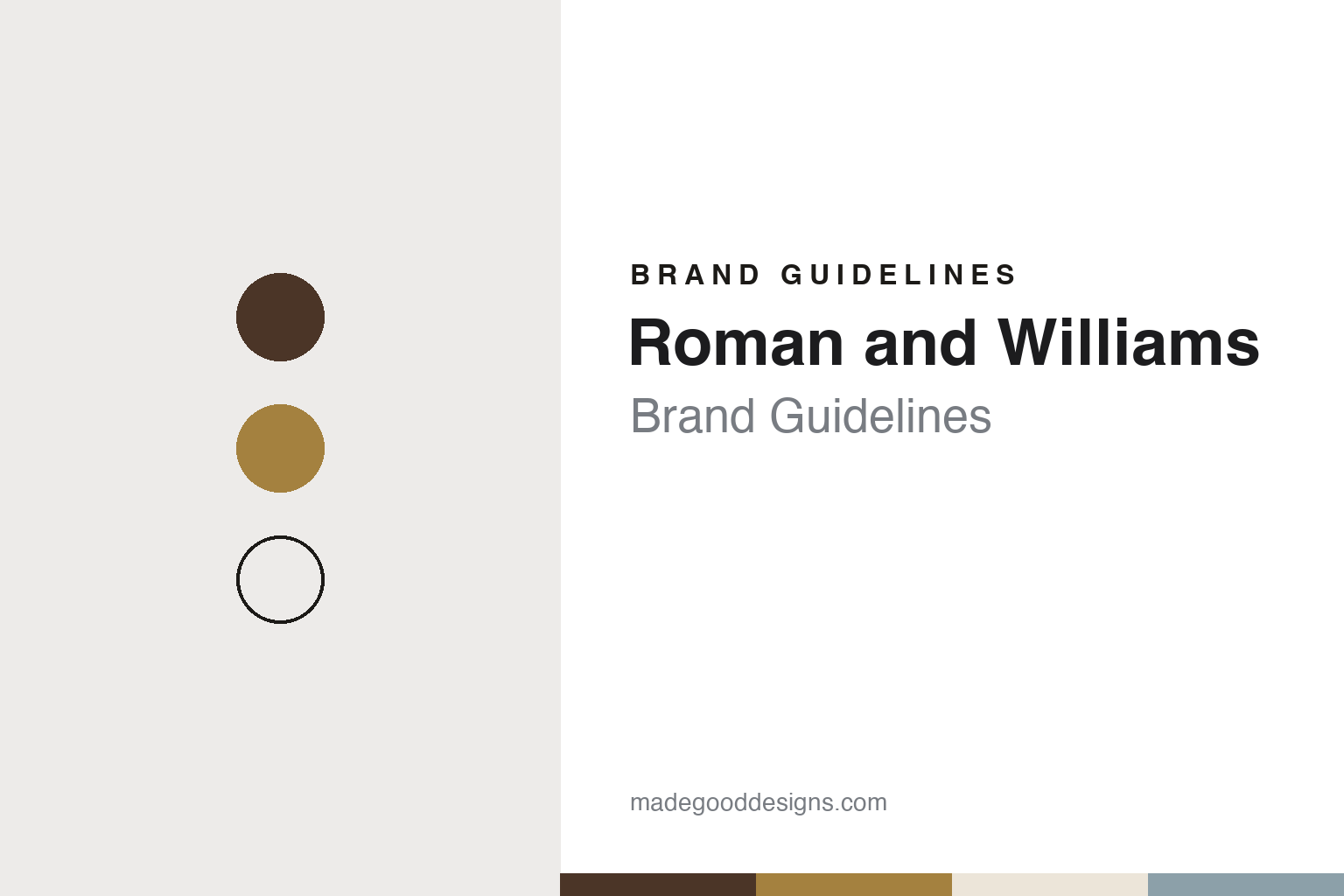
Two constants: a walnut, brass and plaster palette and a workshop sans register. Abstract homage — not a Roman and Williams interior, product or mark; no room, lamp or logo is reproduced.
Buildings and interiors
A studio named after two grandfathers.
Roman and Williams is a New York architecture and interiors studio founded in 2002 by Robin Standefer and Stephen Alesch. Dezeen, writing on 1 February 2020, quoted the firm as saying it founded “Roman and Williams Buildings and Interiors” in 2002, and that longer name still describes the design side of the business. The studio’s own about page now gives the founders as Robin and Stephen Alesch.
The company says the name comes from the founders’ maternal grandfathers. It says the two trained in fine art and architecture and met while working in cinema, and that this background shaped a habit of treating each project as a narrative built on historical research, rather than repeating a signature style.
Over two decades the business has grown beyond design work for clients. The about page lists five parts: architecture and interiors; a line of original furniture and lighting; the home shop Roman and Williams Guild; the design and ceramics gallery Guild Gallery; and the French restaurant La Mercerie. It describes the studio as a team of about 50 people with projects in seven countries.
In 2017 the founders opened the Guild in Soho. Business of Home reported on 20 December 2017 that the shop was opening that week, in a space of about 7,000 square feet; Dezeen later described it as a two-storey flagship of 650 square metres, completed in 2017, holding an art studio, a flower shop, a gallery, a boutique and a restaurant, with painted brick walls and wooden floors. In 2022, the company says, it opened Guild Gallery around the corner on Canal Street, a space for exhibitions by design and ceramic artists.
Colour
Hotels, restaurants and a museum.
The studio’s client work is mostly hospitality. Business of Home, in its December 2017 report, named Le Coucou, the Top of the Standard and the Chicago Athletic Association among the firm’s projects. Galerie, writing on 25 November 2024, described the Boom Boom Room at the top of The Standard, High Line, with its sputnik-style pendants and ceiling medallions, as an example of how the studio uses light. The company’s own project list adds cultural work, among them the British Galleries at the Metropolitan Museum of Art.
The Guild is where the studio shows its own products. Business of Home reported that it opened with the firm’s furniture and lighting lines, its kitchen and bath line for Waterworks, an Emily Thompson flower shop and the restaurant La Mercerie, led by the French chef Marie-Aude Rose. It listed the Founding Collection of more than 50 original pieces, among them the Slab Bed, cut from claro walnut, and the Petite Hoof low stool. Dezeen gave the collection as 55 pieces, drawn from or made for earlier projects, and noted the RW Atlas Collection of fittings for Waterworks and door and cabinet hardware made with H Theophile. It described La Mercerie as an all-day French café created with the restaurateur Stephen Starr and Marie-Aude Rose, in a dining room with a watery blue cast, thick marble counters and pale grey floors.
Lighting has become a large part of that product line. Galerie reported in November 2024 on “A Certain Slant of Light,” an installation of 100 pendants spanning two decades of the firm’s fixtures, hung from the 30-foot ceilings of the second floor of Tribeca’s Mercantile Exchange building. Galerie pictured among them the Dahlia lamp in alabaster and French silver. In that article Standefer said the brass lights are made in France, the cast glass between Milan and Venice and the gradient glass hand-blown in Brooklyn, with bronze cast by a Parisian foundry; those are the company’s statements as reported.
The company says its newest restaurant, Marcel 945 Madison Avenue, is now open in the Breuer Building in partnership with Sotheby’s.
Typography
How interior practices present themselves.
Interior-design practices rarely build their identity the way product brands do. Most trade under the names of their founders, either as a pair of surnames, as Yabu Pushelberg does, or as a single word that joins the studio and its founder, as Studioilse does. The name appears on the website, in press credits and on furniture collections, and it is usually set plainly, with the work itself left to carry the character.
Project photography does much of that work. The practices in this guide present hotels, restaurants, shops and homes through photographs credited to named photographers, with short project titles, a city and a year. Trade magazines such as Dezeen and Wallpaper* usually report a project when it opens, quoting the designers on materials, colours and the building they started from, and those dated reports are the main record of who designed what.
Many practices also design furniture, lighting and objects, often with established manufacturers, and show them at furniture fairs, in exhibitions or in their own studios. Some publish books on their work or write about design more widely. Founders and partners are presented in their professional roles: as designers, creative directors or teachers, and as the people quoted when a project is published.
Offices are described plainly, often as a city and a building, and some practices treat their own studio as a project in its own right. Pages on history and clients tend to be short. This guide sets out what dated sources say about each practice: when and where it was founded, who leads it, and which projects and collections are credited to it, leaving out award lists and private clients.
Aa
A workshop sans, in the spirit of the studio’s plain lettering. (Specimen set in Libre Franklin, a sans STAND-IN; NOT the Roman and Williams logo.)
Roman and Williams
A studio name that reads like a firm of makers.
The name does a lot of the identity’s work. “Roman and Williams” uses neither founder’s name; the company ties it to two grandfathers instead. Around it sits a family of plain descriptive names, Buildings and Interiors for the design practice, Guild for the shop and Guild Gallery for the exhibition space, that make the parts of the business easy to read.
The website joins those parts in one place. Its menu runs from the Guild Shop, with lighting, furniture, tableware and accessories, to Buildings and Interiors, to the restaurants and the gallery, and ends with a “World of RW” section holding the about and press pages. The font files the site loads include ITC Franklin Gothic and the Lyon serif, a pairing of a plain sans and a book serif.
The visual material is photography of rooms, objects and materials: walnut, brass, alabaster, marble and glass, the same materials the trade press lists when it describes the Guild, La Mercerie and the lighting installation of 2024. The company says its products are handcrafted with a focus on material, and the Guild’s presentation, with artists’ ceramics beside the studio’s own lamps, keeps that message consistent between shop, restaurant and gallery.
For a design guide, Roman and Williams shows how an interiors studio can turn its own projects into a range of products and places with names that explain themselves. Compare The Standard, whose High Line hotel holds the Boom Boom Room, and Martin Brudnizki Design Studio, another hospitality interiors practice. For this guide we use walnut brown, a brass and a plaster white with a sans, an unofficial interpretation; no product or logo is reproduced.
Explore & save
Keep Roman and Williams’s identity on hand — save it to a board in the Made Good inspiration library.
Roman and Williams identity set
Pin the walnut, brass and plaster palette and the workshop sans register to your own board.
Source & notes
Frequently Asked Questions
What font can I use to match the Roman and Williams look?
This guide describes Roman and Williams’ type as “A workshop sans, in the spirit of the studio’s plain lettering”. Its type specimen is set in Libre Franklin from Google Fonts as a stand-in; Libre Franklin is not Roman and Williams’ own lettering.
What colours are in the Roman and Williams palette?
This guide’s Roman and Williams palette is Walnut #4B3527, French brass #A4813F, Plaster #ECE5D9, Mercerie blue #8CA0A9 and Ink #1C1A17. The tones are the guide’s own unofficial interpretation, not official Roman and Williams hex codes.
When was Roman and Williams founded?
Roman and Williams was founded in 2002, in New York, United States.
Who founded Roman and Williams?
Roman and Williams was founded by Robin Standefer and Stephen Alesch in 2002.